Artwork
Virgin and Child Surrounded by Angels
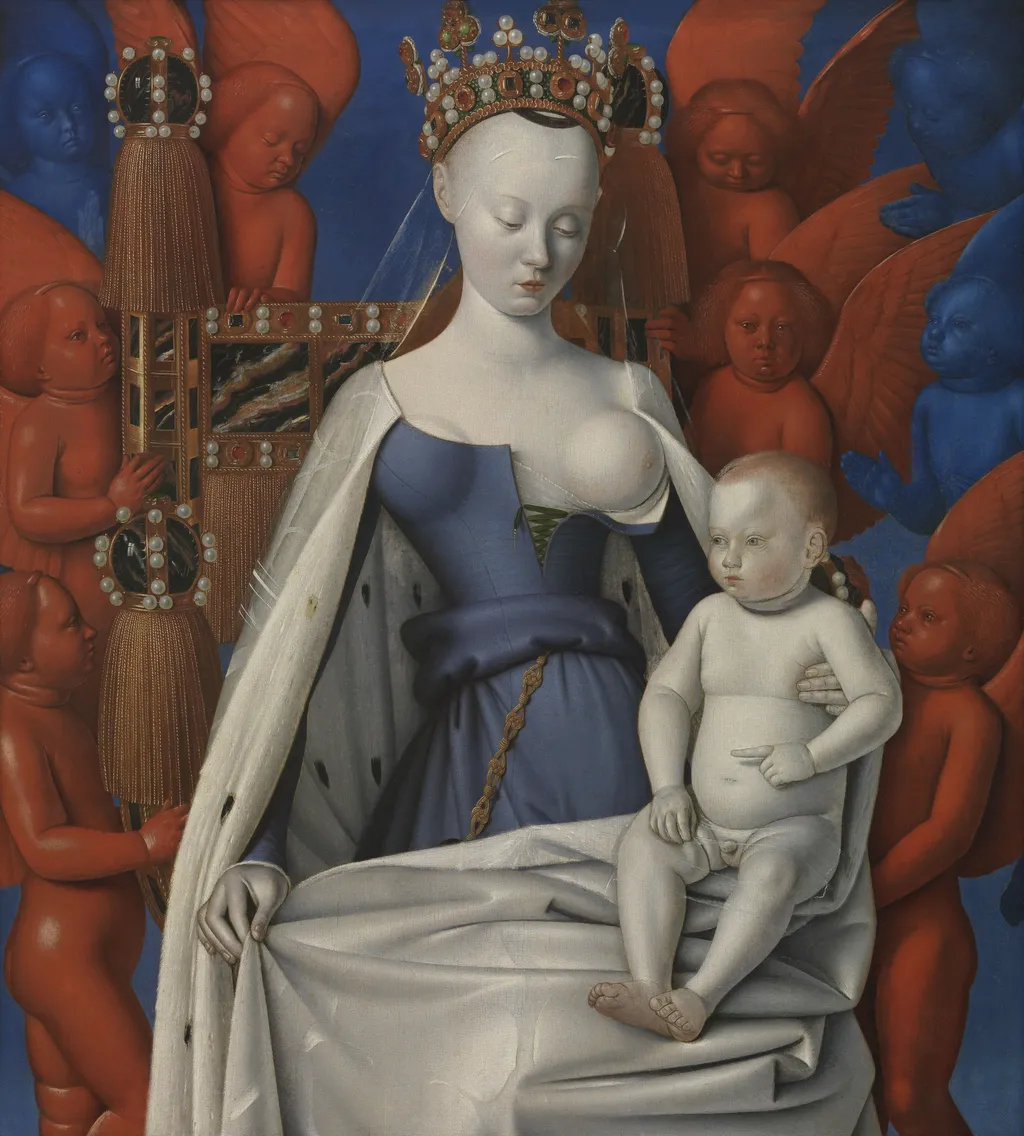
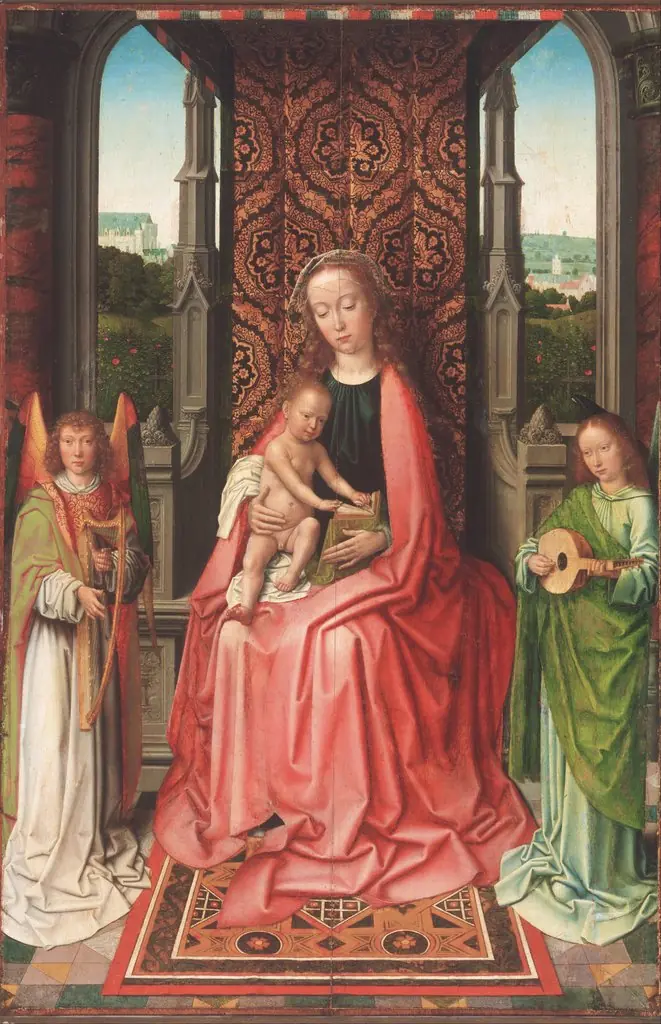
Virgin and Child Surrounded by Angels is an oil painting by the Northern Renaissance artist Jean Fouquet. It dates from 1450 and is held in the collection of the Royal Museum of Fine Arts Antwerp.
About this work
Subject & Meaning
The angels' colors, red and blue, reflect established iconographic conventions rather than symbolic oppositions like good and evil.
The subject depicts the Virgin Mary holding the infant Jesus, surrounded by angels and cherubim in a celestial setting. The composition emphasizes Madonna and Child as the central figures, with angels arranged hierarchically: six red seraphim symbolize divine, fiery love as the highest rank in heavenly hierarchy, while three blue cherubim occupy lower ranks. The angels' colors, red and blue, reflect established iconographic conventions rather than symbolic oppositions like good and evil.
The work embodies the fifteenth-century ideal of feminine perfection, merging worldly beauty with sacred imagery, notably through its sensual yet restrained portrayal of Mary's form, including an exposed breast and tightly cinched waist. This erotic mysticism aligns with contemporary poetic depictions of Maria as the embodiment of female grace, though such themes were rare and controversial in visual art. The painting also reflects Fouquet's synthesis of Netherlandish detail and Italian Renaissance influences, particularly Fra Angelico's frescoes, resulting in a monumental yet ethereal style.
Originally commissioned by Étienne Chevalier and installed above his wife's tomb in Melun, the panel was later acquired by the Royal Museum of Fine Arts Antwerp and has been recognized as a cornerstone of the Flemish primitives since the 1904 Exposition des primitifs français in Paris.
Technique & Style
Jean Fouquet's Virgin and Child Surrounded by Angels is executed in oil on oak panel, measuring 94.5 cm in height and 85.5 cm in width. The painting exemplifies Fouquet's monumental yet detached style, combining rigorous linearity with a cool, almost hieratic figuration.
The composition features the Virgin enthroned against a gilded backdrop, surrounded by nine angels, six red seraphim and three blue cherubim, their color coding following fifteenth-century angelic hierarchies. The Virgin's elongated proportions, pale modeling, and sharply delineated features reflect Fouquet's synthesis of Netherlandish realism and Italian Renaissance influences, particularly Fra Angelico's compositions. Her exposed breast and the serene, detached expression contribute to the work's paradoxical blend of sacred reverence and courtly eroticism, a tension central to Fouquet's mature style.
History & Provenance
The panel was commissioned by Étienne Chevalier, treasurer to King Charles VII of France, and originally hung above the tomb of Catherine Budé in the church of Notre-Dame in Melun, Seine-et-Marne. The work formed the right wing of the Melun Diptych, paired with the left wing depicting Saint Stephen with the kneeling Chevalier, both painted by Jean Fouquet around 1450–1455. The diptych later entered the collection of Florent van Ertborn, who bequeathed it, with more than a hundred other works, to the Royal Museum of Fine Arts Antwerp in 1841.
The left wing is now housed in the Gemäldegalerie, Berlin, while the right wing, depicting the Virgin and Child surrounded by angels, has remained in Antwerp since its acquisition. The panel was executed in oil on wood, measuring 94.5 cm in height and 85.5 cm in width, and originally featured a frame adorned with embroidered 'EC' monograms, enamel medallions, and pearls, of which only a monogrammed plaque survives in the Louvre. The work was exhibited at the 1904 Exposition des primitifs français and has been protected as a Flemish top national treasure since 2009.
Context
Jean Fouquet's Virgin and Child Surrounded by Angels is widely regarded by art historians as a defining work of 15th-century French painting and a cornerstone of the French school. Fouquet, recognized as the leading French painter of his generation, synthesized Northern European detail with Italian Renaissance theory after a study trip to Italy in the mid-1440s, where he engaged with Fra Angelico's work and early Renaissance tenets. The panel's hybrid style, monumental yet detached figures, cool eroticism, and dreamlike atmosphere, positions it as an anomaly within 15th-century religious art, bridging Flemish precision and Italianate idealization.
Scholarly debate has focused on the Madonna's identity and the work's perceived eroticism. Some scholars argue the figure represents Agnès Sorel, mistress of Charles VII, whose contemporary beauty epitomized late-medieval court ideals; others emphasize the theological program of the work. Early criticism in the mid-19th century was reserved, but the painting's status solidified after its inclusion in the 1904 Exposition des primitifs français, securing its place among the Flemish Primitives and later its designation as a Flemish masterpiece in 2009.
Legacy
Considered a masterpiece of fifteenth-century European art and one of the most important holdings of the Royal Museum of Fine Arts Antwerp, the panel has been recognized as a defining work of the French school. It has been on the Flemish government's top-piece list since 2009, granting it special protection. The work's critical reception was not always favorable: nineteenth-century critics appreciated it only moderately, and historians such as Johan Huizinga condemned its sensual treatment of the Virgin.
Broader curatorial attention grew only after the 1904 Exposition des primitifs français, after which museum directors and conservators increasingly acknowledged its significance. Its monumental, synthetic style, which fuses Netherlandish precision with Italian Renaissance influence, continues to anchor Fouquet's reputation as the leading painter of fifteenth-century France.
Overview
Created circa 1450 by the French painter Jean Fouquet, this oil on panel presents a devotional image of the Virgin Mary holding the infant Christ. The composition is centered on the serene mother and child, surrounded by a host of angels rendered against a deep blue sky. The work belongs to the collection of the Royal Museum of Fine Arts in Antwerp.
Own this work as a print
Artist & collection
Artist
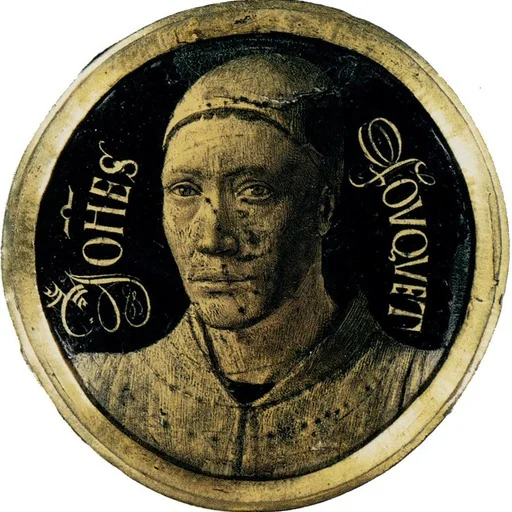
Jean (or Jehan) Fouquet (French:; c. 1420–1481) was a French painter and miniaturist. A master of panel painting and manuscript illumination, and the apparent inventor of the portrait miniature, he is considered one of…