Artwork
George Washington and William Lee
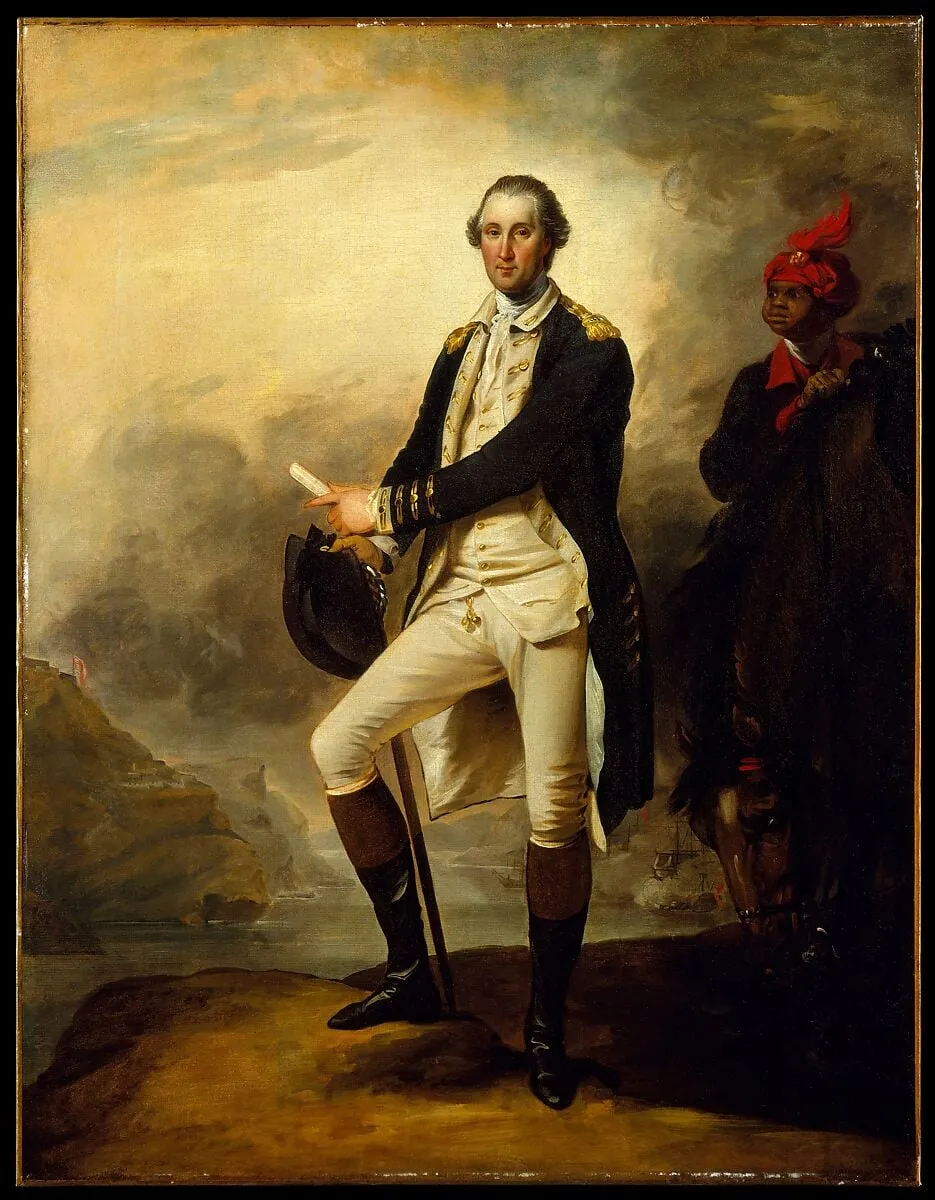
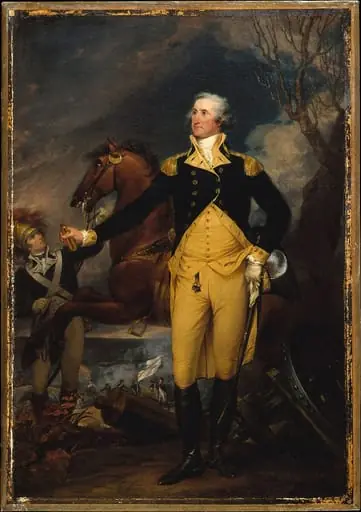
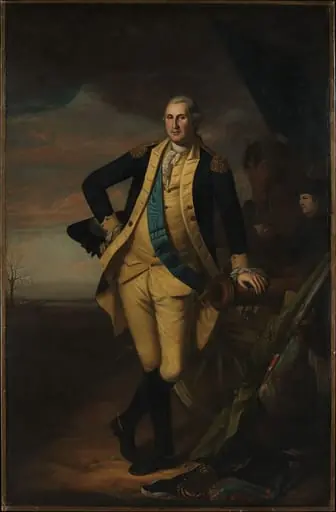
George Washington and William Lee is an oil painting by the Neoclassicist artist John Trumbull. It dates from 1780 and is held in the collection of the Metropolitan Museum of Art.
- Accession no.
- 24.109.88
- Credit line
- Bequest of Charles Allen Munn, 1924
About this work
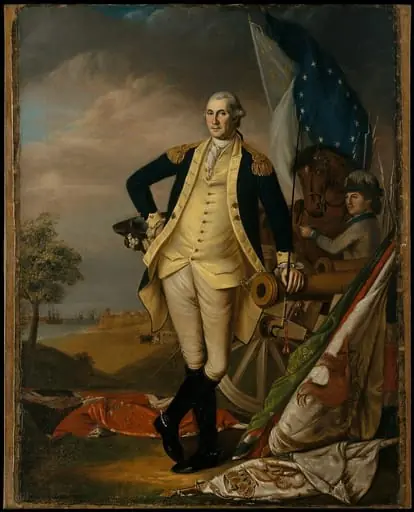
George Washington rides ahead on horseback while his enslaved valet, William Lee, walks beside him holding the reins of a second horse and glancing toward us. John Trumbull painted this in 1780, during the Revolutionary War. Lee was Washington's personal assistant and close companion for decades.
Subject & Meaning
The background elements, including a red and white striped banner, situate the figures within the active theater of the American Revolutionary War.
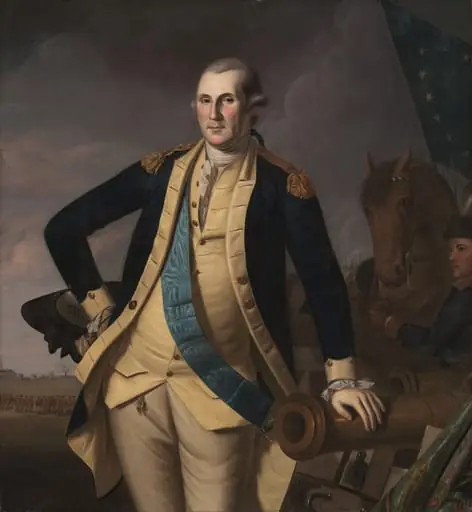
The painting depicts General George Washington in full military uniform standing beside his enslaved servant, William Lee, who is identified by a red turban while attending to Washington's horse. Set against a landscape overlooking the Hudson River with West Point and ships in the background, the composition places Washington centrally, holding a hat, sword, and scrolled document. The work functions as a portrait that integrates the general with his domestic retinue, reflecting the historical reality of slavery within the Revolutionary leadership.
Art historically, the image draws upon traditional equestrian compositions of military men with grooms, echoing works by Anthony van Dyck, while the specific inclusion of Lee alongside Washington serves as a direct visual record of their relationship. The background elements, including a red and white striped banner, situate the figures within the active theater of the American Revolutionary War.
Technique & Style
Created in 1780, the work is an oil painting on canvas measuring 36 by 28 inches (0.91 by 0.71 meters). As a full-length portrait, it depicts General Washington in a blue military coat with buff waistcoat and pants, standing beside his servant William Lee, who wears a red turban. The composition places Washington centrally against a landscape of the Hudson River, with West Point and ships visible in the background.
Stylistically, the execution is described as looser and more convincing in spatial recession than Trumbull's earlier works, featuring softer facial modeling that avoids the wooden quality of previous sitters. The artist reinforced outlines with black, a technique echoing his mentor Benjamin West. The painting relies on memory rather than a live sitting, as Trumbull created it while studying in London during the Revolutionary War.
History & Provenance
The portrait was painted by John Trumbull in 1780 while he was studying under Benjamin West in London, where he executed the work from memory of his earlier service as an aide-de-camp to Washington. He completed it before his arrest for high treason in November 1780. Trumbull subsequently gave the painting to Leendert de Neufville, son of Jean de Neufville, with whom he stayed in Amsterdam in July 1781.
The work remained in the possession of the de Neufville family of the Netherlands until 1890, when it was sold through art dealers in London. It was then acquired by the New York dealer Edward G. Kennedy before 1898, and by 1908 had entered the collection of Charles Allen Munn, who bequeathed it to the Metropolitan Museum of Art in 1924.
The painting is held in the collection of the Metropolitan Museum of Art in New York City, where it remains on view. Its path to the museum began with the de Neufville family of the Netherlands, who retained possession until 1890. Following a sale through London dealers, the work was acquired by New York dealer Edward G. Kennedy prior to 1898.
By 1908, it had entered the collection of Charles Allen Munn, who subsequently bequeathed the piece to the Metropolitan Museum of Art in 1924. The museum highlighted the acquisition in its 1925 bulletin, specifically featuring the work in an article detailing the Charles Allen Munn Bequest.
Context
John Trumbull's 1780 portrait, painted during his study under Benjamin West in London, is historically significant as the first authentic likeness of George Washington published in Europe. Created from memory while Trumbull served as an aide-de-camp, the work demonstrates a stylistic evolution toward looser execution and softer modeling compared to his earlier, more rigid portraits. Art historical analysis notes its composition draws from traditions of military portraiture, specifically Anthony van Dyck's equestrian works, while utilizing black outline reinforcement characteristic of West's technique.
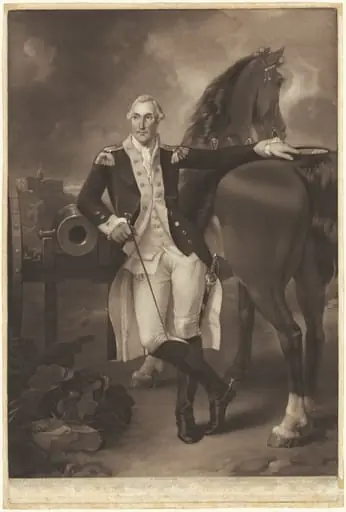
The painting's legacy includes a 1781 mezzotint by Valentine Green and its 1932 adaptation for a United States postage stamp. Its inclusion in major catalogues highlights its role in defining the visual iconography of the Revolutionary War era, bridging Trumbull's personal military service with the broader artistic context of American portraiture.
Legacy
The painting's legacy is evident in its later public recognition: after being bequeathed to the Metropolitan Museum of Art by Charles Allen Munn in 1924, it was chosen for a seven‑cent black‑ink postage stamp issued in 1932 as part of the Washington Bicentennial series, and in 1925 it occupied the front page of the Metropolitan Museum of Art Bulletin in an article describing the Munn bequest. These honors reflect the painting’s enduring stature in American visual culture.
Overview
Painted in 1780 by John Trumbull, George Washington and William Lee depicts the American general on horseback accompanied by his enslaved valet, William Lee. The composition places Washington in profile, gazing forward with a stoic demeanor, while Lee walks beside the horse, holding the reins of a second mount and looking directly at the viewer. This direct engagement breaks the traditional hierarchy of equestrian portraiture, granting Lee a distinct presence within the frame.
Created during the Revolutionary War, the work reflects Trumbull's early commitment to documenting key figures of the American struggle for independence. While Trumbull is best known for his large-scale history paintings of the war, this portrait serves as an intimate character study from his formative period. The painting captures a specific historical reality: Lee served as Washington's personal servant throughout the war and was the only enslaved person Washington freed in his will.
The work stands as a significant, albeit complex, document of the era, illustrating the proximity of slavery to the founding of the nation while showcasing Trumbull's developing skill in capturing psychological depth and historical narrative.
Artist & collection

Artist
John Trumbull (June 6, 1756 – November 10, 1843) was an American painter and military officer best known for his historical paintings of the American Revolutionary War, of which he was a veteran.