Artwork
Hudson's Bay Lemming
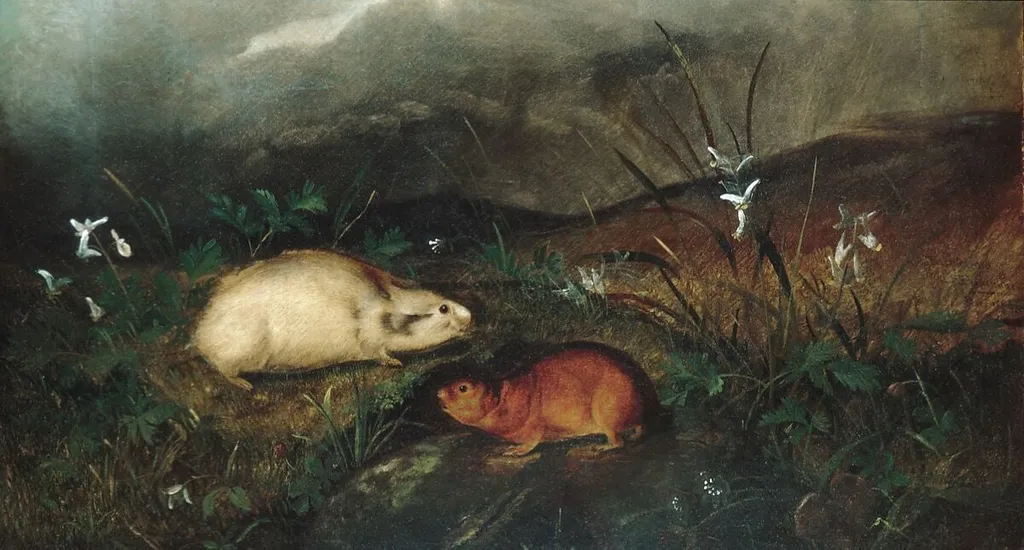
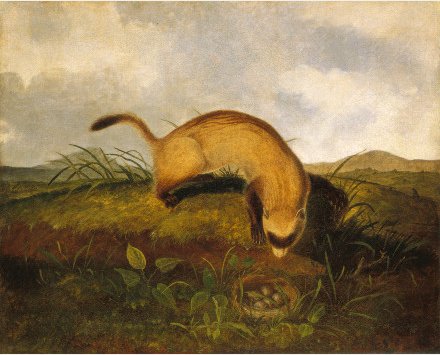
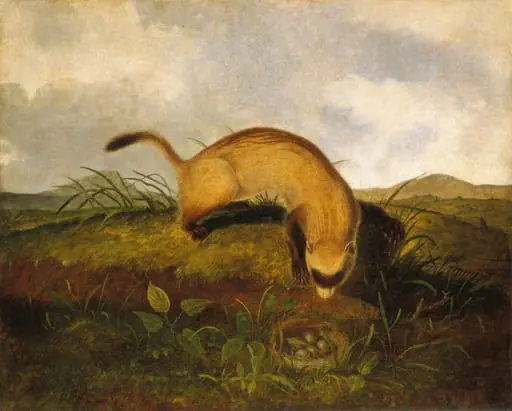
Hudson's Bay Lemming is an oil painting by the American Folk Art artist John Woodhouse Audubon. It dates from 1846 and is held in the collection of the Metropolitan Museum of Art.
About this work
A small furry lemming sits on a patch of moss and grass, dark eyes staring straight out, tiny paws clutching a green leaf. John Woodhouse Audubon painted it in 1846, following his father, John James Audubon, known for detailed bird illustrations. No drama here, just one animal and its textures: soft fur, rough moss, the leaf's delicate veins. For more, look up animals.
Technique & Style
The painting’s condition is considered stable, having been preserved in the museum’s controlled environment.
Executed in oil on canvas in 1846, the work measures roughly 35.6 × 55.9 cm and is supported by a stretched canvas surface typical of Audubon’s wildlife paintings. The Metropolitan Museum of Art’s records note the use of oil paint and canvas as the medium and support, and the piece is classified as a still‑life within the American Wing collection. Audubon renders the lemming with precise anatomical detail, set against a modest assemblage of vegetation that creates a balanced composition and a muted, naturalistic palette.
The handling of brushwork emphasizes texture in the fur and foliage, while the overall arrangement reflects the formal conventions of 19th‑century American still‑life painting. The painting’s condition is considered stable, having been preserved in the museum’s controlled environment.
History & Provenance
John Woodhouse Audubon created the oil on canvas painting Hudson's Bay Lemming in 1846. The work, which depicts a lemming amidst vegetation, measures 35.6 by 55.9 centimeters. Since its inception, the painting has been held in the collection of the Metropolitan Museum of Art, where it remains located within the institution.
The provided records confirm the artist, date, and current museum ownership, though specific details regarding an original commission or intermediate owners between creation and museum acquisition are not documented in the available sources.
Hudson's Bay Lemming (1846) by John Woodhouse Audubon is held in the collection of the Metropolitan Museum of Art. The work is classified within the museum's American Wing and is catalogued as an oil-on-canvas still life depicting a lemming alongside plant and animal elements. No specific accession number, acquisition date, or prior exhibition history is documented in the available sources.
Overview
John Woodhouse Audubon painted Hudson's Bay Lemming in 1846, rendering the small creature in oil on canvas. This work exemplifies his dedication to portraying North American wildlife, a pursuit he shared with his renowned father, John James Audubon. The painting captures a quiet moment, focusing on the intricate details of a single animal within its natural setting.
Subject & Meaning
The painting presents a lone lemming, its dark eyes fixed forward, as it rests on a patch of moss and grass. Its tiny paws gently hold a green leaf, drawing the viewer's attention to the delicate forms of nature. This intimate portrayal emphasizes the animal's presence without narrative drama, inviting close observation of its form and immediate environment.
Context
Created during a period of growing interest in the natural world, this work reflects John Woodhouse Audubon's independent contribution to wildlife art. While following in his father's footsteps as a naturalist-painter, he developed his own distinct focus on individual animal studies. This piece can be understood as a still life, capturing a specific moment in the broader natural history tradition.
Artist & collection