Artwork
The Rabbit Hunters
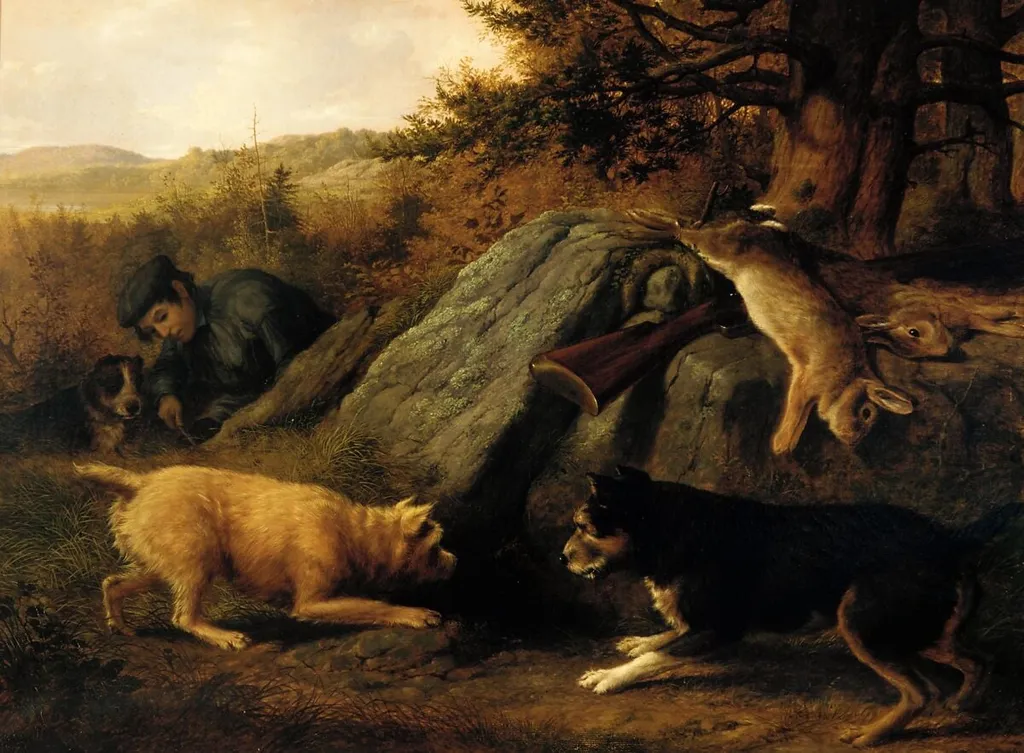
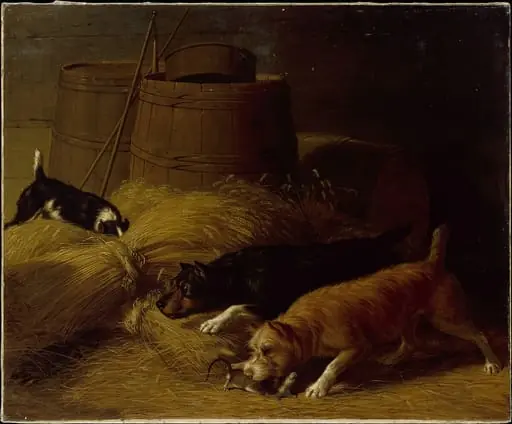
The Rabbit Hunters is an oil painting by the Hudson River School artist Thomas Hewes Hinckley. It dates from 1850 and is held in the collection of the Metropolitan Museum of Art.
- Accession no.
- 43.52
- Credit line
- Gift of Mrs. F. Livingston Pell, 1943
About this work
Subject & Meaning
Thomas Hewes Hinckley's 1850 oil painting, The Rabbit Hunters, depicts a genre scene centered on the act of hunting.
Thomas Hewes Hinckley's 1850 oil painting, The Rabbit Hunters, depicts a genre scene centered on the act of hunting. The composition features a man accompanied by a dog in pursuit of a rabbit, capturing a moment of rural activity. As a work within the genre-painting tradition, it illustrates the practical and recreational aspects of nineteenth-century life rather than mythological or allegorical narratives.
The visual focus remains on the interaction between the human figure, the animal companion, and the quarry, presenting a straightforward representation of the hunt.
Technique & Style
The Rabbit Hunters is executed in oil on canvas, a standard mid-nineteenth-century medium for American genre painting. The work measures 101.6 × 137.8 cm, a horizontal format suited to its outdoor hunting scene. Painted in 1850 by Thomas Hewes Hinckley, the canvas is held in the collection of the Metropolitan Museum of Art's American Wing.
The composition depicts figures and animals engaged in rabbit hunting, consistent with Hinckley's known specialization in sporting and animal subjects rendered in oil.
History & Provenance
The Rabbit Hunters, painted by Thomas Hewes Hinckley in 1850, is part of the permanent collection of the Metropolitan Museum of Art in New York. It is housed in The American Wing, the museum's designated space for American art. The painting's accession number is not specified in the available documentation.
Its presence in the museum's catalog reflects its classification as an American genre scene depicting a man, a dog, and a rabbit in a hunting context. No exhibition history beyond its inclusion in the museum's display of American paintings is recorded in the cited sources.
Legacy
The Rabbit Hunters is a representative example of mid-nineteenth-century American genre painting, noted for its naturalistic rendering of wildlife. As part of The American Wing at the Metropolitan Museum of Art, the 1850 oil on canvas reflects the period's interest in sporting scenes and rural pursuits, consistent with Hinckley's specialization in animal and sporting subjects.
Overview
Thomas Hewes Hinckley's The Rabbit Hunters, painted in 1850, is an oil on canvas genre scene. It captures a moment of anticipation in a winter landscape, featuring two hunters and their dogs poised over a hidden rabbit. The artwork is characterized by its depiction of a quiet, suspended instant rather than the action of the chase, reflecting a contemplative approach to a common subject.
Context
In the mid-19th century, hunting scenes were a popular subject within American art, often celebrating the vigor and skill associated with the pursuit of game. Hinckley's The Rabbit Hunters engages with this prevalent theme but distinguishes itself by foregoing the dramatic climax. Instead of depicting the shot or the kill, the artist chose to highlight the quiet, observant phase of the hunt, offering a nuanced perspective on a traditional genre.
Artist & collection