Artwork
Black-Footed Ferret
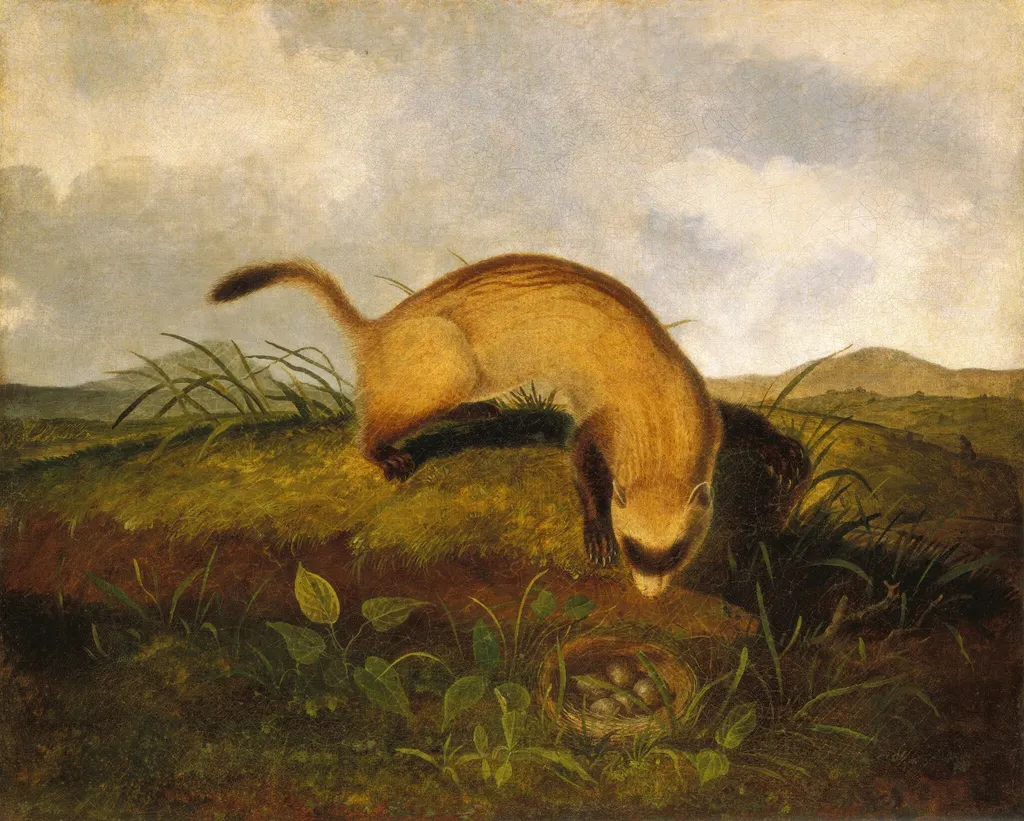
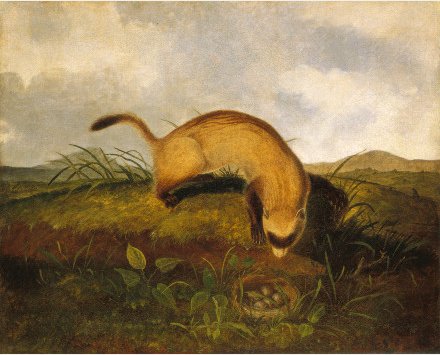
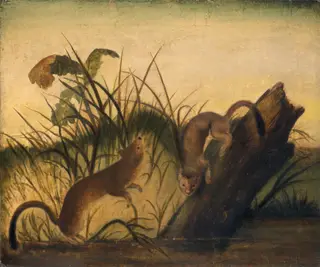
Black-Footed Ferret is an oil painting by the American Folk Art artist John Woodhouse Audubon. It dates from 1843 and is held in the collection of the National Gallery of Art.
- Inscription
- Inscribed:on reverse, written twice at right angles, now obscured by lining fabric (photo in NGA curatorial file): W.B. Audubon
About this work
Subject & Meaning
The painting depicts a single black-footed ferret standing on a rocky outcrop, its pale body and dark mask-like facial markings rendered with naturalistic detail against a muted background of earth tones. The subject is presented frontally, emphasizing the animal's distinctive morphology, short legs, long body, and the characteristic black feet and mask that give the species its name.
Within Audubon's oeuvre, such depictions served both scientific documentation and aesthetic celebration, aligning with the nineteenth-century tradition of wildlife portraiture that elevated native fauna to subjects of artistic attention. The ferret's alert posture and unthreatened stance convey neither aggression nor distress, suggesting a neutral, observational treatment of the creature in its natural setting.
Technique & Style
The handling combines smooth, blended passages in the animal's fur with sharper, descriptive strokes for the ferret's facial features and claws.
The work is executed in oil on canvas, a medium typical of Audubon's paintings. The handling combines smooth, blended passages in the animal's fur with sharper, descriptive strokes for the ferret's facial features and claws. Stylistically, the composition is tightly framed, with the ferret positioned centrally against a neutral backdrop that directs attention to the animal's anatomy and the subtle gradations of brown and white fur. The dark eyes and nose are rendered with careful contrast to convey alertness.
History & Provenance
The painting Black-Footed Ferret was created by John Woodhouse Audubon in 1843 in oil on canvas. It descended through the artist's family: after his death in 1862 it passed to his second wife, Caroline Hall Audubon, and then to their son William Bakewell Audubon, who emigrated to Australia. By about 1899–1900 the work had been sent to Australia, likely following Caroline's death in early 1899.
It remained in the family until 1950, when Leonard Benjamin Audubon sold it to E. J. L. Hallstrom in Sydney. Hallstrom gave the painting to the National Gallery of Art, Washington, in 1951, where it remains as part of the museum's American holdings.
Overview
John Woodhouse Audubon’s oil on canvas from 1843 portrays a solitary black‑footed ferret poised on a grassy rise. The animal, rendered in tan and black fur with a long, bushy tail, lowers its head as if sniffing or feeding among the blades, while a backdrop of rolling hills and a cloud‑filled sky extends behind it.
Context
Created during a time when American artists were documenting native wildlife, the painting reflects contemporary scientific interest and the Romantic movement’s fascination with the untamed frontier. Audubon’s dedication to accurate animal portrayal aligns with his broader contributions to natural history illustration.
Own this work as a print
Artist & collection