Artwork
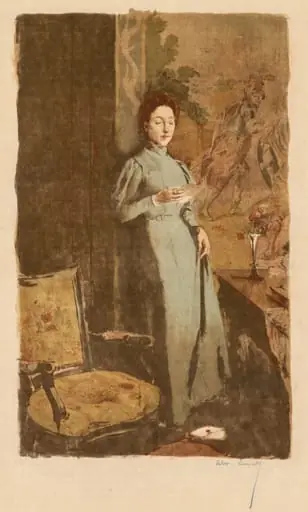
Anna Dwight Weir Reading a Letter
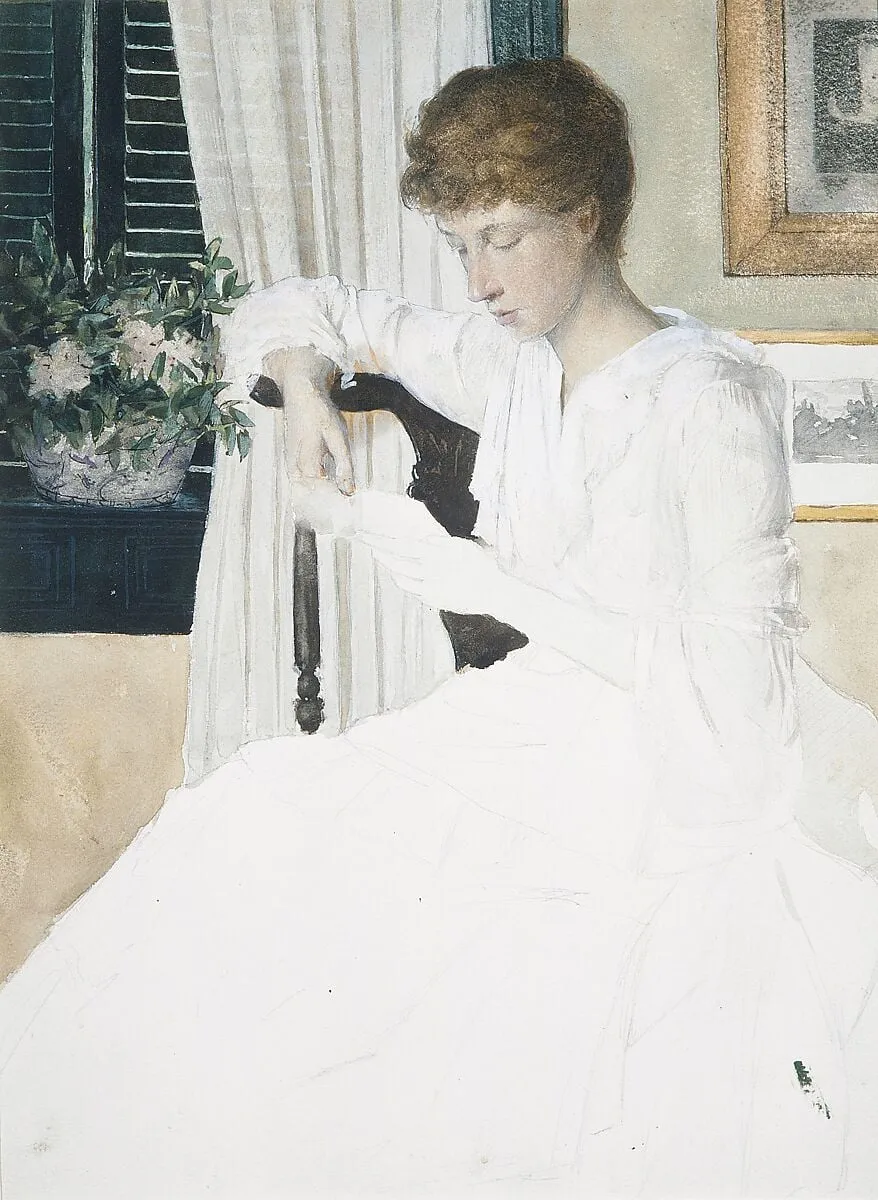
Anna Dwight Weir Reading a Letter is a watercolor work on paper by the American Impressionist artist Julian Alden Weir. It dates from 1890 and is held in the collection of the Metropolitan Museum of Art.
About this work
Technique & Style
The artist combined watercolor and gouache with black ink and graphite to render the figure of a woman.
Created in 1890, this portrait utilizes a mixed-media approach on white wove paper. The artist combined watercolor and gouache with black ink and graphite to render the figure of a woman. The work measures 31.8 cm in height and 23.5 cm in width.
As a piece held by the Metropolitan Museum of Art, it exemplifies the artist's application of opaque and transparent washes alongside linear drawing elements to achieve its formal effects.
History & Provenance
Julian Alden Weir painted Anna Dwight Weir Reading a Letter in 1890 using watercolor, gouache, black ink, and graphite on white wove paper. The work entered the collection of the Metropolitan Museum of Art, where it remains on view in The American Wing. Its dimensions are 31.8 cm by 23.5 cm, and it depicts a woman. The painting was created in the late 19th century and is classified as a portrait.
Context
Julian Alden Weir painted Anna Dwight Weir Reading a Letter in 1890, depicting his sister Anna in a domestic moment captured through watercolor, gouache, ink and graphite on paper (31.8 cm × 23.5 cm). The portrait, housed in The American Wing at the Metropolitan Museum of Art, belongs to the portrait genre and reflects the intimate family subjects favored by early American Impressionists. Its creation coincides with Weir's development of a restrained, atmospheric style that blended European influences with American themes, situating it within the broader context of late 19th-century American art.
Legacy
The work's quiet domestic focus influenced later American portraitists who sought to elevate everyday moments through refined realism. Its inclusion in The American Wing at the Metropolitan Museum helped establish Weir as a significant figure in late 19th-century American art, contributing to renewed scholarly interest in his role as a bridge between academic tradition and emerging modernist sensibilities.
The painting's delicate handling of interior narrative inspired artists exploring psychological depth in domestic subjects during the early 20th century.
Overview
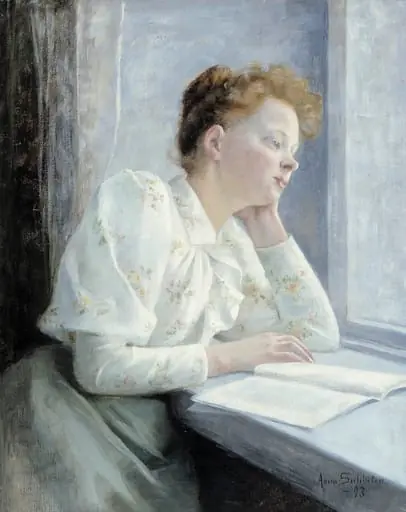
Anna Dwight Weir Reading a Letter (1890) is a watercolor, gouache, and ink portrait by the American artist Julian Alden Weir. The work depicts the artist's sister, Anna Dwight Weir, seated in a sunlit interior, her head bowed as she reads a letter. Weir employs a loose, atmospheric technique characteristic of his mature style, utilizing the white wove paper to enhance the luminosity of the scene.
Light filters through the composition, illuminating the subject's hair and the soft folds of her dress while casting the background in a wash of soft greens and blues that suggests a window view. Executed in 1890, this piece reflects Weir's transition from his earlier tonalist influences toward a more impressionistic handling of light and color, a shift that would define his later career. The painting captures a quiet, domestic moment, emphasizing the interplay of natural light and the intimate stillness of the subject.
It stands as a significant example of Weir's portraiture, demonstrating his ability to convey psychological presence through subtle tonal variations and the translucency of watercolor media.
Subject & Meaning
The sitter is Anna Dwight Weir, the artist’s sister, captured in an intimate, everyday moment. Her head is inclined toward the paper, suggesting personal contemplation. The absence of narrative drama focuses attention on the quiet act of reading, offering a glimpse into domestic life of the late nineteenth‑century middle class.
Artist & collection

Artist
Julian Alden Weir was an American impressionist painter and member of the Cos Cob Art Colony in Greenwich, Connecticut.