Artwork
Tradition
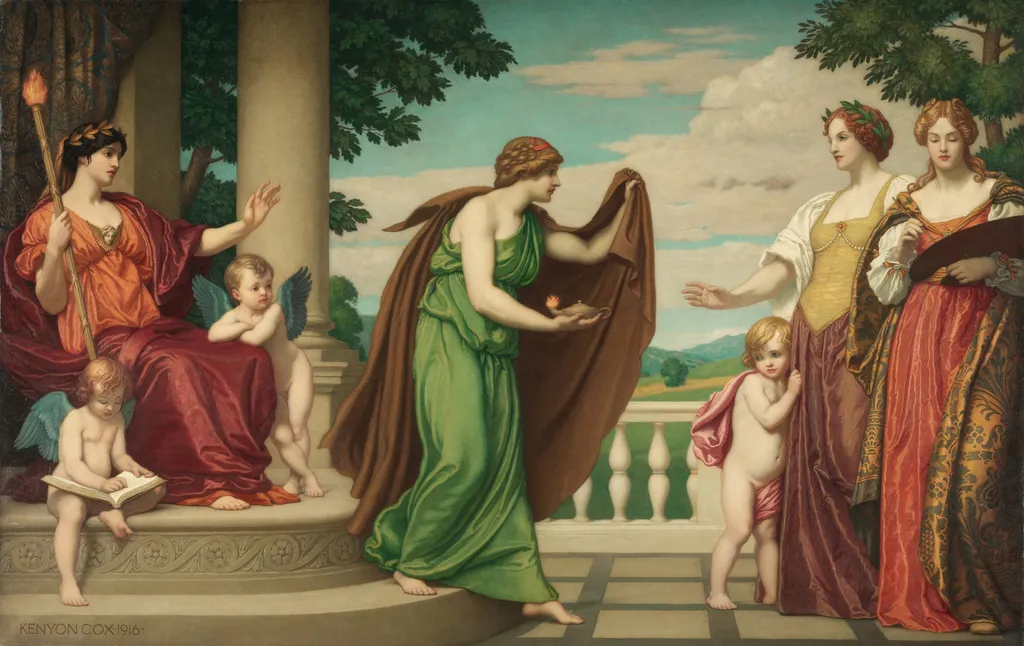
Tradition is an oil painting by the American Impressionist artist Kenyon Cox. It dates from 1916 and is held in the collection of the Cleveland Museum of Art.
About this work
Subject & Meaning
Kenyon Cox's Tradition is a 1916 oil painting held by the Cleveland Museum of Art. The work measures 106 cm in height by 165.5 cm in width and was produced in the United States using oil paint on canvas. Beyond these cataloguing details, the sources provided do not describe the figures, scene, or symbolic content depicted in the work, nor do they address its iconography or interpretive meaning.
Technique & Style
Cox’s handling emphasizes smooth, blended modeling and controlled transitions in light and shadow, aligning with his academic training and neoclassical aims.
Executed in oil paint on canvas, the work measures 106.0 cm by 165.5 cm. Cox’s handling emphasizes smooth, blended modeling and controlled transitions in light and shadow, aligning with his academic training and neoclassical aims. The composition’s formal qualities feature a balanced arrangement of classical figures, rendered with clarity and restraint to convey an idealized vision of tradition. The canvas support and oil medium support the luminous, evenly lit surface, with no evidence of impasto or visible brushwork disrupting the refined finish.
The painting’s condition has not been reported as requiring conservation treatment, and its surface remains intact according to institutional records.
History & Provenance
Tradition is an oil painting by the American artist Kenyon Cox, created in 1916 in the United States. The work entered the collection of the Cleveland Museum of Art, where it is held today. No further details regarding its commission, prior ownership, or chain of custody are documented in the available sources.
The painting measures 106.0 cm in height by 165.5 cm in width and is executed in oil paint on canvas.
Overview
Kenyon Cox's 'Tradition' (1916) is an oil painting that visualizes the transmission of cultural and intellectual heritage through allegorical figures. The composition features a group of women and children arranged within a classical architectural setting defined by columns and a lanter. The central female figures are draped in flowing robes, embodying the dignity of the past; one holds a torch, symbolizing enlightenment and the guiding light of knowledge, while another clutches a book, representing the preservation of written history and learning.
The children in the foreground are depicted engaging with the adults, suggesting the active reception of these values by the younger generation. Executed in 1916, the work reflects Cox's commitment to academic realism and his role as a leading proponent of the American Renaissance style, which sought to revive classical ideals in response to modernist trends. The painting serves as a didactic statement on the continuity of civilization, utilizing a balanced, frieze-like arrangement and a restrained palette to emphasize order and moral clarity.
It stands as a significant example of Cox's later career, where he frequently explored themes of art, history, and education through idealized, timeless imagery.
Context
Cox, a prominent muralist and educator, often explored themes of cultural continuity and moral instruction in his work. Tradition aligns with his broader oeuvre, which frequently employed historical or allegorical settings to comment on contemporary values, echoing the academic tradition that dominated American art education at the time.
Own this work as a print
Artist & collection

Artist
Kenyon Cox was an American painter, illustrator, muralist, writer, and teacher. Cox was an influential and important early instructor at the Art Students League of New York. He was the designer of the League's logo,…

- Tradition
 Venus Induces Helen to Fall in Love with Paris
 Perseus and the Nymphs
 The Sorrow of Telemachus
 Las griegas de los dados
 Poem of the Soul - Sunrays
 Story of Minerva - The Muses Showing Minerva Hippocrene Waters of the River that Brings Out Pegasus
 Parnassus
 Winding the skein
 Chloe
Chloe Allegorie auf Musik und Malerei
 Theatrical Rehearsal in the House of an Ancient Rome Poet