Artwork
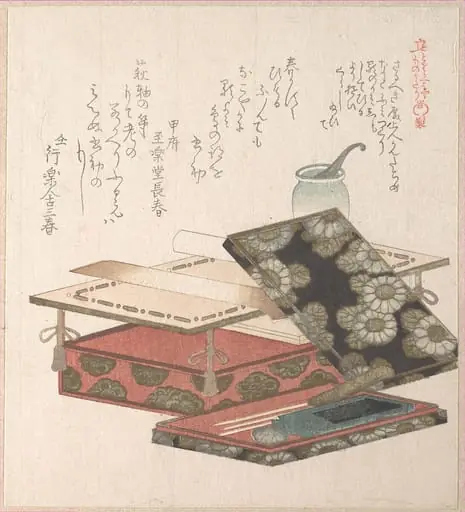
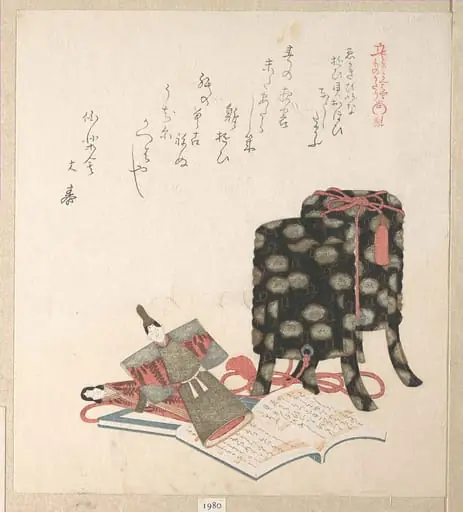
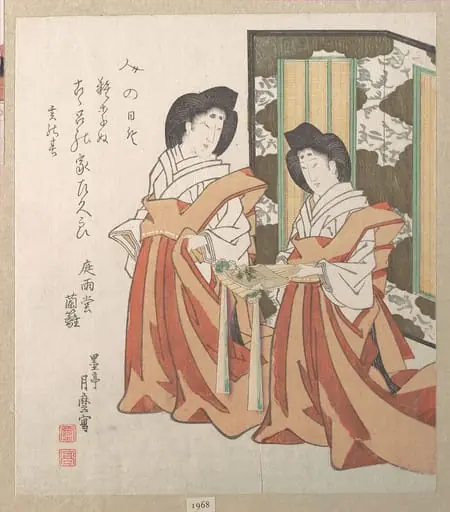
女官図|Court Woman at her Desk with Poem Cards
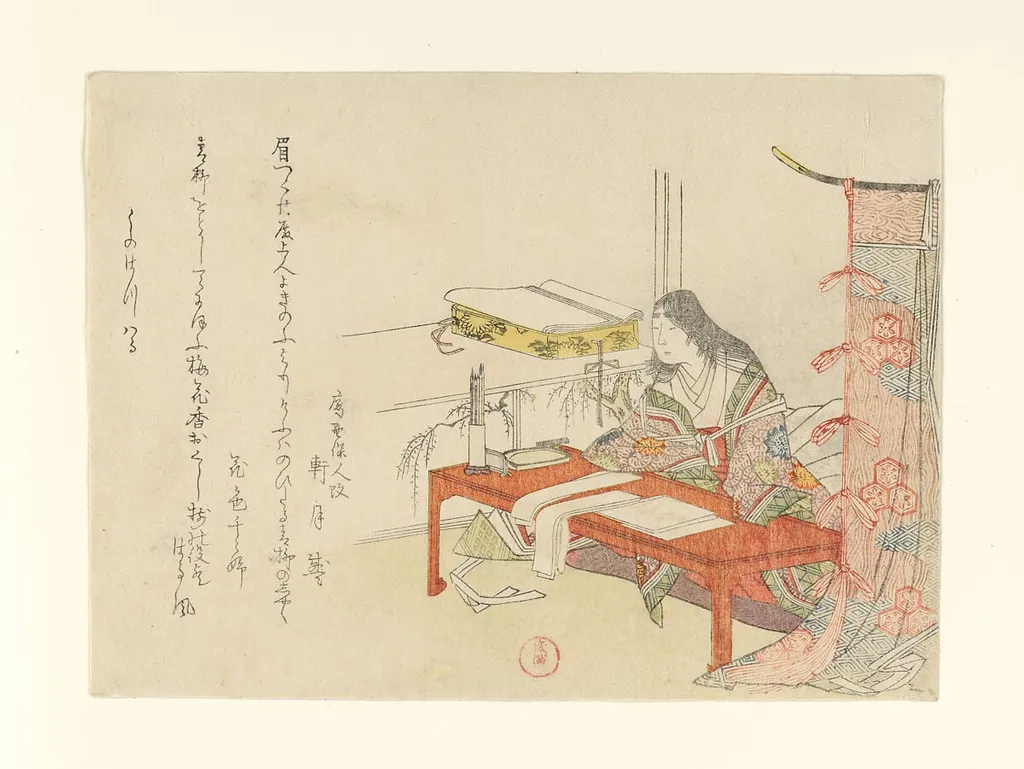
女官図|Court Woman at her Desk with Poem Cards is an ink print by the Romanticist artist Kubo Shunman. It dates from 1795 and is held in the collection of the Metropolitan Museum of Art.
About this work
Overview
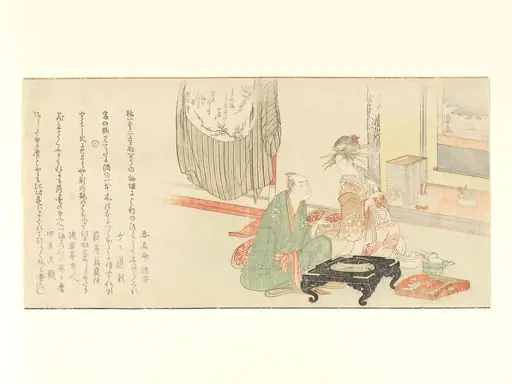
Behind the figure, a red curtain featuring geometric designs hangs adjacent to a window covered by bamboo blinds, creating a layered interior space.
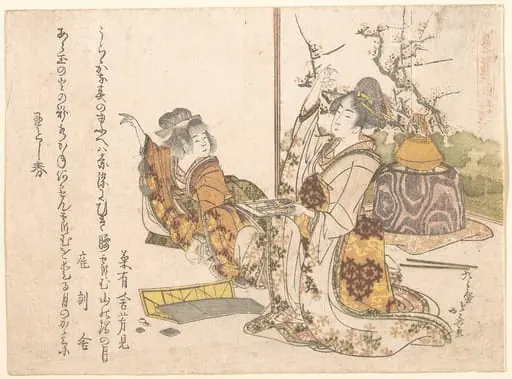
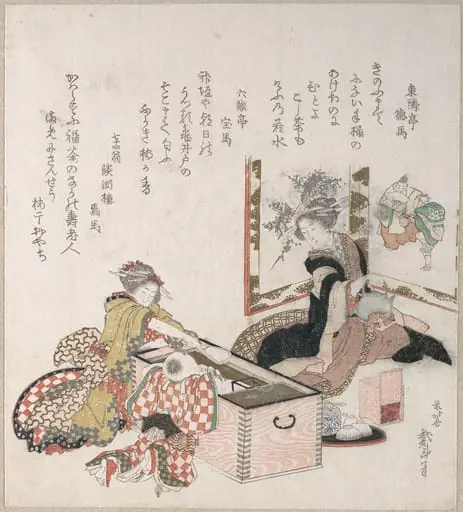
Created in 1795 by Kubo Shunman, Court Woman at her Desk with Poem Cards is a surimono, a privately commissioned woodblock print distinct from commercial ukiyo-e. The work depicts a court lady seated at a low desk, engaged in literary or domestic pursuits. She wears an elaborately patterned robe and a headband, her posture suggesting quiet concentration.
The composition centers on the desk, which holds a small stand with a folded paper umbrella, a book, and various tools, likely related to calligraphy or needlework. Behind the figure, a red curtain featuring geometric designs hangs adjacent to a window covered by bamboo blinds, creating a layered interior space. As a surimono, this print was produced for a poetry club or private group, often accompanying a specific poem or celebrating a seasonal event.
Shunman, known for his elegant designs and sophisticated use of color and embossing, utilized this format to explore refined themes of courtly life and aesthetics. The inclusion of poem cards, implied by the title and the scholarly objects, reflects the integration of visual art and poetry characteristic of the Edo period's elite cultural circles. This piece exemplifies Shunman's mastery in capturing the subtle grace of female subjects within intimate, domestic settings.
Subject & Meaning
The scene presents a court lady seated at a low writing desk, her hands occupied with needlework or weaving. She is dressed in a long, patterned kimono and a decorative headband, while a small stand holds a folded paper parasol, a book, and assorted tools. A red, geometrically patterned curtain and bamboo‑shuttered window form the background, suggesting an interior of refined, everyday court life. A surrounding Japanese poem reinforces the theme of quiet, cultivated activity.
Technique & Style
Shunman employs fine, intersecting lines to model fabrics and objects, a method akin to cross‑hatching that builds texture without heavy shading. The palette is restrained, using muted blues, greens, and ochres that lend a serene atmosphere. The composition balances negative space with detailed elements, allowing the viewer’s eye to linger on the subtle interplay of light, line, and pattern characteristic of surimono prints intended for private poetry gatherings.
History & Provenance
The print was originally produced as a limited‑edition surimono, a format commissioned for literary societies and special occasions, and would have been distributed among a select audience. It entered the Metropolitan Museum of Art’s collection through a 20th‑century acquisition, where it remains catalogued as an example of Shunman’s refined approach to courtly genre scenes.
Artist & collection