Artwork
Alleen in het atelier
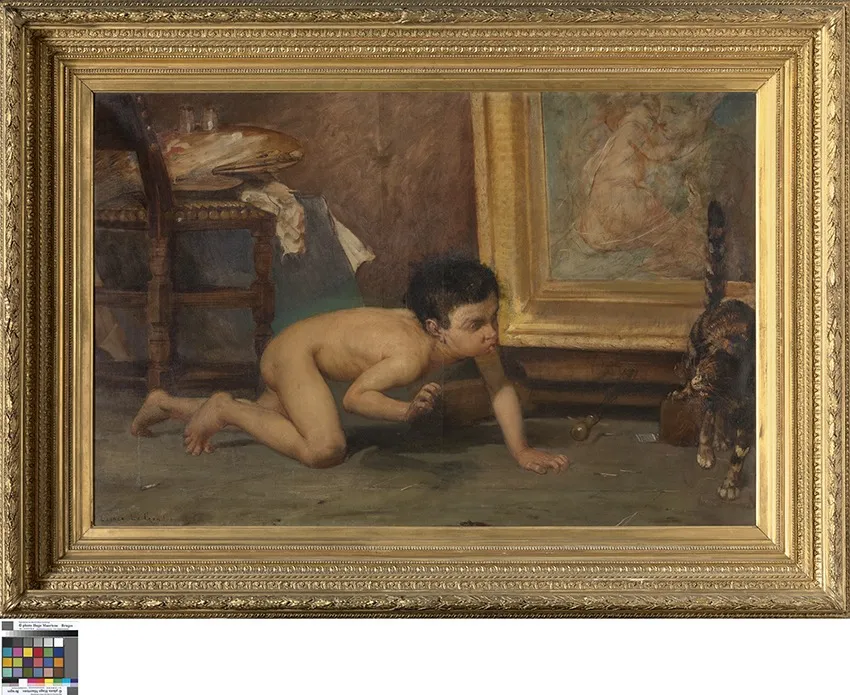
Alleen in het atelier is an oil painting by the Impressionist artist Léonce Legendre. It dates from 1888 and is held in the collection of the Groeningemuseum.
About this work
Overview
Measuring 87 by 131 cm, the work is held in the collection of the Groeningemuseum in Bruges, Belgium, where it is catalogued under accession number 0040379000.
Alleen in het atelier (Alone in the Studio) is an oil-on-canvas painting by the Belgian artist Léonce Legendre, dated 1876. Measuring 87 by 131 cm, the work is held in the collection of the Groeningemuseum in Bruges, Belgium, where it is catalogued under accession number 0040379000. The painting occupies a modest but telling place within late-nineteenth-century Belgian genre painting, offering an intimate glimpse into the domestic and professional space of the artist's studio through the unexpected focal point of a child.
Subject & Meaning
The painting depicts a nude child crawling on hands and knees across a wooden floor, oriented toward a small cat that stands near a large gilt-framed canvas. The child's body cuts diagonally across the lower center of the composition, creating a dynamic axis that draws the eye toward the background. To the left, a wooden stool or table supports a painter's palette with dabs of pigment and a cloth, while behind the child a greenish draped fabric hangs down. The large framed canvas at right contains only a faint, sketchy figure study in warm tones, suggesting a work in progress. The iconography juxtaposes the innocence and spontaneity of childhood with the implements and symbols of artistic labor. The cat, a traditional emblem of domesticity and sometimes of independence, stands as a silent witness to this private moment. The title's emphasis on solitude, Alleen in het atelier, underscores a meditation on the studio as a space where personal and professional lives interweave, where the artist's child replaces the artist as the inhabitant of this creative domain.
Technique & Style
Legendre executed the painting in oil on canvas, employing an earthy palette dominated by browns, muted greens, ochres, and dull golds. Light enters from the upper left, casting soft shadows beneath the child and furniture that model the forms with naturalistic subtlety. The brushwork varies considerably across the surface: the child's skin is rendered with smooth, careful handling, while the background elements, the wooden floor, and the draped fabric receive looser, more suggestive treatment. This differential handling focuses attention on the living subject while allowing the setting to recede into atmospheric unity. The composition's diagonal thrust and the placement of studio props demonstrate Legendre's command of interior genre conventions, even as the unconventional subject, a nude infant in an artist's studio, departs from more typical studio scenes populated by working painters or models. The painting is presented in an ornate gilded frame with repeating decorative patterns, a presentation choice that elevates the modest subject to a status of finished, collectible art.
History & Provenance
The painting bears the date 1876, placing it in the mature phase of Legendre's career. Its provenance before acquisition by the Groeningemuseum remains undocumented in the available sources. The work entered the museum's collection and is now identified by the inventory number 0040379000. A photographic reproduction was produced by Hugo Maertens on 14 February 2012, and the image was subsequently made available through the LUKAS - Art in Flanders platform and Wikimedia Commons. No exhibition history prior to or following its museum acquisition is recorded in the accessible sources.
Context
Léonce Legendre worked within the Belgian academic and salon tradition of the later nineteenth century, a period when artists increasingly explored intimate, domestic, and studio-based subjects as alternatives to grand historical or mythological narratives. The Groeningemuseum, located in Bruges, collects and preserves works that illuminate the history of Flemish art from the medieval period through the modern era; Legendre's painting contributes to this narrative by representing the continuation of figurative tradition into the post-Romantic period. The work's depiction of a child in the studio resonates with broader European interest in childhood as a subject of artistic and psychological inquiry during the nineteenth century, from the naturalism of Courbet to the sentiment of Victorian genre painting. Within Belgian art specifically, it aligns with tendencies toward intimate realism and the documentation of artists' private environments.
Legacy
The legacy of Alleen in het atelier remains closely tied to its institutional home. As part of the Groeningemuseum's permanent collection, it represents a fixed point in the museum's holdings of nineteenth-century Belgian painting, accessible to researchers and the public through the museum's catalogue and digital platforms. Its dissemination via Wikimedia Commons and the LUKAS photographic archive has extended its visibility beyond the physical museum, allowing broader audiences to engage with Legendre's work. The painting has not, however, achieved significant independent art-historical fame or been the subject of extensive scholarly monograph; its reputation rests on its value as a characteristic example of Legendre's studio-themed genre painting and as a document of late-nineteenth-century Belgian artistic culture. Its afterlife is thus primarily museological and digital, preserved and transmitted through institutional stewardship rather than through reproduction or citation in major art-historical narratives.
Artist & collection