Artwork
Guillaume du Vair
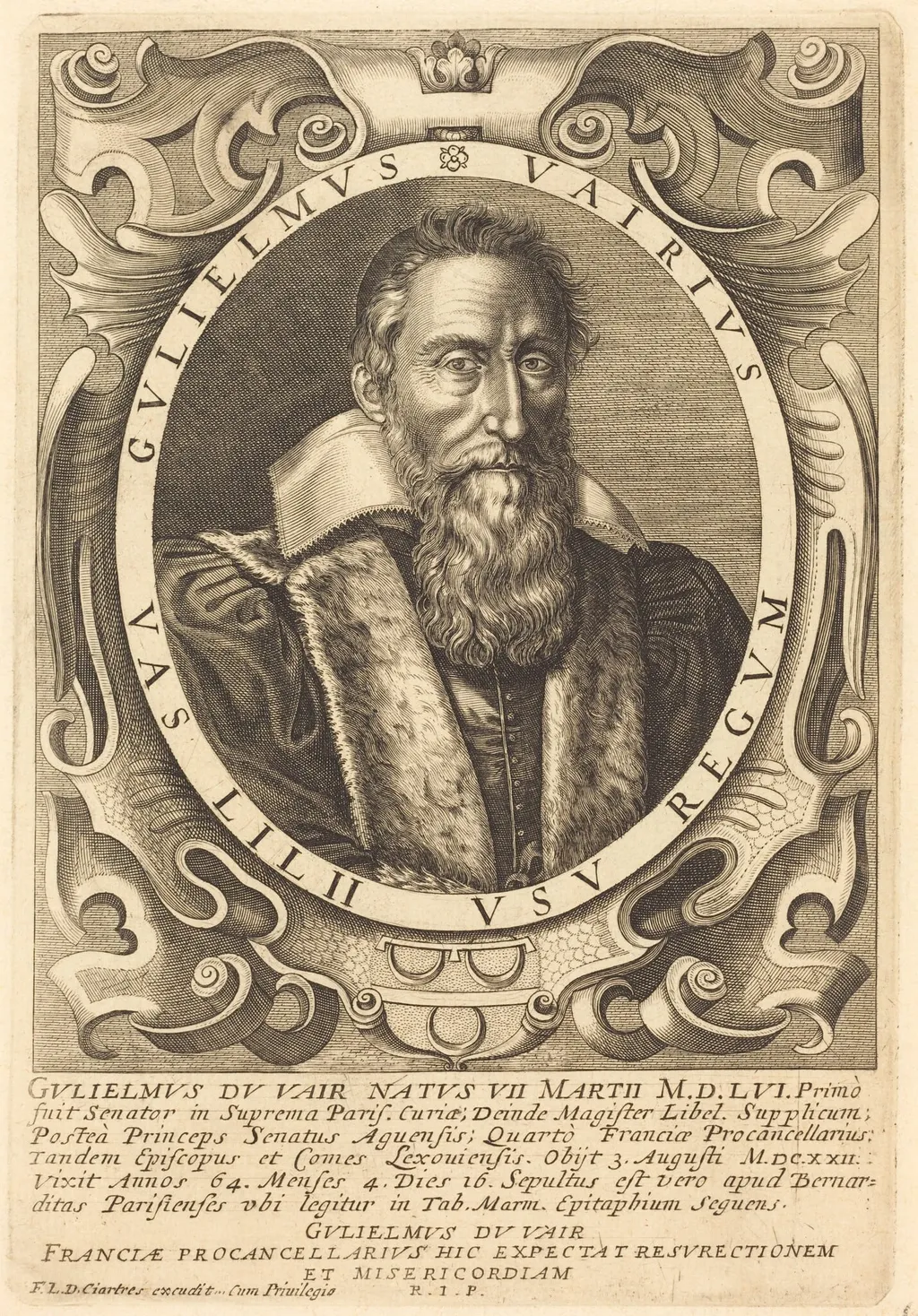
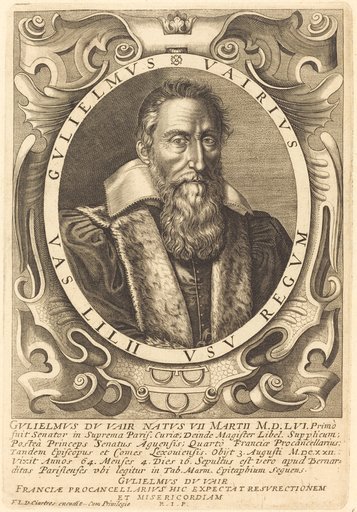
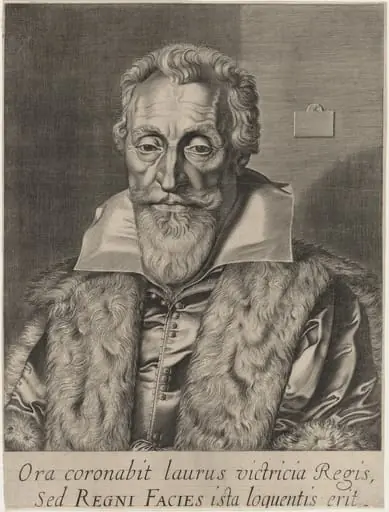
Guillaume du Vair is an ink print by the Renaissance artist François Langlois. It dates from 1618 and is held in the collection of the National Gallery of Art.
- Inscription
- Inscribed:lower left in plate: F.L.D.Ciartres excudit...Cum Priuilegio; around oval border in plate: GVLIELMVS VAIRIVS VAS LIL II VSV REGVM; across bottom in plate: GVLIELMVS DV VAIR NATVS VII MARTII M.D.LVI. Primo / fuit Senator in Suprema Paris ...; by later hands, across bottom in graphite: F. Langlois of Chartres Sc. (undeciphered) Statesman Duvair 1556-1621; by later hand, lower center vserso in graphite: Fine copy of a picture by Porbus. / -in the Louvre Gallery-
About this work
Overview
François Langlois produced this engraved portrait in 1618, depicting the French jurist and writer Guillaume du Vair. Executed on laid paper, the image presents a dignified, bearded figure in a fur‑trimmed robe, his hands placed over his chest. The composition is framed by an ornamental oval border that contains swirling motifs and a Latin inscription identifying du Vair’s titles and lifespan.
Subject & Meaning
The serious expression and upright posture convey his intellectual authority, while the inclusion of his titles underscores his public stature.
The sitter, Guillaume du Vair (1540–1621), was a prominent legal scholar and moralist whose works influenced early modern thought. The serious expression and upright posture convey his intellectual authority, while the inclusion of his titles underscores his public stature. The decorative border, with its Latin legend, functions as a formal device that both isolates the portrait and affirms his scholarly legacy.
Technique & Style
Langlois employed the traditional copper‑plate engraving method, using fine, closely spaced lines to render subtle gradations of light and shadow. This hatching technique gives the fur lining of the robe and the texture of the beard a convincing three‑dimensional quality. The stark black‑and‑white palette emphasizes line work over tonal modeling, a hallmark of early seventeenth‑century portrait engravings.
History & Provenance
Created in the early reign of Louis XIV, the print was likely circulated among du Vair’s intellectual circle and patrons. Though specific ownership records are scarce, the work appears in several eighteenth‑century catalogues of French portrait prints, indicating its continued recognition as a visual record of the jurist’s appearance.
Context
The engraving belongs to a broader tradition of commemorative portraiture that flourished in France during the late Renaissance and early Baroque periods. Such images served both documentary and propagandistic purposes, reinforcing the social status of scholars and officials through reproducible prints that could reach a wider audience than painted portraits.
Own this work as a print
Artist & collection