Artwork
The Bullfight
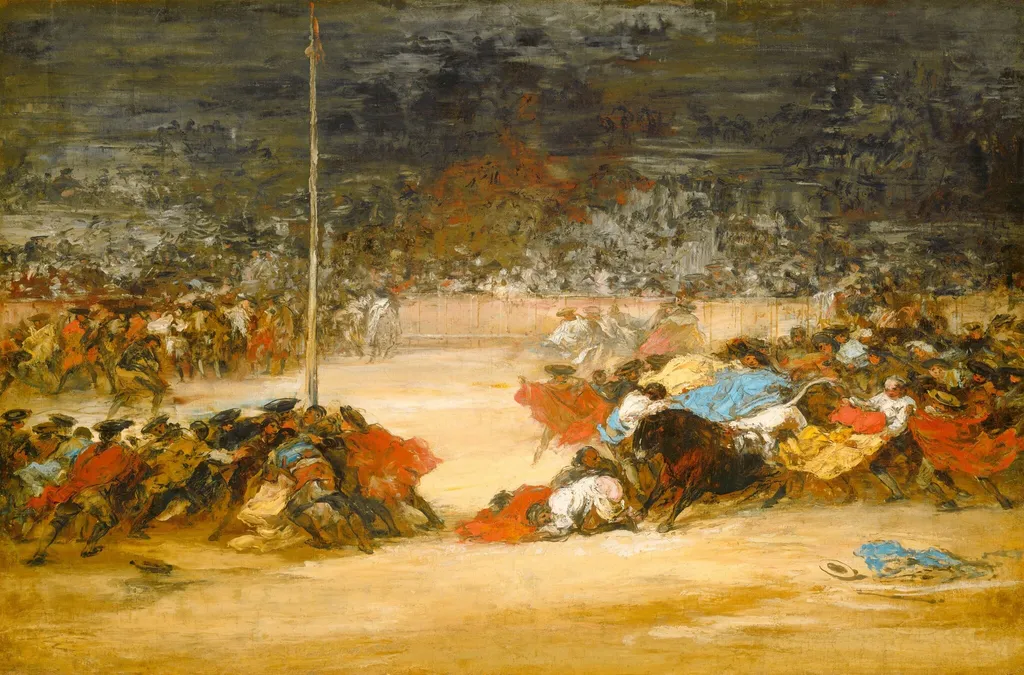
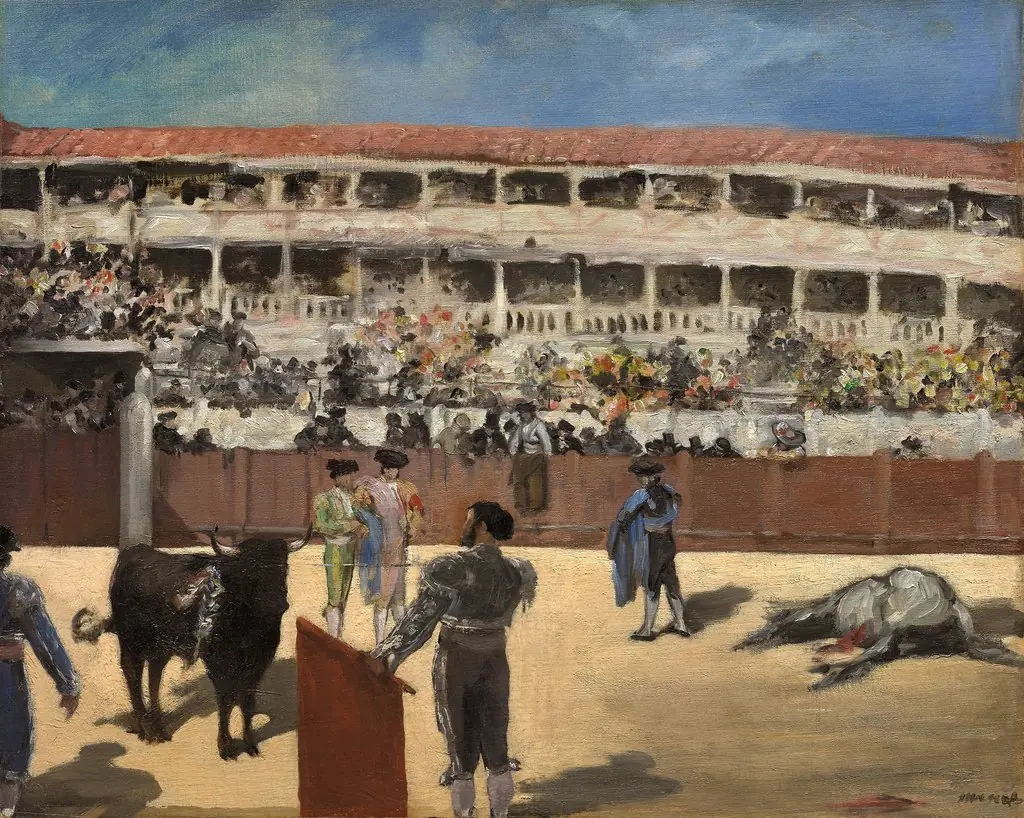
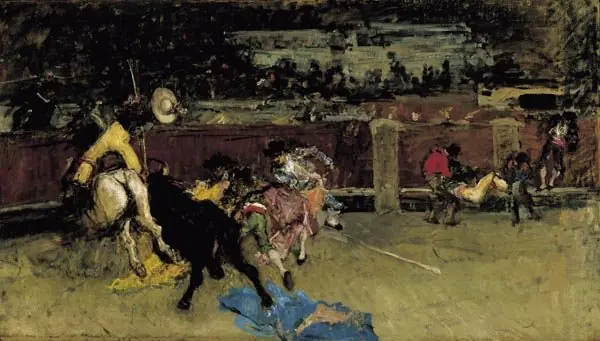
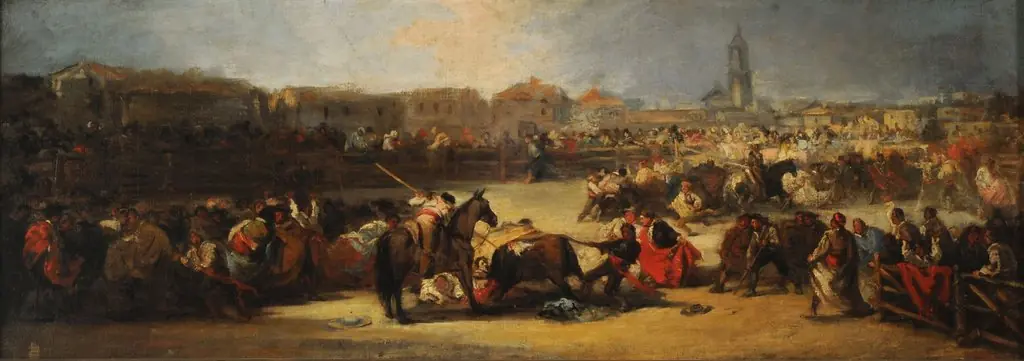
The Bullfight is an oil painting by the Impressionist artist Eugenio Lucas Villamil. It dates from 1895 and is held in the collection of the National Gallery of Art.
About this work
Technique & Style
As an oil-on-canvas work from the late nineteenth century, the painting reflects the medium and support typical of the period's Spanish genre scenes.
Executed in 1895, The Bullfight is an oil painting on canvas. The work measures 73.9 cm in height and 109.9 cm in width, dimensions noted as nearly identical to those of a companion piece in the Oskar Reinhart Collection at Winterthur. As an oil-on-canvas work from the late nineteenth century, the painting reflects the medium and support typical of the period's Spanish genre scenes.
It passed through private Parisian holdings before entering the National Gallery of Art in Washington, D.C., following a 1954 gift.
History & Provenance
Created in 1895, The Bullfight is an oil on canvas painting by Eugenio Lucas Villamil. The work likely entered the Parisian art market through Édouard Kahn, appearing in his sale at the Hôtel Drouot on June 8, 1895, where it was purchased by Goldschmidt. It subsequently belonged to Sigismond Bardac in Paris until his estate sale in 1910.
By 1924, the painting was held by the dealer firm E. Gimpel & Wildenstein before being acquired in 1925 by Baron Maurice de Rothschild of Paris. Arthur Sachs of New York and Cannes owned the work by 1928, eventually gifting it to the National Gallery of Art in Washington, D.C., in 1954.
Context
The Bullfight is an oil on canvas painting created in 1895 by Eugenio Lucas Villamil. Its provenance traces from Édouard Kahn in Paris, who sold it at the Hôtel Drouot on 8 June 1895, through Sigismond Bardac, the firm E. Gimpel & Wildenstein, and Baron Maurice de Rothschild, to Arthur Sachs by 1928. Sachs lent it to a 1928 exhibition of Spanish paintings at The Metropolitan Museum of Art in New York before gifting it to the National Gallery of Art in 1954, where it remains part of the collection in Washington, D.C.
Legacy
The painting's history rests on its provenance and exhibition record. After its 1895 sale it passed through several notable collections, including those of Baron Maurice de Rothschild by 1924 and Arthur Sachs by 1928. Sachs lent the work to a 1928 exhibition of Spanish paintings at The Metropolitan Museum of Art in New York.
It later entered the collection of the National Gallery of Art in Washington, D.C., where it remains. Its attribution to Eugenio Lucas Villamil has been supported by comparison with a companion piece in the Oskar Reinhart Collection at Winterthur.
Overview
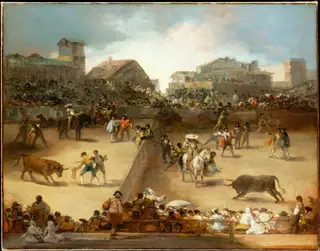
Eugenio Lucas Villamil’s oil on canvas, The Bullfight, dates to around 1895. Executed in a relatively large format, the work captures a bustling arena where spectators crowd a sandy ring, a solitary pole rising at its centre. The composition conveys the kinetic energy of a public spectacle, rendered with the loose brushwork typical of its era.
Subject & Meaning
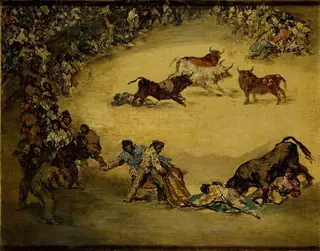
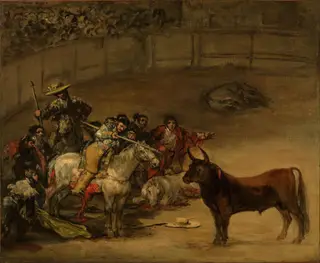
The scene depicts a chaotic bullfight, with figures in motion, some fleeing, others collapsing, while a handful of participants don vivid capes that flash against the muted surroundings. The dense audience encircles the arena, suggesting a collective fascination with danger and drama, and the overall atmosphere feels charged and urgent.
Own this work as a print
Artist & collection