Artwork
Bullfight in a Divided Ring
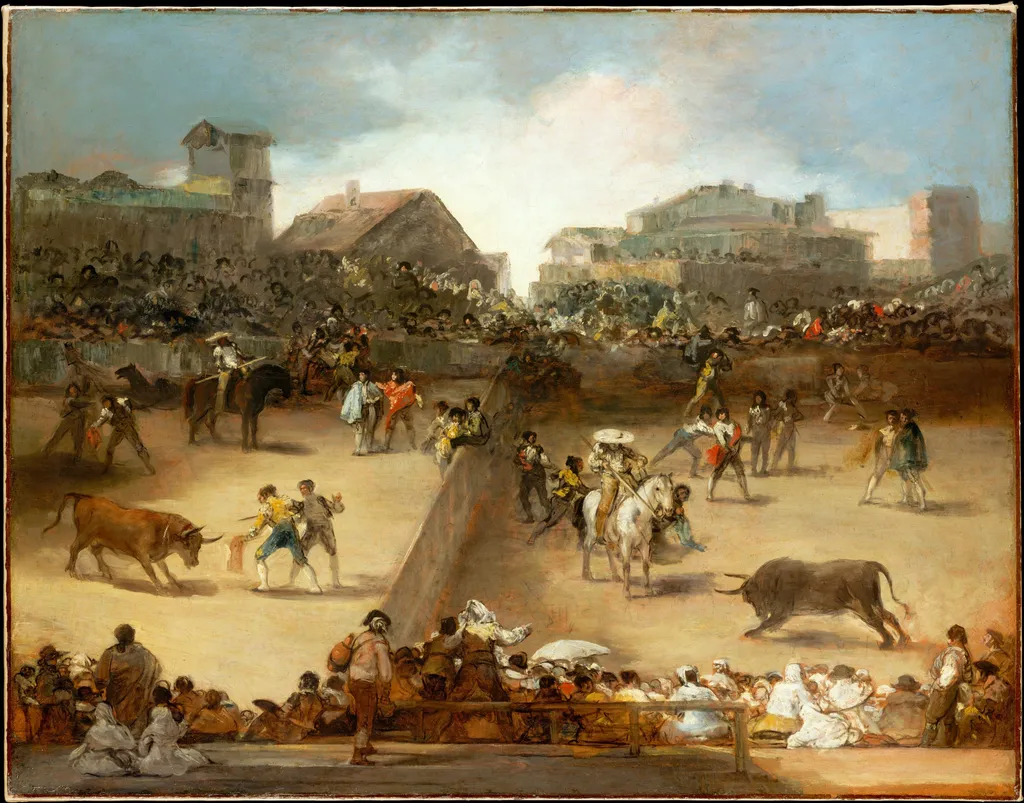
Bullfight in a Divided Ring is an oil painting by Francisco de Goya. It dates from 1816 and is held in the collection of the Metropolitan Museum of Art.
About this work
Subject & Meaning
One scholar, Julian Gallego, has proposed that Goya inserted himself into the crowd in the left foreground, wearing a flat hat and overcoat [].
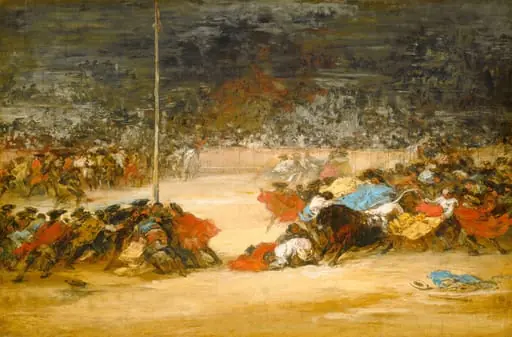
Bullfight in a Divided Ring depicts a bullfighting scene in which the ring is partitioned by a barrier, separating the action into two zones: on one side a picador awaits the bull's charge, while on the other two toreros prepare to deliver the killing blow []. The composition includes a bull, horses, spectators, and the sport of bullfighting itself []. Stylistically, Goya stylizes the bulls with crescent-shaped horns, slender curves, and tense necks, while the crowd is rendered as an agitated, revolutionary mass spilling toward the arena, contrasting sharply with the orderly tiers seen in his earlier tauromaquia scenes [].
Painted during Spain's War of Independence, when bullfighting had been reinstated by Joseph Bonaparte to ease tensions, the work is read as a metaphor for national division: the divided ring mirrors a country torn between guerrilleros and afrancesados, and the rough, non-professional toreros and picadors resemble the irregular fighters of the civil conflict []. One scholar, Julian Gallego, has proposed that Goya inserted himself into the crowd in the left foreground, wearing a flat hat and overcoat [].
Technique & Style
Painted in oil on canvas, Bullfight in a Divided Ring measures 98.4 × 126.4 cm and belongs to Goya’s second bullfighting period (1810–1815). The composition employs a broad, dynamic handling to render the crowd and action, with the foreground figures articulated through vigorous, almost sketch-like brushwork that heightens the scene’s raw energy. Goya’s stylization of the bull emphasizes grace and elegance, depicting its neck and horns with flowing, curvilinear contours that contrast with the angular, tense postures of the human figures.
The divided arena structure organizes the space into opposing zones of action, isolating the picador’s stance on one side and the matadors’ preparations on the other, while the densely packed spectators form a swirling mass that presses against the barriers. The palette is earthy and restrained, punctuated by flashes of red and white costume details, reinforcing the charged atmosphere of popular spectacle and latent violence.
History & Provenance
Bullfight in a Divided Ring is an oil-on-canvas painting attributed to Francisco Goya, with its creation date varying across sources between 1810, 1812, and 1816. The work belongs to Goya's second bullfighting period (1810–1815), a phase influenced by the Spanish War of Independence and the subsequent authorization of bullfights by Joseph Bonaparte in 1808. While the Metropolitan Museum of Art currently lists the piece as attributed to the artist, earlier scholarship by Jeanine Baticle (1986) and Alvaro Martinez-Novillo (1988) treated it as a major Goya work, and Robert Bérard (2003) specifically dated it to 1812.
The painting's composition and handling of the crowd are cited by the museum as worthy of Goya himself, despite a historical context of numerous copies made in his style since the mid-19th century. The artist later reused the imagery for a lithograph in his Bordeaux series.
Legacy
The painting is recognized as Goya's largest bullfighting work and served as a direct inspiration for his later lithograph 'The Divided Arena,' part of the 'Bulls of Bordeaux' series. Art historians situate the canvas within the artist's second bullfighting period (1810–1815), linking its chaotic atmosphere and depiction of irregular fighters to the turmoil of the Peninsular War. Scholars such as Ramón Gómez de la Serna have analyzed the work's legacy through its portrayal of a desperate, revolutionary crowd and stylized animals, distinguishing it from Goya's earlier, more formal depictions of the sport.
Although the Metropolitan Museum of Art currently lists the piece as attributed to Goya due to the prevalence of nineteenth-century copies, prominent experts including Jeanine Baticle, Alvaro Martinez-Novillo, and Robert Bérard have maintained its status as a major authentic work, praising its compositional richness and handling of the foreground figures.
Overview
This oil painting, titled "Bullfight in a Divided Ring," captures a dynamic outdoor spectacle. The composition centers on a bustling arena filled with spectators observing a chaotic event. The artist employs oil paint to render a scene of intense activity, drawing the viewer into the heart of the action unfolding within the divided space.
Own this work as a print
Artist & collection
Artist
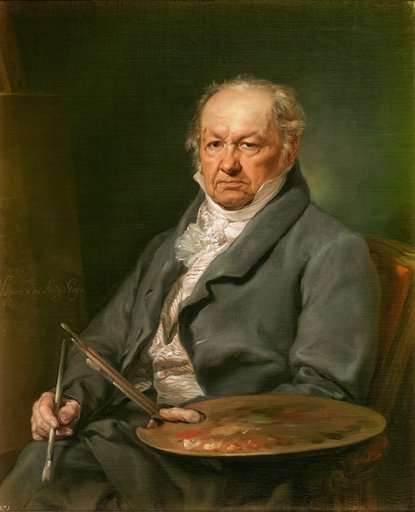
Francisco José de Goya y Lucientes was a Spanish romantic painter and printmaker.

- The Bullfight
 The Bullfight
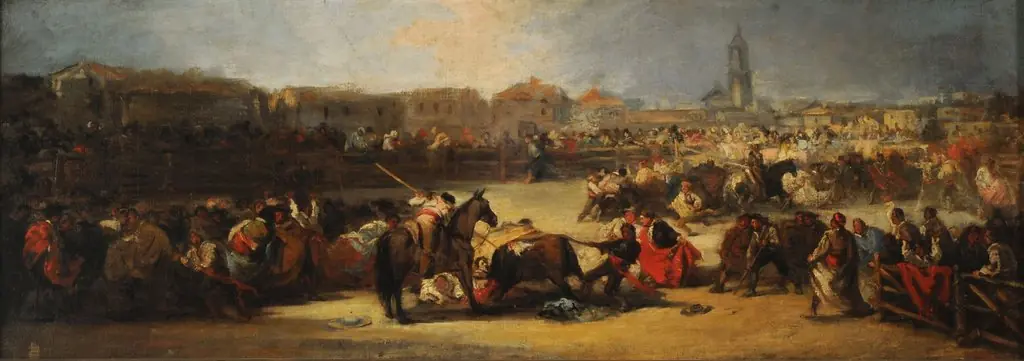 Bullfight in a village
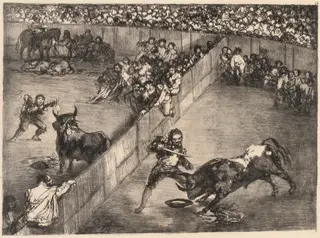 Bullfight in a Divided Ring
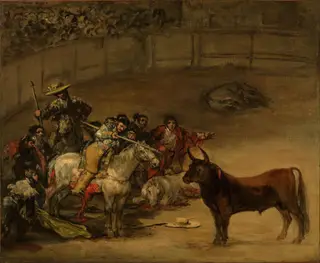 Bullfight, Suerte de Varas
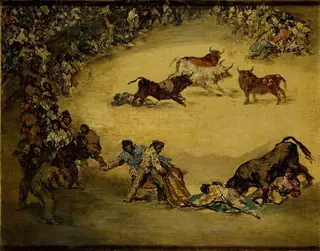 Scene at a Bullfight: Diversión de España
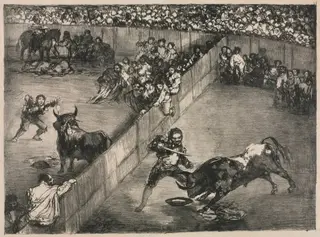 The Bulls of Bordeaux: Bullfight in a Divided Ring
 Bullfight
 Bullfight. Wounded Picador
 Bullfights: The Same Ceballos Mounted on Another Bull Breaks Short Spears in the Ring at Madrid