Artwork
Scene in a Courtyard
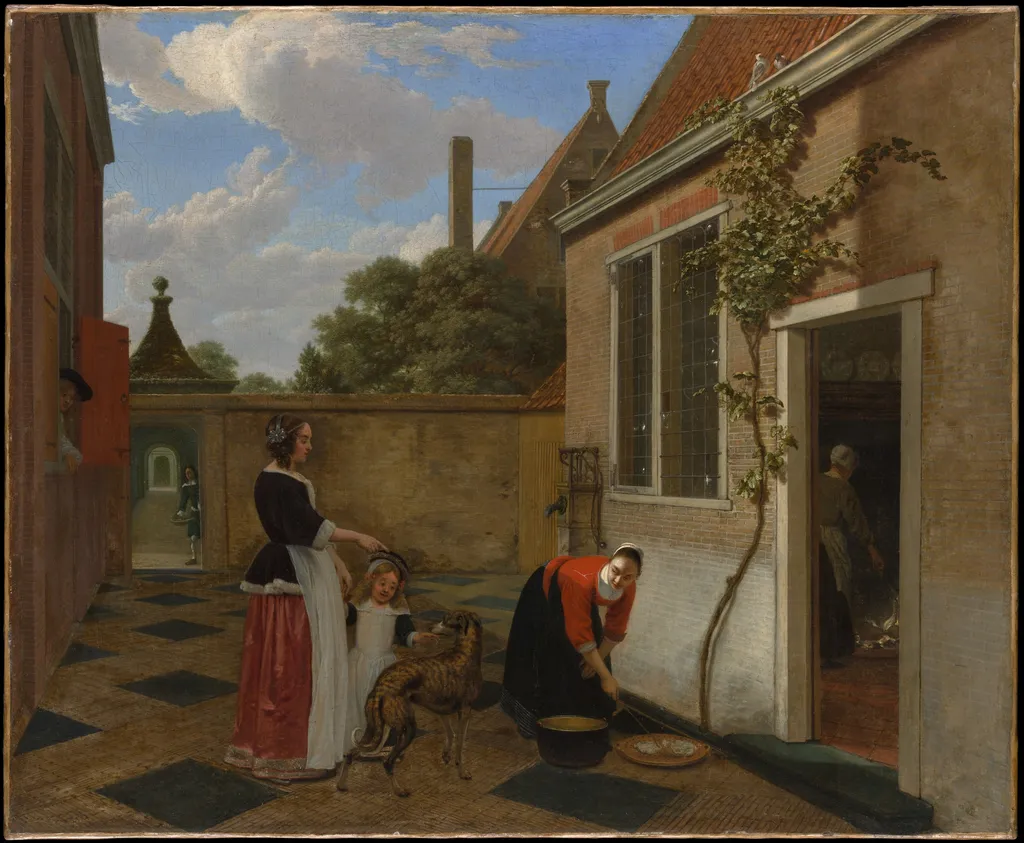
Scene in a Courtyard is an oil painting by the Dutch Golden Age artist Ludolf de Jongh. It dates from 1660 and is held in the collection of the Metropolitan Museum of Art.
About this work
Subject & Meaning
The painting depicts an interior courtyard scene featuring a young girl and an adult woman alongside a dog, framed by the architecture of a house.
The painting depicts an interior courtyard scene featuring a young girl and an adult woman alongside a dog, framed by the architecture of a house. The arrangement emphasizes domestic life in a prosperous Dutch setting, with the figures’ attire and the orderly space suggesting themes of household virtue and social propriety. The presence of the dog may symbolize fidelity or protection within the home environment.
These elements collectively reflect the seventeenth-century Dutch interest in celebrating everyday life and moral values through carefully observed genre scenes.
History & Provenance
The painting Scene in a Courtyard was created by the Dutch artist Ludolf de Jongh in 1660. Executed in oil paint on canvas, the work measures 67.3 centimeters in height and 82.2 centimeters in width. It depicts a domestic setting featuring a house, a courtyard, a girl, a woman, and a dog.
While the specific commissioning patron and the detailed chain of ownership prior to its current location are not detailed in the provided records, the work is firmly dated to the mid-17th century. The piece is currently held in the collection of the Metropolitan Museum of Art, where it is classified as a genre scene. The creation date of 1660 places the work within the later period of de Jongh's career, reflecting the artistic conventions of Dutch genre painting during that era.
Overview
Painted in 1660, Ludolf de Jongh's Scene in a Courtyard is a genre work depicting a domestic moment within a paved Dutch courtyard. The composition centers on four female figures and a dog arranged across a patterned stone floor. One woman, dressed in red and black, holds the hand of a small child, while another figure in bright red kneels to feed a dog from a bowl.
A third woman stands observing from a doorway, and a fourth figure is partially visible, peering from an adjacent hallway. De Jongh, a prominent Dutch Golden Age painter known for his detailed interior and exterior scenes, utilizes this setting to explore themes of daily life and social interaction. The work exemplifies his skill in rendering textures, from the rough stone of the courtyard to the varied fabrics of the clothing, and his ability to capture candid, unposed moments.
Created during the height of his career, the painting reflects the 17th-century Dutch interest in realistic depictions of the middle class and their domestic environments, emphasizing quiet narrative over dramatic action.
Technique & Style
The artist meticulously applied oil paint to achieve a lifelike representation. Particular attention was paid to the effects of light and shadow, which define forms and create a sense of depth throughout the composition. Detailed brushwork is evident in the rendering of textiles, capturing the folds of the women's dresses, and in the texture of the dog's fur, enhancing the painting's tactile quality.
Own this work as a print
Artist & collection

Artist
Ludolf de Jongh or Ludolf Leendertsz. de Jongh (Overschie, 1616 – Hillegersberg, 1679) was a Dutch painter, known for his genre scenes, hunting scenes, history paintings, landscapes, cityscapes, and portraits. He was…

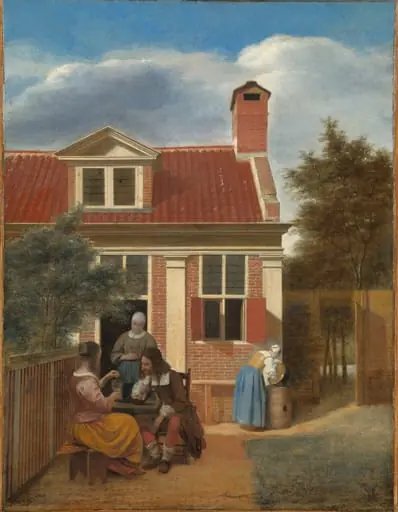 Een gezelschap op de plaats achter een huis
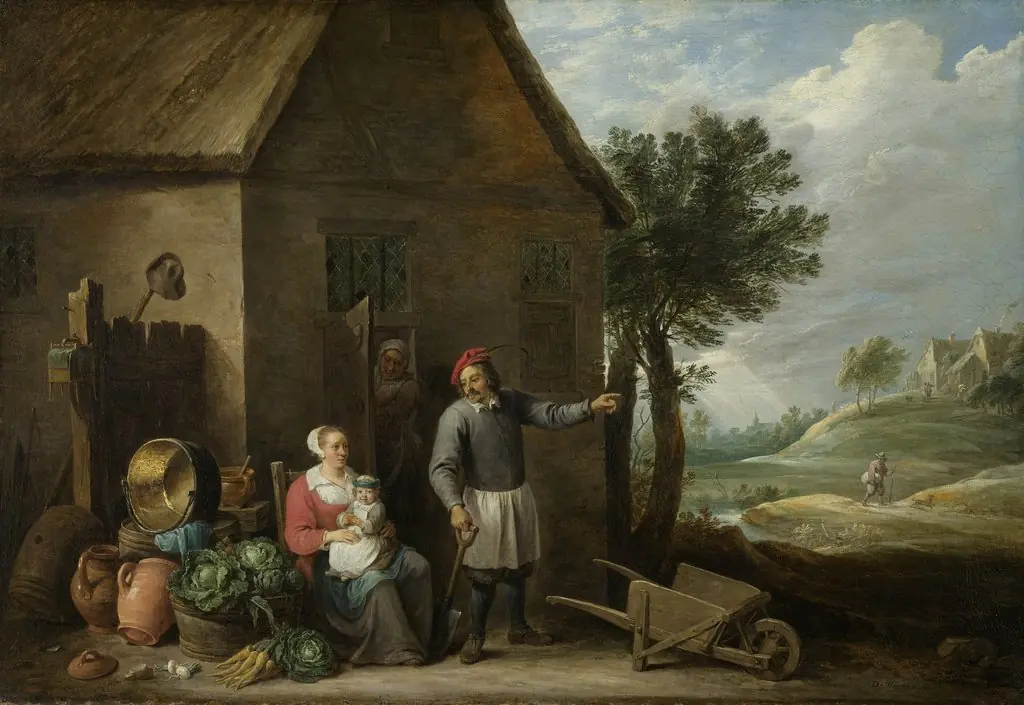 A peasant with his wife and child in front of the farmhouse
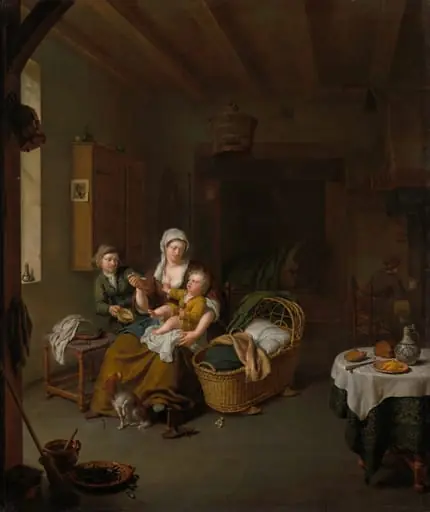 A Mother Feeding her Child (The Happy Mother)
 Inner Courtyard
 A Party of Peasants
 A Kitchen
 Nursing Mother, and Child with Serving Maid
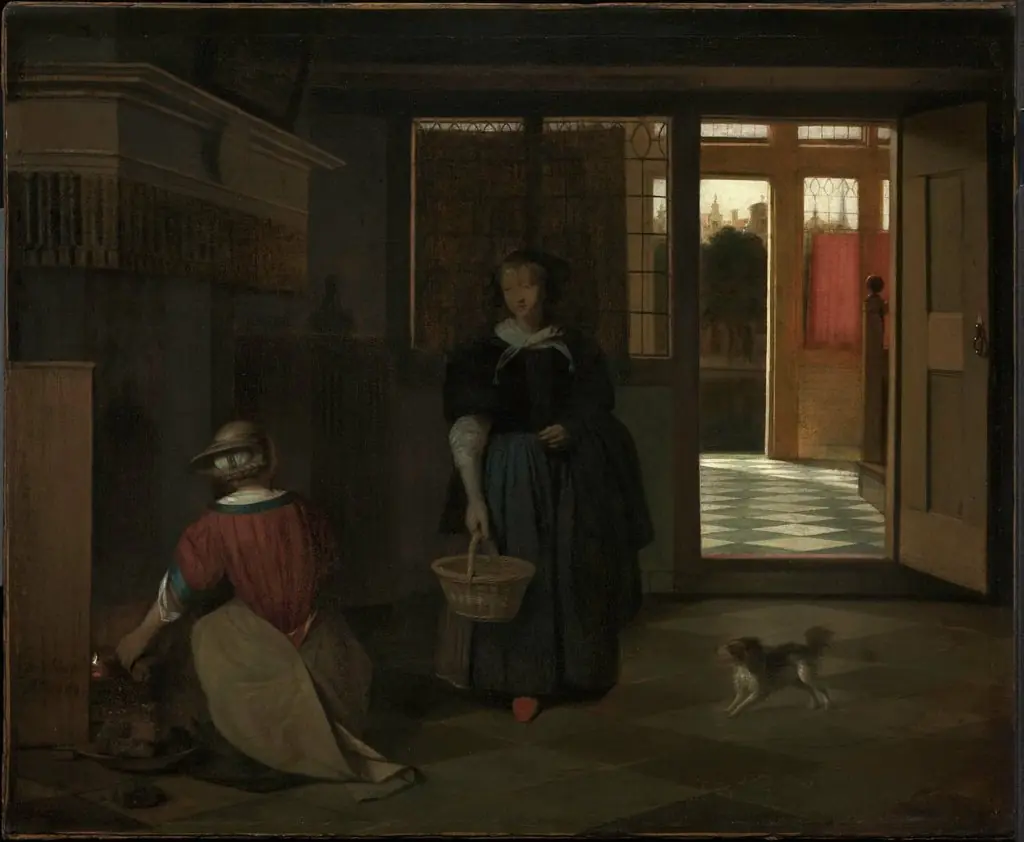 Interior of a Dutch house with a woman kneeling by a fire conversing with a woman standing
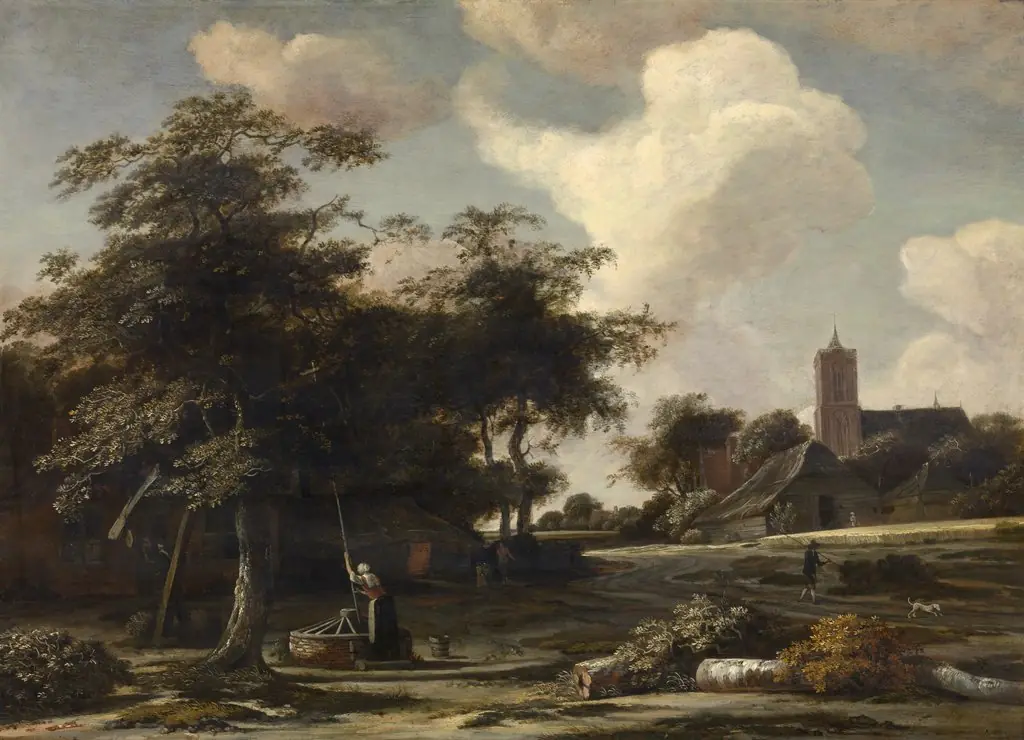 Landscape