Artwork
Figures in a Courtyard behind a House
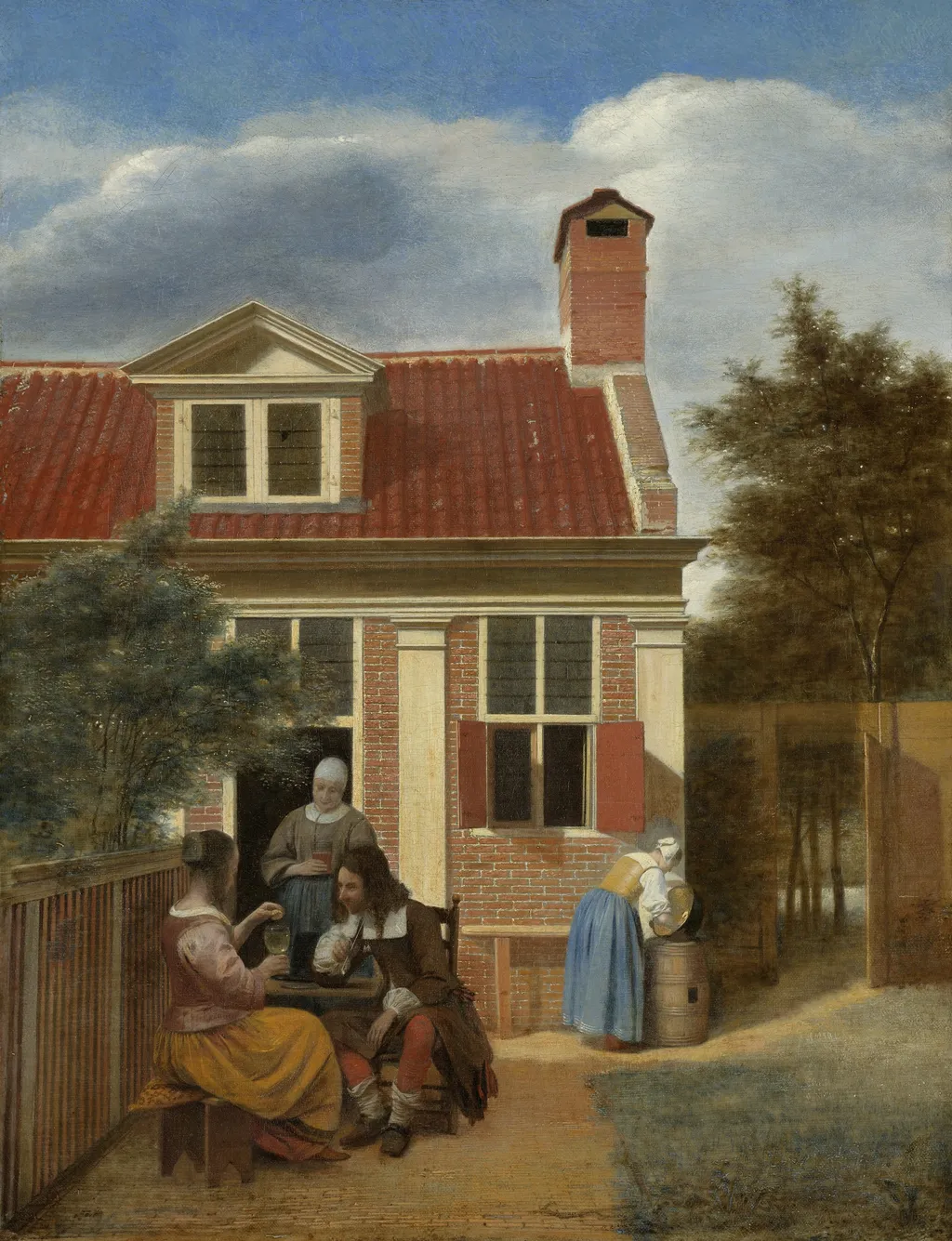
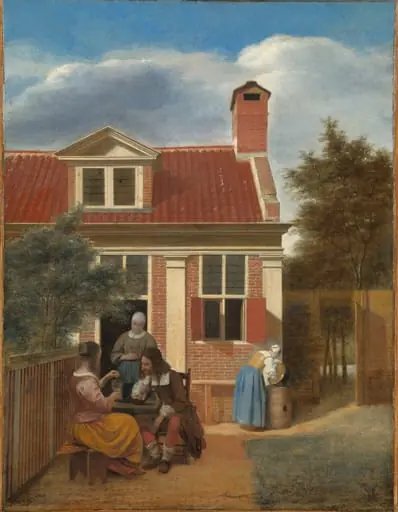
Figures in a Courtyard behind a House is an oil painting by the Dutch Golden Age artist Pieter de Hooch. It dates from 1663 and is held in the collection of the Rijksmuseum.
About this work
Subject & Meaning
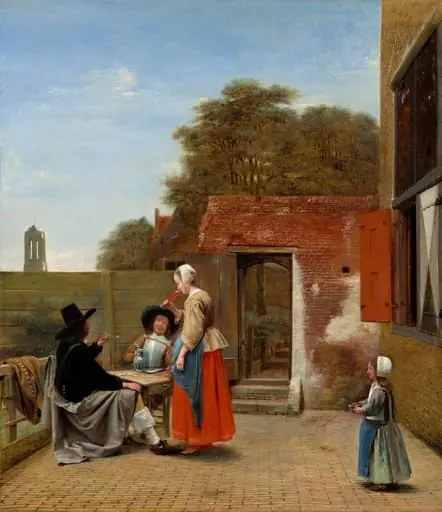
The painting depicts a domestic interior scene in a private courtyard behind a house, showing a man and woman seated at a table where the woman squeezes a lemon into a glass of wine while the man holds a pipe, observed by an older woman carrying a glass of beer and a servant cleaning a brass pot; the composition includes a red-roofed house, white pilasters, a hedge, and trees, reflecting everyday middle-class life in the Dutch Golden Age and emphasizing quiet intimacy and domestic order
Technique & Style
The palette remains restrained and cool, with silvery greys and soft ochres modulating the sunlit masonry and shadowed areas.
Executed in oil on canvas in 1663, the work measures 60 cm in height and 45.7 cm in width. De Hooch’s handling emphasizes controlled, evenly diffused daylight that models the small brick house with white pilasters and the figures with quiet precision, while a geometric composition organizes the courtyard space through receding planes and planar alignments.
The palette remains restrained and cool, with silvery greys and soft ochres modulating the sunlit masonry and shadowed areas. Figures are rendered with smooth transitions, capturing the texture of satin and linen without overt impasto, and the scene’s measured recession is underscored by the carefully observed orthogonal joints of the brickwork and the alignment of the wooden fence and garden door.
History & Provenance
Pieter de Hooch executed this oil-on-canvas work in 1663, shortly after relocating from Delft to Amsterdam. The painting bears the signature "P D HOOG" on a bank to the left. In the nineteenth century, the dealer Chaplin imported the piece into England, where it entered the O'Niel collection by 1832.
In 1834, the banker and collector Adriaan van der Hoop acquired the work for 2,600 guilders. Upon his death in 1854, Van der Hoop bequeathed his extensive collection to the city of Amsterdam. Initially displayed in the dedicated Museum Van der Hoop, the painting was transferred on loan to the Rijksmuseum in 1885, where it remains part of the Amsterdam Museum's holdings.
The painting is part of the collection of the Amsterdam Museum, having been bequeathed to the city of Amsterdam by Adriaan van der Hoop upon his death in 1854. It was previously housed in the dedicated Museum Van der Hoop until 1885, after which the collection was transferred on loan to the Rijksmuseum in Amsterdam, where the work is currently displayed in the Gallery of Honour. In the 1903 Rijksmuseum catalogue, the piece was recorded as number 1251, having formerly been number 686.
Prior to entering the Van der Hoop collection in 1842, the artwork was documented in the O'Niel collection in 1832 and had been imported into England by the dealer Chaplin. The work was also described in 1910 by Cornelis Hofstede de Groot in his catalogue raisonné.
Context
Created around 1663-1665, *Figures in a Courtyard behind a House* is recognized as a significant example of Dutch Golden Age genre painting. Art historian Cornelis Hofstede de Groot cataloged the work in 1910, describing it as a fine early piece characterized by brilliant afternoon sunshine. Scholarly analysis places the painting within the artist's transition from Delft to Amsterdam, noting its clear, cool palette and geometric composition as typical of this period. The work demonstrates Pieter de Hooch's engagement with contemporaries like Gerard ter Borch, particularly in the depiction of a woman viewed from behind and the specific motif of squeezing a lemon into wine. These elements reflect broader seventeenth-century cultural interpretations regarding love and restraint. The painting is currently displayed in the Rijksmuseum's main gallery as part of the Adriaan van der Hoop bequest.
Legacy
The painting has been recognized as a key example of Dutch Golden Age domestic genre scenes, influencing later interpretations of interior and courtyard space in European art. Its compositional strategies, particularly the use of open architectural settings to frame intimate human interactions, have been cited in scholarly studies of 17th-century visual narrative. The work's provenance through Adriaan van der Hoop's collection and its bequest to the Rijksmuseum have contributed to its prominence in museum displays of Dutch painting. Documentation by Hofstede de Groot in 1910 and subsequent references in major publications have reinforced its documented legacy.
Own this work as a print
Artist & collection
Artist
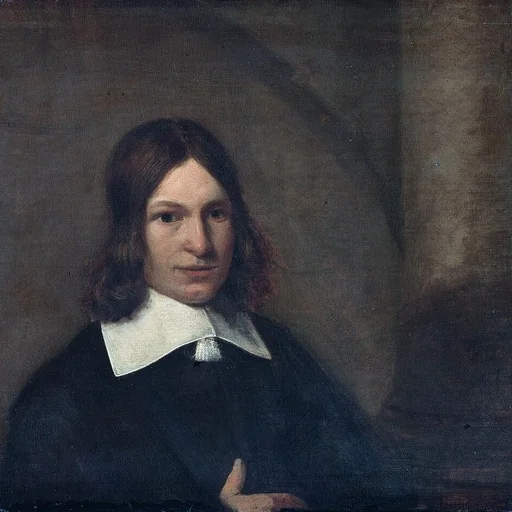
Pieter Hendricksz. de Hooch (Dutch:; also spelled Hoogh or Hooghe; bapt. 20 December 1629 – after 1683), was a Dutch Golden Age painter famous for his genre works of quiet domestic scenes with an open doorway. He was a…