Artwork
The Bersaglieri
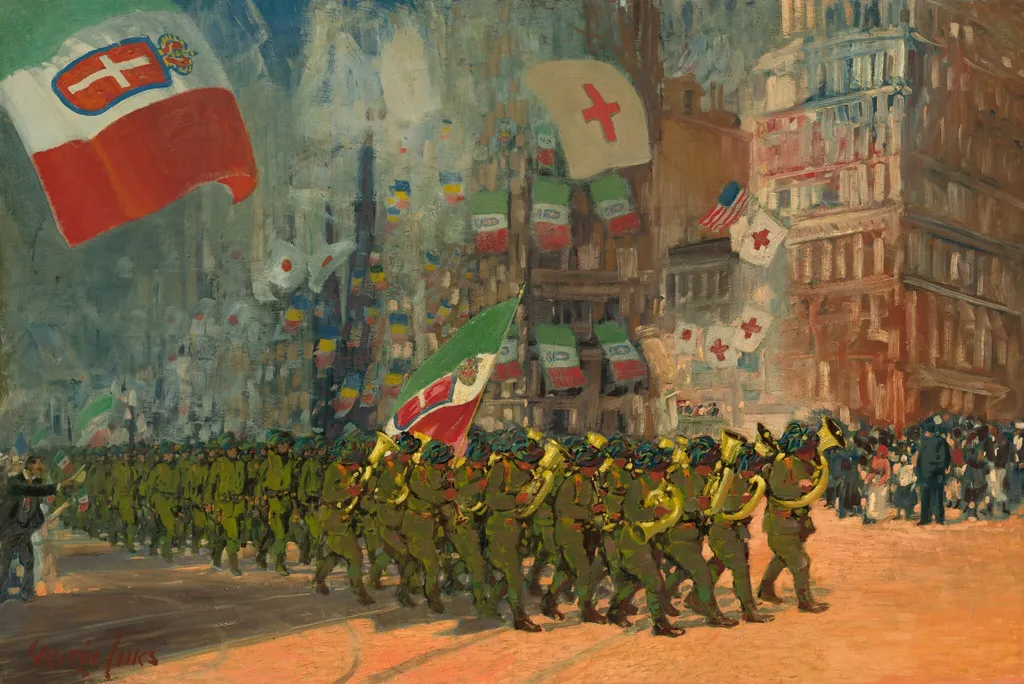
The Bersaglieri is an oil painting by the Realist artist George Luks. It dates from 1918 and is held in the collection of the National Gallery of Art.
- Inscription
- Inscribed:lower left: George Luks
About this work
Technique & Style
Thus the painting’s formal qualities combine a richly layered oil medium with a planar support that contributes to its vibrant, narrative character.
The Bersaglieri is an oil painting executed on canvas. According to the catalog entry, the work is rendered in oil on canvas and measures 101.9 cm in height by 151.5 cm in width, placing it within the typical scale of early twentieth‑century American landscapes. The surface bears the loose, gestural brushwork associated with George Benjamin Luks’s realist approach, while the composition depicts a crowd, a flag and a soldier in a dynamic arrangement.
Thus the painting’s formal qualities combine a richly layered oil medium with a planar support that contributes to its vibrant, narrative character.
History & Provenance
The Bersaglieri was painted by George Benjamin Luks in 1918 in oil on canvas. It initially remained in the artist's possession before being acquired by Arthur F. Egner of South Orange, New Jersey, by 1934, when Egner lent it to the Newark Museum exhibition The Work of George Benjamin Luks. Following Egner's death, the painting entered his estate sale at Parke-Bernet Galleries in New York on 4 May 1945, listed as lot 116.
It subsequently passed through the New York dealers Knoedler and Co. by 1947, during which year it was lent to the Fiftieth Anniversary Exhibition at the Syracuse Museum of Fine Arts. On 16 May 1950, the work was purchased by the National Gallery of Art, where it has remained in the collection since.
The Bersaglieri is held in the collection of the National Gallery of Art in Washington, D.C., having been purchased by the institution on May 16, 1950. Prior to this acquisition, the work passed from the artist to Arthur F. Egner of South Orange, New Jersey, by 1934, and was sold at the Egner estate auction in New York on May 4, 1945. It subsequently entered the stock of Knoedler and Co. by 1947.
The painting's exhibition history includes a 1934 showing at the Newark Museum titled The Work of George Benjamin Luks, where it was lent by Egner. Later, Knoedler lent the piece to the Syracuse Museum of Fine Arts for its Fiftieth Anniversary Exhibition: Paintings by American Artists 1896-1930 in 1947.
Legacy
The Bersaglieri (1918) is part of the National Gallery of Art's collection in Washington, D.C.. It was exhibited in the 1934 Newark Museum exhibition “The Work of George Benjamin Luks” [1]) and later in the 1947 “Fiftieth Anniversary Exhibition: Paintings by American Artists 1896-1930” at the Syracuse Museum of Fine Arts [2]). These showings and its inclusion in a major museum collection have helped shape Luks’s reputation as a central American realist and underscore the painting’s enduring legacy in early twentieth-century American art scholarship.
Overview
“The Bersaglieri” is an oil on canvas painting by George Luks, created in the immediate aftermath of World War I. The artwork presents a lone soldier, distinguished by his dark uniform, standing within a gathered crowd. He grips a flag in one hand and a rifle in the other, positioned centrally in the composition. This piece reflects Luks's characteristic focus on depicting ordinary individuals and the realities of human experience during a pivotal historical period.
Subject & Meaning
The painting centers on a soldier, identifiable by his dark uniform, who stands prominently within a surrounding crowd. His dual grasp of a flag and a rifle imbues the scene with a sense of duty or vigilance. The expressions of the onlookers suggest a collective tension or concentrated attention, reflecting the profound societal shifts and lingering emotions that characterized the period immediately following the First World War.
Own this work as a print
Artist & collection

Artist
George Benjamin Luks (August 13, 1867 – October 29, 1933) was an American artist, identified with the aggressively realistic Ashcan School of American painting.

- Începuturile revoluției ruse la Iași, 1917
 The Flags, Saint Mark's, Venice - Fête Day
 Dedication Page
 Reveille
 Трубачи Первой Конной армии
 Lupta de la Mărășești
 Levy in Mass
 Returning to the Trenches
 The Fair in Csíkszereda
 Untitled
 The Corpus Christi Procession Leaving the Church of Santa Maria del Mar
 Allies Day, May 1917