Artwork
Allies Day, May 1917
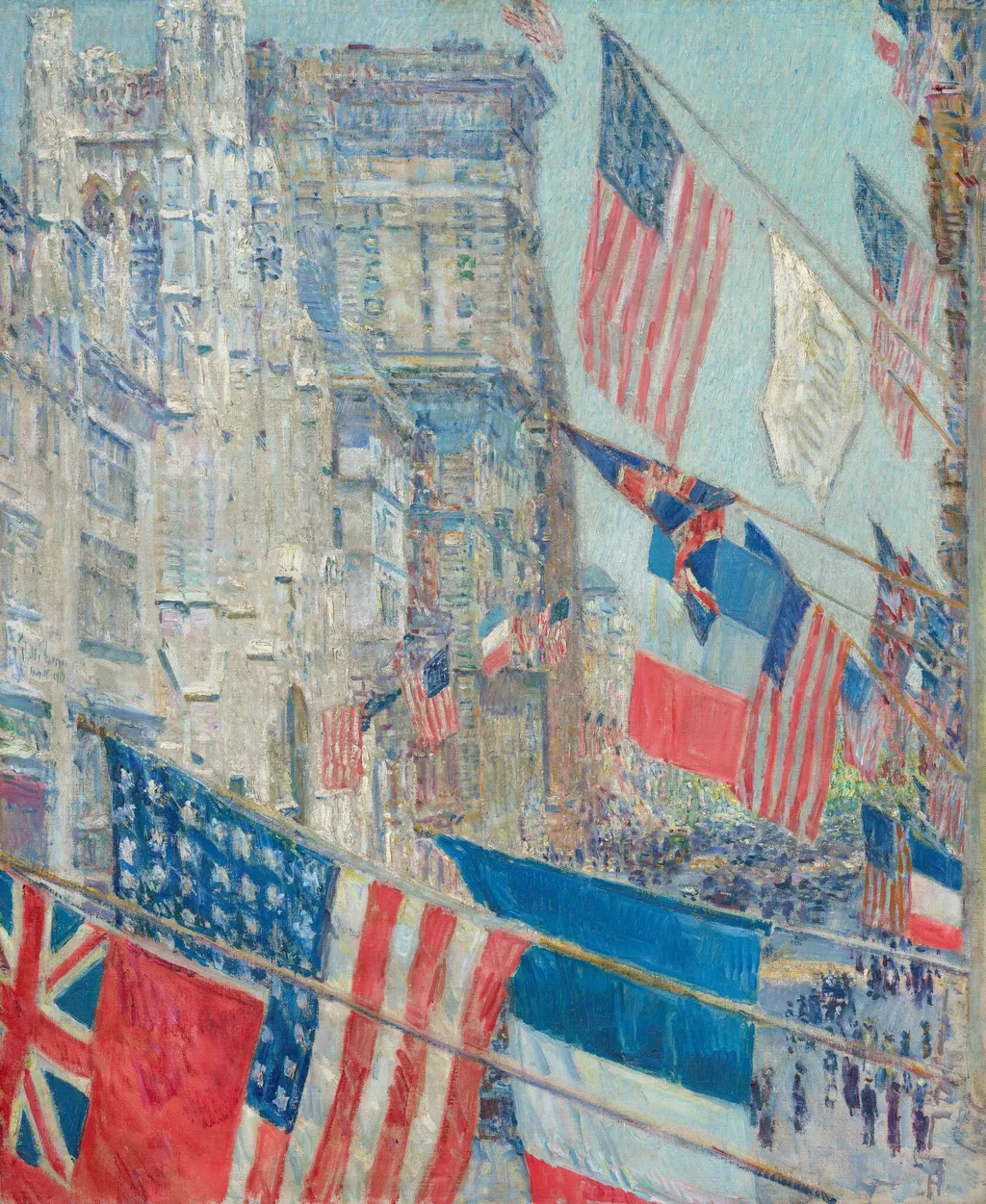
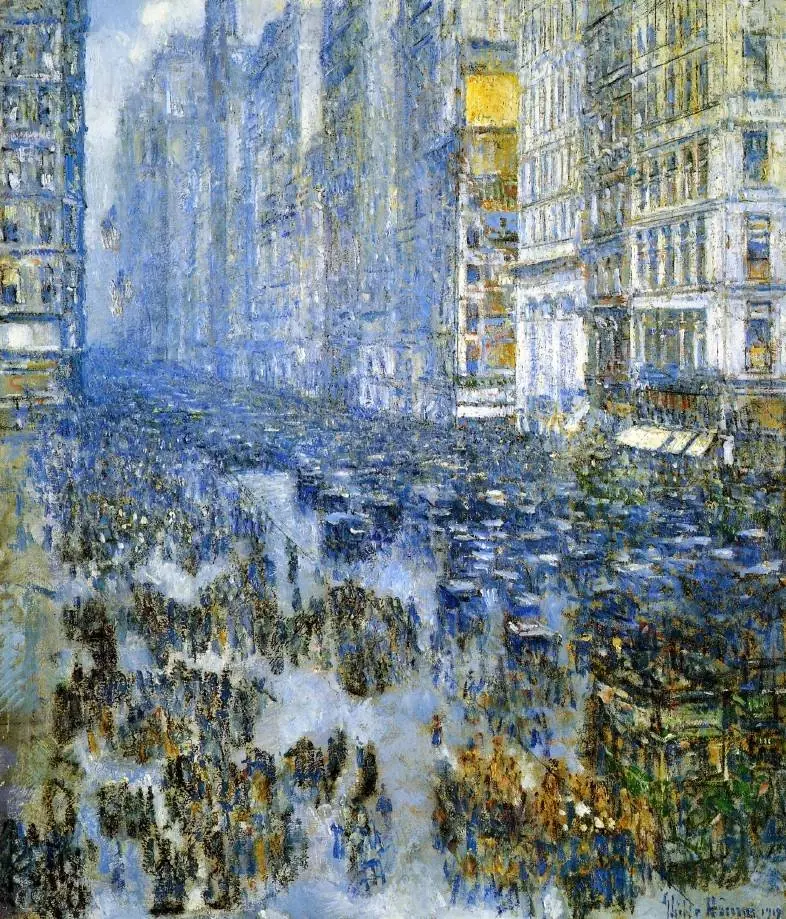
Allies Day, May 1917 is an oil painting by the American Impressionist artist Childe Hassam. It dates from 1917 and is held in the collection of the National Gallery of Art.
- Inscription
- Inscribed:center left: Childe Hassam / May 17 1917; upper left reverse, in monogram: C.H.; upper right reverse: May 1917
About this work
Technique & Style
The flag-draped Fifth Avenue is depicted with a loose, impressionistic touch that conveys the energy of a patriotic parade rather than a static urban view.
Allies Day, May 1917 is an oil painting on canvas executed by Childe Hassam in 1917. The work measures 92.7 cm in height by 76.8 cm in width. Hassam employed a fluid handling of oil paint to render the scene with quick, lively brushwork that captures the movement of flags and foliage.
The composition emphasizes bright, high-key color and crisp contrasts between the white starbursts of the flags and the darker tones of the surrounding architecture. The flag-draped Fifth Avenue is depicted with a loose, impressionistic touch that conveys the energy of a patriotic parade rather than a static urban view.
The canvas support and oil medium are consistent with Hassam’s practice during the World War I period, when he frequently painted urban scenes suffused with nationalistic symbolism.
History & Provenance
Childe Hassam created this oil on canvas in 1917. The work entered the market in 1919 when it was sold through E. & A. Milch, Inc. of New York to Gilbert E. Rubens, who retained ownership until 1930. Following a transaction involving William Macbeth of New York, the painting was sold in December 1930 to Glenn Ford McKinney.
Upon McKinney's death in 1934, his sister, Ethelyn McKinney of Greenwich, Connecticut, acquired the piece. She subsequently donated the artwork to the National Gallery of Art in Washington, D.C., in 1943.
The work is held by the National Gallery of Art in Washington, D.C. Its accession occurred in 1943 as a gift from Ethelyn McKinney, following its passage through several owners including Gilbert E. Rubens, William Macbeth, and Glenn Ford McKinney. The painting was acquired by the National Gallery of Art in 1934 and has been part of its collection since. It has been exhibited in the gallery's presentation of American Impressionism and in thematic shows on World War I-era American art.
The National Gallery of Art (Washington, D.C.) is the institution that currently holds the work under its official collection.
Context
Childe Hassam's Allies Day, May 1917, depicting a parade on Fifth Avenue celebrating the United States' entry into World War I, earned contemporary praise for its vibrant Impressionist technique and patriotic subject matter, reflecting the artist's role in shaping American modernism. Scholarship emphasizes its significance within Hassam's 'Flag Series' and as a visual record of wartime civic celebration, situating the work amid early 20th-century debates about public space and national identity.
The painting's provenance traces a clear path from its 1919 sale through E. & A. Milch, Inc. to Gilbert E. Rubens, then to William Macbeth, and finally to the National Gallery of Art in 1943, illustrating mid-century American art market practices. Its acquisition by the NGA solidified its place in institutional collections, while its formal dimensions of 92.7 cm by 76.8 cm underscore Hassam's scale for public events.
Overview
Allies Day, May 1917 is an oil on canvas painted by American Impressionist Childe Hassam in the spring of 1917. The work captures a bustling Washington, D.C., street awash with the colors of Allied flags during the First World War. Its composition is dominated by the fluttering banners, while the urban backdrop recedes in muted blues and grays.
Subject & Meaning
The painting records a public display of solidarity with the Allied powers, reflecting the United States’ emerging involvement in the conflict. By foregrounding the red, white and blue banners, Hassam emphasizes collective patriotism and the civic atmosphere of wartime celebration, while the barely discernible figures and vehicles suggest a city momentarily subsumed by national sentiment.
Own this work as a print
Artist & collection

Artist
Frederick Childe Hassam (; October 17, 1859 – August 27, 1935) was an American Impressionist painter, noted for his urban and coastal scenes.