Artwork
Siberian Dogs in the Snow
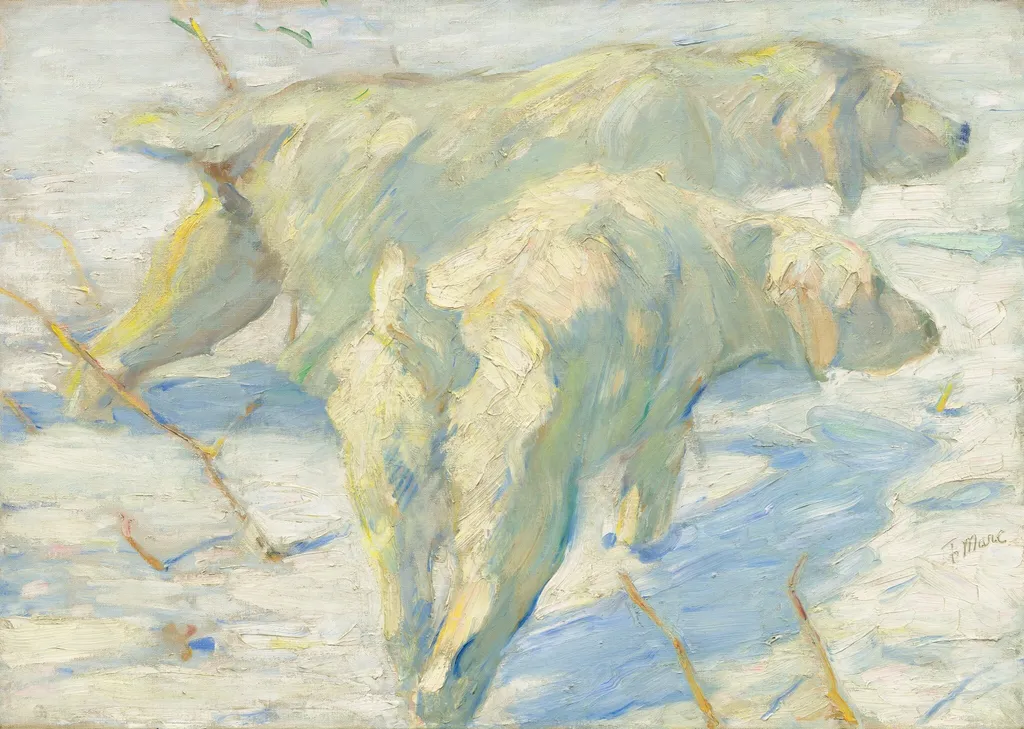
Siberian Dogs in the Snow is an oil painting by Franz Marc. It dates from 1910 and is held in the collection of the National Gallery of Art.
- Inscription
- Inscribed:lower right: F Marc
About this work
Overview
Siberian Dogs in the Snow is an oil on canvas painted by German artist Franz Marc in 1909.
Siberian Dogs in the Snow is an oil on canvas painted by German artist Franz Marc in 1909. Measuring 80.5 by 114 cm, the work depicts two dogs resting in a winter landscape and is executed in the loose, textured brushwork characteristic of Marc's early animal paintings. The painting is held in the collection of the National Gallery of Art in Washington, D.C., where it arrived in 1983 as a gift from Mr. and Mrs. Stephen Kellen. While Marc would later achieve fame for the bold, prismatic color of his Blue Rider period, this painting represents a crucial transitional phase in his career, demonstrating his emerging commitment to animal subjects and his growing departure from naturalistic representation toward a more expressive, symbolically charged approach to form and color.
Subject & Meaning
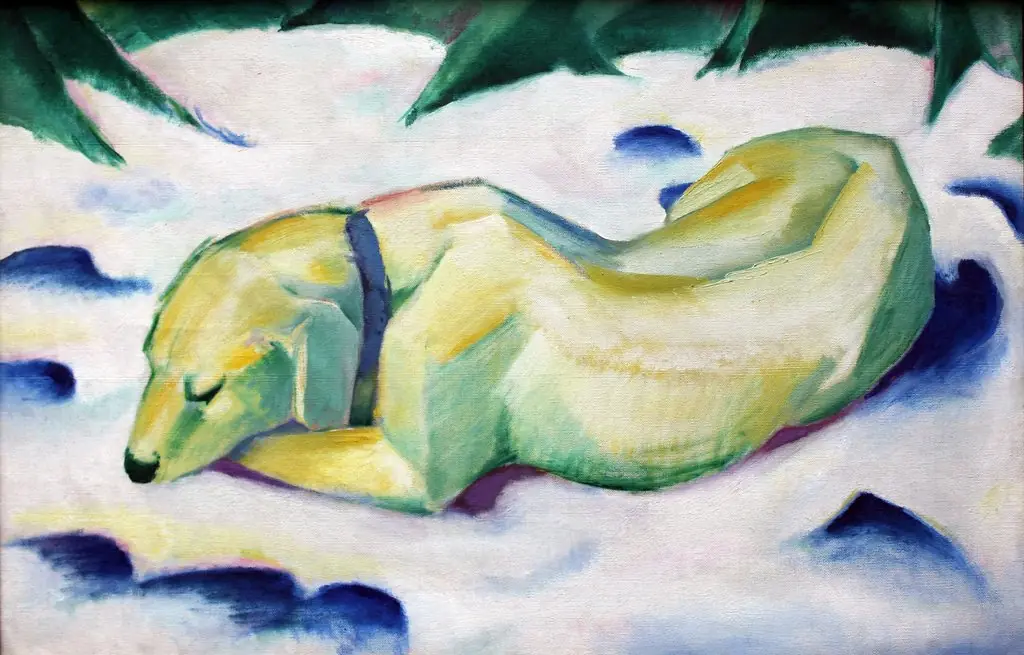
The painting presents two Siberian dogs in a snowy setting. One animal lies curled in the foreground, its body forming a loose spiral with its head tucked near its hindquarters, while the second stretches behind it with body extended toward the upper right and head lowered. Sparse brown and yellow twigs or branches protrude from the snow, providing the only vegetative detail in an otherwise minimal composition. Marc's choice of subject reflects his deep philosophical interest in animals as purer, more authentic beings than humans, a theme that would dominate his entire oeuvre. The dogs are not depicted as domestic pets in a narrative setting but as creatures in harmonious communion with their environment. The cool, diffused light and restrained palette evoke a sense of peaceful isolation rather than harsh winter adversity. The composition centers entirely on the animals with minimal background, focusing attention on their forms and the textured snow surface, suggesting Marc's concern with essential being rather than anecdotal detail.
Technique & Style
The work is executed in oil on canvas with thick, visible brushwork composed of short, directional strokes that build texture across the entire surface. The paint application remains loose and impressionistic, leaving individual marks distinct rather than blending them smoothly. The palette is restrained and cool, dominated by whites, grays, and pale blues, with touches of yellow and green in the fur and subtle warm accents. Blue shadows mark the snow drifts. No strong light source is clearly defined; instead, light seems diffused across the scene. This handling places the painting within a Post-Impressionist framework, with expressive, fluid brushwork that captures the intrinsic connection between the animals and their surroundings. The dogs' forms, though rendered with a certain abstraction, retain a life-like presence. The signature "F Marc" appears in the lower right corner.
History & Provenance
The painting was first handled by Kunshandlung Brakl in Munich, and was acquired around 1910 by Dr. Ludwig Hopf and Alice Goldschmidt Hopf of Aachen, Germany. Dr. Hopf, a respected physicist, was forced to flee Germany in 1939 after losing his position at the University of Aachen under Nazi racial policies. The family relocated to London and shortly thereafter to Dublin, Ireland, where Hopf became a lecturer at Trinity College; he died shortly after this move. His wife Alice eventually returned to London following the death of their daughter Liselore in 1942. The painting remained with the Hopf family, and Alice lent it to an exhibition organized by the Friends of the National Collections of Ireland at the National College of Art, Dublin in 1944. In November 1958, Lea Bondi Jaray of London sold the work to Stephen Kellen of New York; Kellen had seen the painting in London before its Dublin exhibition. The Kellens gave the painting to the National Gallery of Art in 1983, where it bears accession number 1983.97.1. The work has been exhibited extensively, including at the Pasadena Art Museum in 1961, Marlborough Fine Arts in London in 1966, the University Art Museum at Berkeley in 1979, the Lenbachhaus in Munich in 1980 and again in 2005-2006, and in the exhibition "Franz Marc and August Macke, 1909-1914" at the Neue Galerie New York in 2018-2019. From 1991 to 1997, it was on extended loan for use by Justice Anthony Kennedy at the Supreme Court of the United States.
Context
Franz Marc was a central figure in German Expressionism and co-founder of the Blue Rider group, though this painting predates his most radical innovations. Created in 1909, Siberian Dogs in the Snow belongs to a period when Marc was moving away from academic training toward a personal vision of nature and animality. The work has been catalogued as number 79 in Annegret Hoberg and Isabelle Jansen's 2004 complete works of Franz Marc, the authoritative reference for the artist's oil paintings. Critical reception has situated the painting within Marc's early exploration of animal subjects, before he developed the color symbolism that would define his mature style. The painting's presence in major retrospectives, including the 2005-2006 Lenbachhaus exhibition and the 2018-2019 Neue Galerie show, confirms its established place in Marc's corpus. Its inclusion in dog-themed exhibitions such as "Best in Show" at the Bruce Museum and Museum of Fine Arts, Houston in 2006-2007 also testifies to its accessibility and continued public interest.
Legacy
Siberian Dogs in the Snow occupies a significant position as an early statement of Franz Marc's lifelong artistic project: the elevation of animal subjects to vehicles of spiritual and aesthetic meaning. While less visually striking than his later works such as Blue Horse I or Fate of the Animals, this painting demonstrates the foundations of his approach, its presence in the National Gallery of Art ensuring its visibility to American and international audiences. The painting's provenance also embodies the traumatic displacement of European modernism during the Nazi era, passing from a persecuted Jewish family into exile and eventually to an American public collection. Its loan to the Supreme Court of the United States from 1991 to 1997 represents an unusual chapter in its institutional history, bringing Marc's vision into one of the most symbolically charged spaces in American civic life. Today, the work remains an important touchstone for understanding Marc's development and the broader trajectory of German modernism's engagement with nature, animality, and color.
Own this work as a print
Artist & collection

Artist
Franz Moritz Wilhelm Marc (8 February 1880 – 4 March 1916) was a German painter and printmaker, one of the key figures of German Expressionism.