Artwork
Weasels at Play
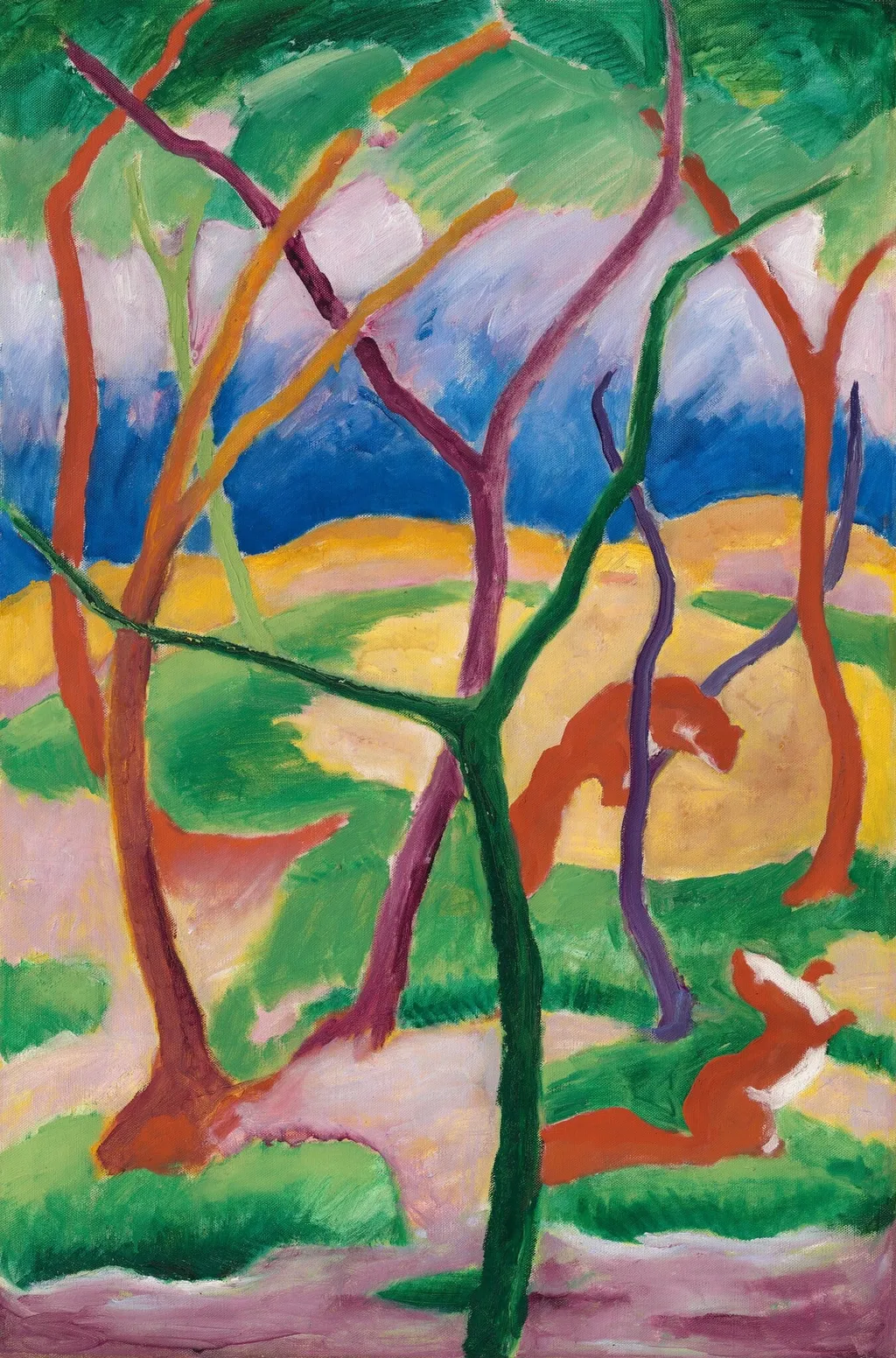
Weasels at Play is an oil painting by Franz Marc. It dates from 1911 and is held in the collection of the National Gallery of Art.
About this work
Overview
, where it is displayed in the East Building Mezzanine, Gallery E217, under accession number 2020.
Weasels at Play is an oil on canvas painted by the German artist Franz Marc in 1911. Measuring 101 x 68 cm (39 3/4 x 26 3/4 in.), the work is now held by the National Gallery of Art in Washington, D.C., where it is displayed in the East Building Mezzanine, Gallery E217, under accession number 2020.112.2. The painting belongs to Marc's celebrated series of animal pictures from the years leading up to World War I, a period in which he sought to transcend naturalistic depiction and express what he regarded as the spiritual essence of animals. As a key figure of German Expressionism and a co-founder of Der Blaue Reiter, Marc used bold, non-naturalistic color and simplified form to invest his animal subjects with symbolic weight, making works such as this central to the development of early modernist abstraction.
Subject & Meaning
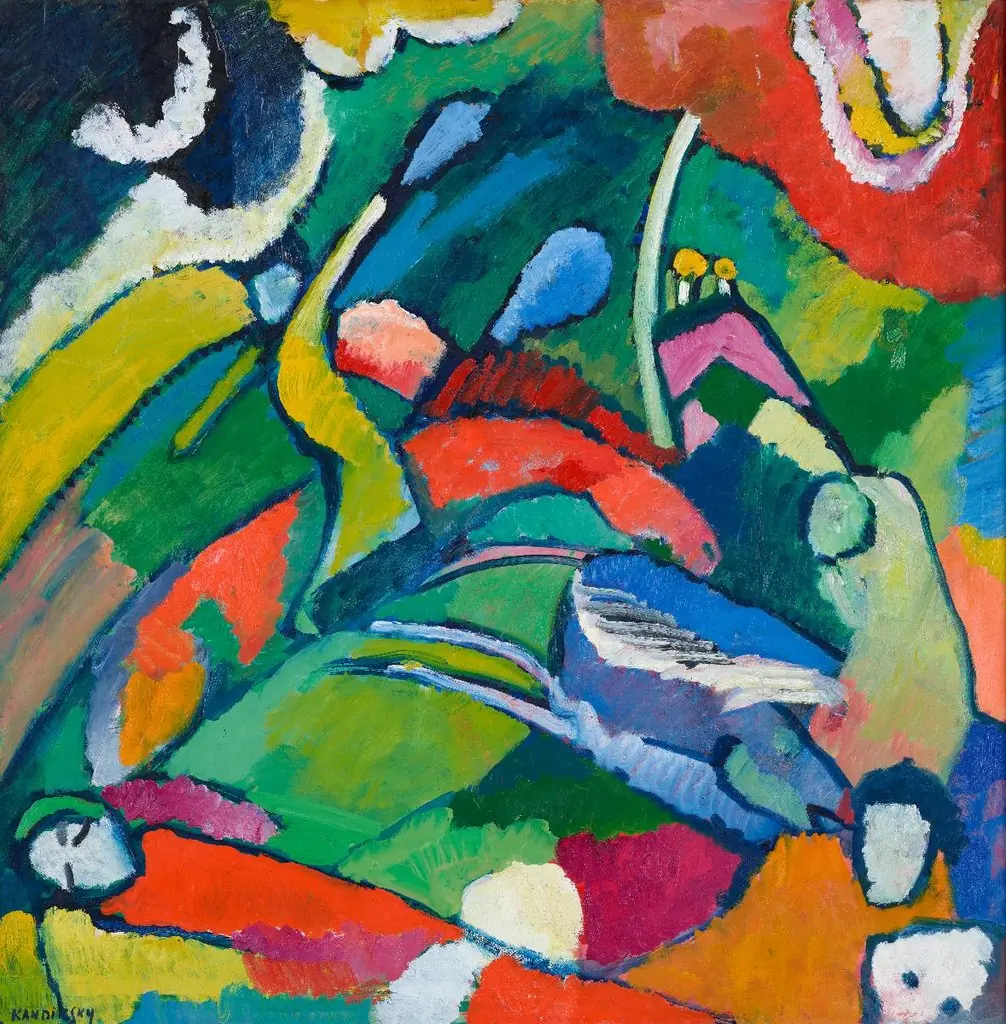
The painting depicts two weasels within a densely wooded landscape. One animal arches upward in the middle ground, while the second sits upright in the lower right. Marc renders the creatures in reddish-orange with white markings, their sinuous forms integrated into a setting of slender, twisting tree trunks that crisscross the vertical picture plane. Rather than pursuing zoological accuracy, Marc treats the weasels as embodiments of vitality and instinctive energy. The background is organized into layered bands of color that suggest hills or distant terrain: green canopy above, blue mountains or sky at center, and yellow-green fields below. This schema reflects Marc's well-documented color symbolism, in which he assigned specific spiritual values to hues. The overall effect is not of observed nature but of a visionary realm in which animal life participates in a higher, harmonious order.
Technique & Style
Executed in oil on canvas, Weasels at Play displays the hallmarks of Marc's mature style. The palette is vivid and deliberately non-naturalistic, combining orange, purple, green, and blue trees against patches of yellow, pink, and green ground. Light is evenly distributed across the surface without strong directional shadows, flattening the pictorial space and emphasizing decorative patterning over illusionistic depth. The brushwork is loose and visible, with broad, flat strokes and unblended color areas that call attention to the canvas texture. Forms are simplified and defined by color relationships rather than by contour lines. These qualities place the painting firmly within the Expressionist movement, while also anticipating later developments in abstract art through their radical departure from conventional representation.
History & Provenance
The painting was first owned by Bernhard Koehler (1882-1964) of Berlin and Munich, who had acquired it by 1936; it remained in his collection until at least 1955. During Koehler's ownership, the work was exhibited at the Galerie Walter Schuler in Berlin in 1947, as part of a show devoted to Franz Marc, Auguste Macke, and Paul A. Seehaus, and subsequently at the Stedelijk Museum in Amsterdam in 1955. It then passed to Berthold von Bohlen and Halbach (1913-1987) of Essen, and later to Leonard Hutton Galleries in New York in 1968. Julian J. Aberbach of New York owned the painting by 1979, the year it was shown at the University Art Museum in Berkeley as part of the exhibition Franz Marc: Pioneer of Spiritual Abstraction. Thomas Gibson Fine Art Ltd. in London handled the work before it entered the collection of Arnold A. Saltzman (1916-2014) and Joan R. Saltzman (1919-2019) of Sands Point, New York. The Saltzmans lent the painting to the National Gallery of Art in 2001-2002 for the exhibition German Expressionist Paintings from the Saltzman Family Collection, and in 2020 they gave it to the museum outright. The work was also included in the 2018-2019 exhibition Franz Marc and August Macke, 1909-1914 at the Neue Galerie New York.
Context
Weasels at Play belongs to the extraordinary burst of creativity that Marc experienced between 1911 and 1914, years in which he produced his most influential animal paintings. During this period, Marc was a leading member of Der Blaue Reiter, the Munich-based group that included Wassily Kandinsky, August Macke, and Gabriele Münter, and that championed an art of spiritual abstraction. Marc's theoretical writings of these years articulated his belief that animals possessed a purity and innocence lost to humanity, and that color could be deployed symbolically rather than descriptively. The painting has been discussed in significant scholarly literature, including Alois Schardt's 1936 monograph F. Marc, Mark Rosenthal's 1989 study Franz Marc, and Annegret Hoberg and Isabelle Jansen's 2004 catalogue raisonné Franz Marc: The Complete Works, Volume 1, The Oil Paintings, where it appears as number 144. Its place in Marc's oeuvre is that of a characteristic, if somewhat less famous, counterpart to iconic works such as Blue Horse I and Fate of the Animals, sharing their ambitions while offering a more intimate, playful tone.
Legacy
Since entering the National Gallery of Art's permanent collection in 2020, Weasels at Play has assumed a more prominent place in public understanding of Franz Marc's achievement. Its earlier exhibition history, particularly the 2018-2019 showing at the Neue Galerie New York, contributed to renewed scholarly and popular interest in Marc's pre-1914 output. The painting's accessibility through the National Gallery of Art's digital platforms, including its publication on Google Arts & Culture, has extended its reach beyond the museum's physical walls. As a work that combines Marc's characteristic color symbolism with an unusually lighthearted subject, it offers a valuable counterpoint to the apocalyptic themes that dominate some of his best-known paintings, and thus enriches understanding of the range within his brief but intensely productive career. Marc was killed in action at Verdun in 1916, making the works of 1911-1914 the full measure of his mature achievement; within this corpus, Weasels at Play stands as a significant, fully realized example of his artistic vision.
Own this work as a print
Artist & collection

Artist
Franz Moritz Wilhelm Marc (8 February 1880 – 4 March 1916) was a German painter and printmaker, one of the key figures of German Expressionism.