Artwork
Sketchbook of Greek, Italian Islands, and Near East Subjects
Sketchbook of Greek, Italian Islands, and Near East Subjects is a watercolor work on paper by Mary Newbold Sargent. It dates from 1904 and is held in the collection of the Metropolitan Museum of Art.
About this work
Overview
Executed in watercolor, graphite, and gouache on toned wove paper, the sketchbook measures 5 5/16 x 8 5/8 inches (13.
The Sketchbook of Greek, Italian Islands, and Near East Subjects is a bound collection of forty-four drawings and watercolors created in 1904 by Mary Newbold Sargent (1826-1906), an American amateur artist and the mother of painter John Singer Sargent. Executed in watercolor, graphite, and gouache on toned wove paper, the sketchbook measures 5 5/16 x 8 5/8 inches (13.5 x 21.9 cm) for its cover, with individual sheets measuring 5 1/2 x 8 3/8 inches (14 x 21.3 cm). The work is held in The Metropolitan Museum of Art's American Wing under accession number 50.130.151, having been gifted to the museum in 1950. This late-life travel document, produced when Sargent was seventy-eight years old, captures Mediterranean and Near Eastern landscapes with an observational directness that reflects both her personal mobility and the broader tradition of American expatriate art-making at the turn of the twentieth century.
Subject & Meaning
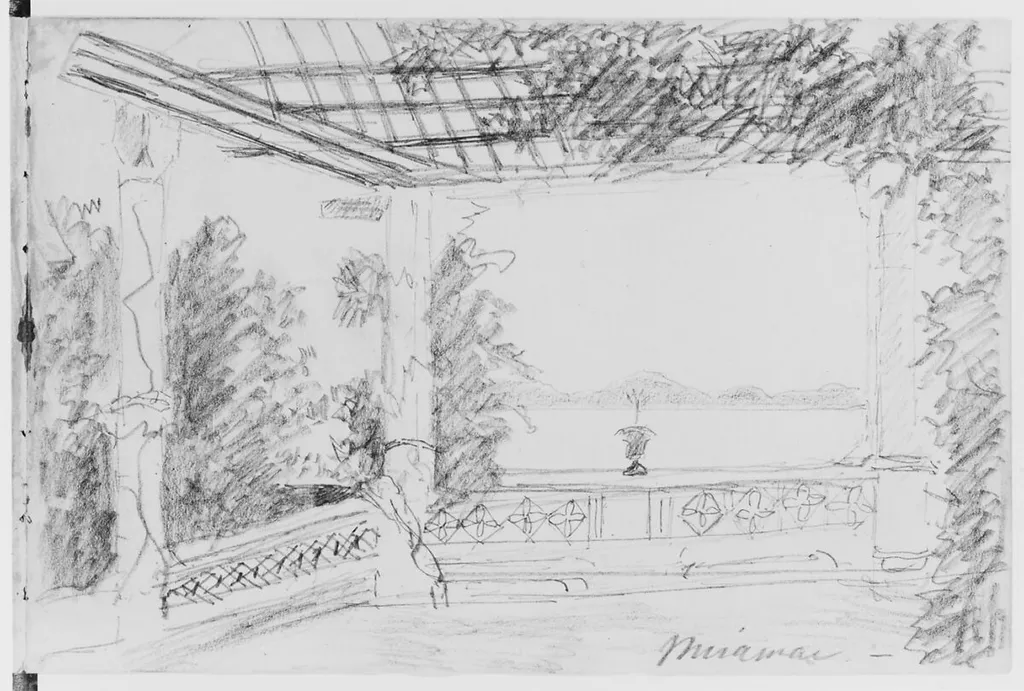
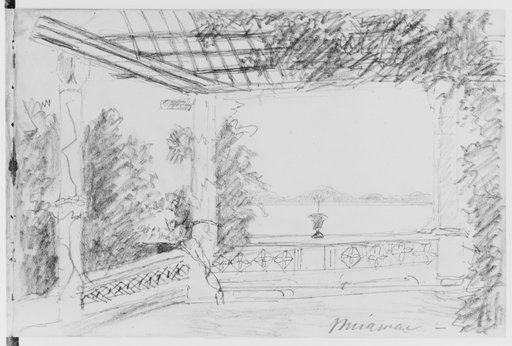
The sketchbook records specific locations encountered during Sargent's 1904 journey through Greece, the Italian islands, and the Near East. Individual sheets bear titles including Salonika, Dulcigno, Corfu, Catene de Cattaro, Gulf of Corinth, and Temple of Minerva, alongside views of Mount Athos monasteries observed from a boat. One graphite drawing depicts a terrace or veranda opening onto distant water, featuring a latticed pergola roof with climbing vegetation, tiled flooring, a bench with diamond-patterned sides, dense foliage, and a balustrade with repeating circular motifs topped by a single urn. Beyond the balustrade, calm water stretches toward hazy, low-lying hills. No human figures appear in this sheet, emphasizing architectural and natural elements over narrative or social observation. The absence of figures and the focus on vernacular architecture and coastal topography suggest an interest in atmospheric place-making rather than documentary or ethnographic aims. The handwritten inscriptions that appear on individual sheets serve as locational markers, transforming the sketchbook into a spatial diary of movement through historically and culturally significant Mediterranean terrain.
Technique & Style
Sargent employed a mixed-media approach combining watercolor, graphite, and gouache on toned wove paper, with the entire collection bound in linen-covered cardboard. The graphite work exhibits loose, rapid strokes with varying pressure, creating tonal contrast between darker vegetative masses and lighter architectural elements and sky. This handling suggests speed and informality, characteristic of travel sketching executed on site rather than in a studio setting. The toned paper support, likely chosen for its mid-value ground, allowed Sargent to work both upward with light gouache and downward with graphite and watercolor to establish form efficiently. The combination of precise architectural notation, as seen in the repeating circular balustrade motifs and diamond-patterned bench sides, with spontaneous vegetative rendering, indicates a practiced eye trained through decades of European museum and site visits. The overall effect is observational rather than composed, prioritizing the immediate recording of visual experience over finished aesthetic resolution. The sketchbook format itself, portable and cumulative, shaped the work's formal qualities, demanding adaptability to changing conditions and subjects.
History & Provenance
Mary Newbold Sargent produced this sketchbook in 1904 during a journey undertaken at age seventy-eight, despite having resided in Cairo since 1881 for health reasons. The work remained in family hands until 1950, when it was gifted to The Metropolitan Museum of Art by Mrs. Francis Ormond, Sargent's granddaughter and the daughter of John Singer Sargent. The museum assigned it accession number 50.130.151. A related sketchbook, Sketchbook of Greek and Near East Subjects (accession number 50.130.150), was donated in the same transaction, suggesting a coordinated family effort to preserve and place Mary Newbold Sargent's late work in an institutional context. The 1950 gift coincided with a period of increasing scholarly and curatorial attention to American art produced abroad, though the work itself has not been the subject of extensive independent exhibition history beyond its inclusion in the museum's permanent collection displays. The Met's Open Access policy now makes images of the sketchbook available for unrestricted use.
Context
Mary Newbold Sargent occupied a distinctive position within nineteenth-century American expatriate culture. Born Mary Newbold Singer in Philadelphia in 1826, she married Dr. FitzWilliam Sargent in 1850 and subsequently lived a nomadic life across Europe, France, Germany, Italy, and Switzerland, following the death of her first daughter in 1853. This peripatetic existence shaped her children's upbringing, her son John Singer Sargent was born in Florence in 1856, Emily in Rome in 1857, and Violet in Florence in 1870, within an environment saturated with art and cultural tourism. Though largely self-taught, Sargent fostered creative practice within her family, supplying young John with sketchbooks and copying illustrations alongside him. Her 1870 Switzerland sketchbook includes a profile portrait of her by her son, documenting their shared artistic activity. The 1904 sketchbook thus represents both a personal late-life achievement and the continuation of a family culture of graphic recording that spanned decades and generations. Critical reception of her work has been modest but appreciative, with scholarly attention focusing primarily on her role as matriarch and enabler of John Singer Sargent's career rather than as an independent practitioner. The preservation of her sketchbooks at The Metropolitan Museum of Art, however, has allowed for reassessment of her own artistic output.
Legacy
The Sketchbook of Greek, Italian Islands, and Near East Subjects endures as a material testament to the mobility and perceptual curiosity of an elderly woman artist at the turn of the twentieth century. Its forty-four drawings and watercolors, produced during a period when many contemporaries would have limited their activities, demonstrate sustained engagement with travel and visual documentation. The work's placement in The Metropolitan Museum of Art's American Wing, alongside pages from the related Sketchbook of Greek and Near East Subjects, ensures its accessibility to researchers interested in American art abroad, women's travel practices, and the informal graphic arts of the period. As public-domain images, the sketchbook pages circulate beyond institutional walls, occasionally appearing in digital repositories and image databases. The sketchbook's cultural afterlife is inseparable from the Sargent family legacy, its preservation reflecting the continued cultural capital of the Sargent name even as it offers evidence of Mary Newbold Sargent's own practice. For historians of American art, it provides rare documentation of a woman's independent travel and recording in the eastern Mediterranean at a moment when such journeys were becoming increasingly codified as male professional activities. The work invites further scholarly attention to the relationship between amateur practice, family artistic culture, and the institutional frameworks that have determined which objects enter museum collections and under what conditions.
Artist & collection
Artist
Mary Newbold Sargent filled linen-bound sketchbooks with watercolor and graphite scenes from Greece and nearby islands like Hydra and Mykonos, plus stops along the Near East coast.

- Landscape
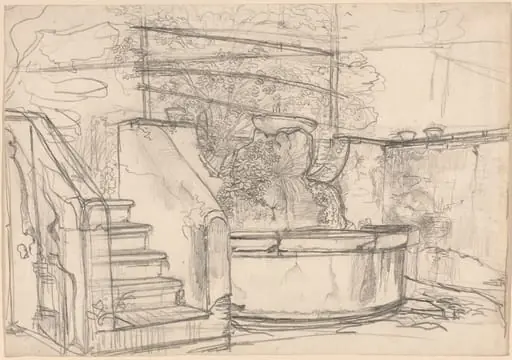 Corner of a Garden Court
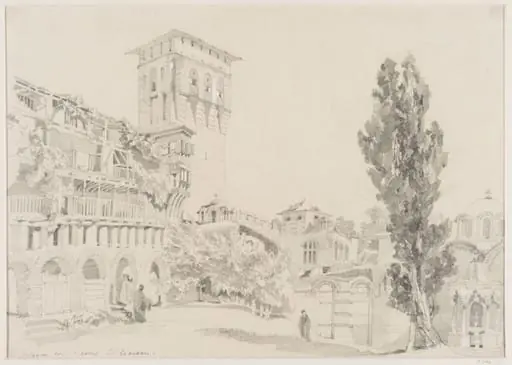 Bulgarian Convent called Chiliandari
![The Ripetta in Rome [verso], by Augustin Pajou](https://artifactworldgallery.com/img/augustin-pajou--the-ripetta-in-rome-verso--4bc04e9c9476a91b-w320.webp) The Ripetta in Rome [verso]
The Ripetta in Rome [verso]![A Terrace and Garden on Capri [recto], by François-Édouard Bertin](https://artifactworldgallery.com/img/francois-edouard-bertin--a-terrace-and-garden-on-capri-recto--8bd3839591b56d81-w320.webp) A Terrace and Garden on Capri [recto]
A Terrace and Garden on Capri [recto] Fan design
 The Zhengjiao Chanlin Buddhist Temple, a part of the A-Ma Temple in Macau
 A Terraced Garden by a Villa
 Haven
Haven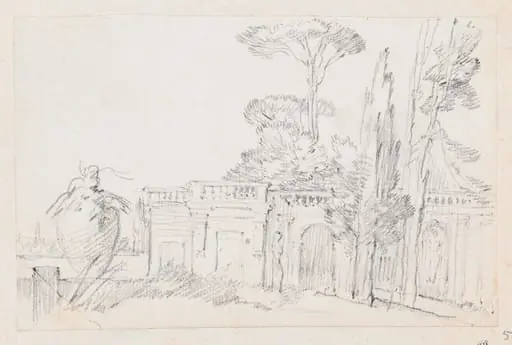 Gardens of an Italian Villa
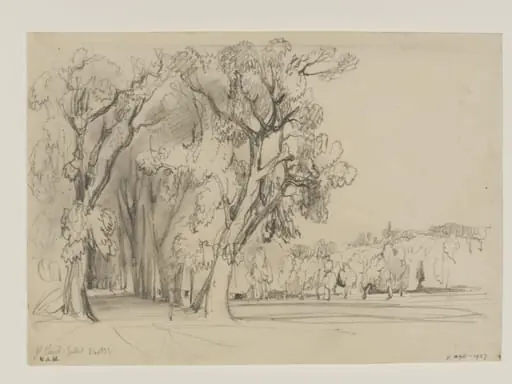 Drawing of St. Cloud
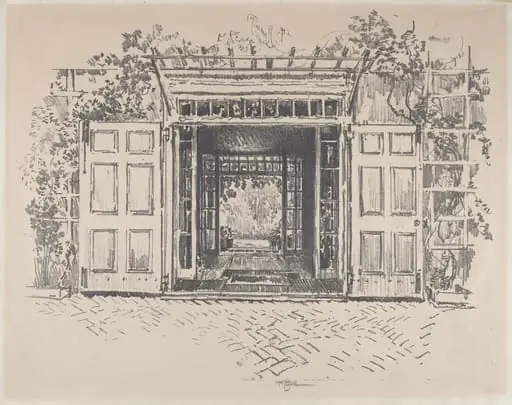 Doorway, Wyck