Artwork
The Harvesters
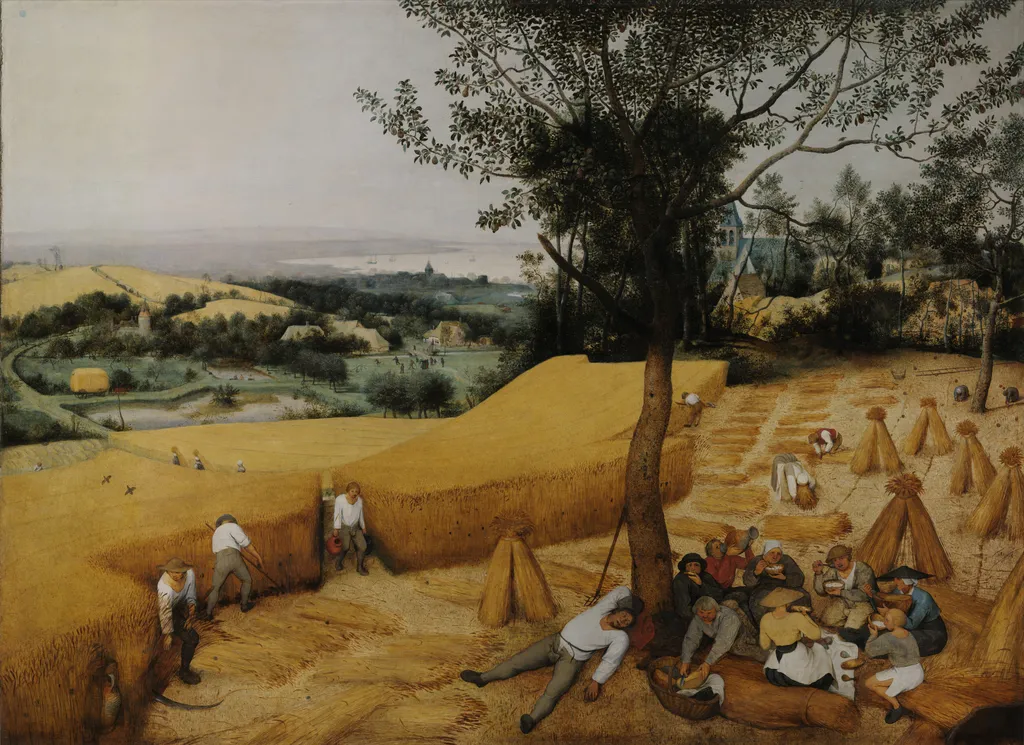
The Harvesters is an oil painting by the Northern Renaissance artist Pieter Brueghel I. It dates from 1565 and is held in the collection of the Metropolitan Museum of Art.
About this work
Under a pear tree, peasants share bread and porridge while one companion sleeps slumped against the trunk. Pieter Bruegel the Elder painted the scene in 1565 for the Antwerp merchant Niclaes Jongelinck, part of a six-panel cycle following the seasons. Now at the Met, it catches the heavy heat of late summer in golden fields and drowsy laborers.
Technique & Style
Stylistically, it belongs to the genre scene category, depicting peasants harvesting wheat in a detailed, naturalistic manner.
The Harvesters is painted in oil on a panel support, a typical substrate for Northern Renaissance panel paintings. The work, dated 1565, measures 116.5 by 159.5 centimeters. Stylistically, it belongs to the genre scene category, depicting peasants harvesting wheat in a detailed, naturalistic manner.
Bruegel’s handling is characterized by precise brushwork and a panoramic composition with a high horizon, emphasizing both human activity and the expansive landscape. The color palette employs warm earth tones, consistent with the late summer setting. No specific condition information is provided in the sources.
History & Provenance
The Harvesters was painted in 1565 by Pieter Bruegel the Elder. It is part of a series depicting the labors of the months and is held in the collection of the Metropolitan Museum of Art in New York. No commission information is provided in the available sources, and the documented creation history extends only to the artist and date.
Overview
Pieter Bruegel the Elder's 1565 oil on wood panel, The Harvesters, captures the essence of late summer. This work is one of six commissioned pieces illustrating the changing seasons throughout the year. It portrays the demanding labor and brief respite of peasants during the July and August harvest, set within a broad, sun-drenched landscape. The painting offers a detailed glimpse into rural life during the Netherlandish Renaissance.
Subject & Meaning
The painting vividly portrays the intense heat and demanding work of the harvest season. In the foreground, weary laborers gather under a pear tree, sharing a simple meal of bread and porridge, while one figure rests, slumped against the trunk. Beyond them, fields of golden wheat stretch into the distance, where other peasants continue their arduous tasks. Bruegel emphasizes the physical toll of agricultural life, contrasting it with moments of communal sustenance and rest.
Own this work as a print
Artist & collection

Artist
Pieter Bruegel (also Brueghel or Breughel) the Elder ( BROY-gəl, US also BROO-gəl; Dutch: ; c.