Artwork
The Virgin Annunciate [middle right panel]
![The Virgin Annunciate [middle right panel], by Cosimo Tura, oil, 1475](https://artifactworldgallery.com/img/cosimo-tura--the-virgin-annunciate-middle-right-panel--9eeab22c5567995d-w1024.webp)
The Virgin Annunciate [middle right panel] is an oil painting by the Early Renaissance artist Cosimo Tura. It dates from 1475 and is held in the collection of the National Gallery of Art. This painting, titled The Virgin Annunciate, is a tempera and distemper work on panel created by the artist Cosmè Tura around 1475.
About this work
Subject & Meaning
The panel depicts the Virgin Mary at the moment of the Annunciation, the central event in which the Archangel Gabriel announces to her that she will conceive and bear Jesus Christ. As part of an Annunciation composition, the image captures Mary's response to the divine message, a subject drawn from the Gospel of Luke that became one of the most frequently represented scenes in late medieval and Renaissance devotional art.
The narrow format and religious genre classification indicate that the panel functioned as a wing within a larger altarpiece ensemble, presenting Mary as a model of humility, purity, and receptive faith. Her solitary, contemplative figure embodies the theological idea of the Incarnation taking place through her willing acceptance, a meaning central to Marian iconography in fifteenth-century Italian painting.
History & Provenance
The painting entered the modern market through the Cook family collection at Doughty House, Richmond, Surrey, where it is recorded by 1888.
The Virgin Annunciate (middle right panel) by Cosmè Tura is dated to circa 1475, based on stylistic and technical analysis associated with the artist's mature period.
The painting entered the modern market through the Cook family collection at Doughty House, Richmond, Surrey, where it is recorded by 1888. It descended from Sir Francis Cook (d. 1901) to his son Sir Frederick Lucas Cook, then to Sir Herbert Frederick Cook, and finally to Sir Francis Ferdinand Maurice Cook, who sold it in February 1947 to the Francis A. Drey firm. Drey brokered its transfer the same year to the Samuel H. Kress Foundation, which donated it to the National Gallery of Art, Washington, D.C., in 1952, where it is held as part of the Samuel H. Kress Collection.
Overview
This painting, titled The Virgin Annunciate, is a tempera and distemper work on panel created by the artist Cosmè Tura around 1475. It forms part of a larger depiction of the Annunciation, specifically representing the Virgin Mary's reception of the angelic message. The panel showcases Tura's approach to religious narrative through a focused portrayal of a key moment in Christian iconography.
Technique & Style
Tura utilized tempera and distemper on panel, a common technique during the 15th century, allowing for precise detail and vibrant color. The rendering of the Virgin's attire, with its worn appearance and simple gold necklace, suggests an attention to textural realism within the devotional context. The blue background further isolates the figure, drawing focus to her expression and posture, characteristic of the artist's refined execution.
Artist & collection
Artist
Cosmè Tura (Italian pronunciation:; c. 1430 – 1495), also known as Il Cosmè or Cosimo Tura, was an Italian early-Renaissance (or Quattrocento) painter and considered one of the founders of the School of Ferrara. He…

![Saint Francis [far left panel], by Cosimo Tura](https://artifactworldgallery.com/img/cosimo-tura--saint-francis-far-left-panel--3b890eb4471ebc8a-w320.webp)
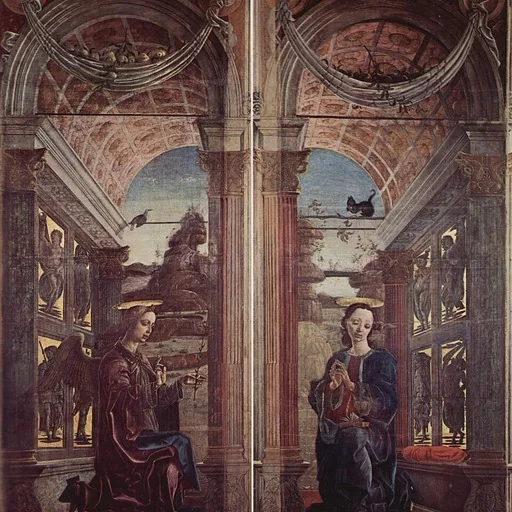
![The Annunciation with Saint Francis and Saint Louis of Toulouse [four panels], by Cosimo Tura](https://artifactworldgallery.com/img/cosimo-tura--the-annunciation-with-saint-francis-and-saint-louis-of-toulo--b6fe2fe99644e8d8-w320.webp)
![The Archangel Gabriel [middle left panel], by Cosimo Tura](https://artifactworldgallery.com/img/cosimo-tura--the-archangel-gabriel-middle-left-panel--c900f72d54477be2-w320.webp)