Artwork
Joseph of Egypt
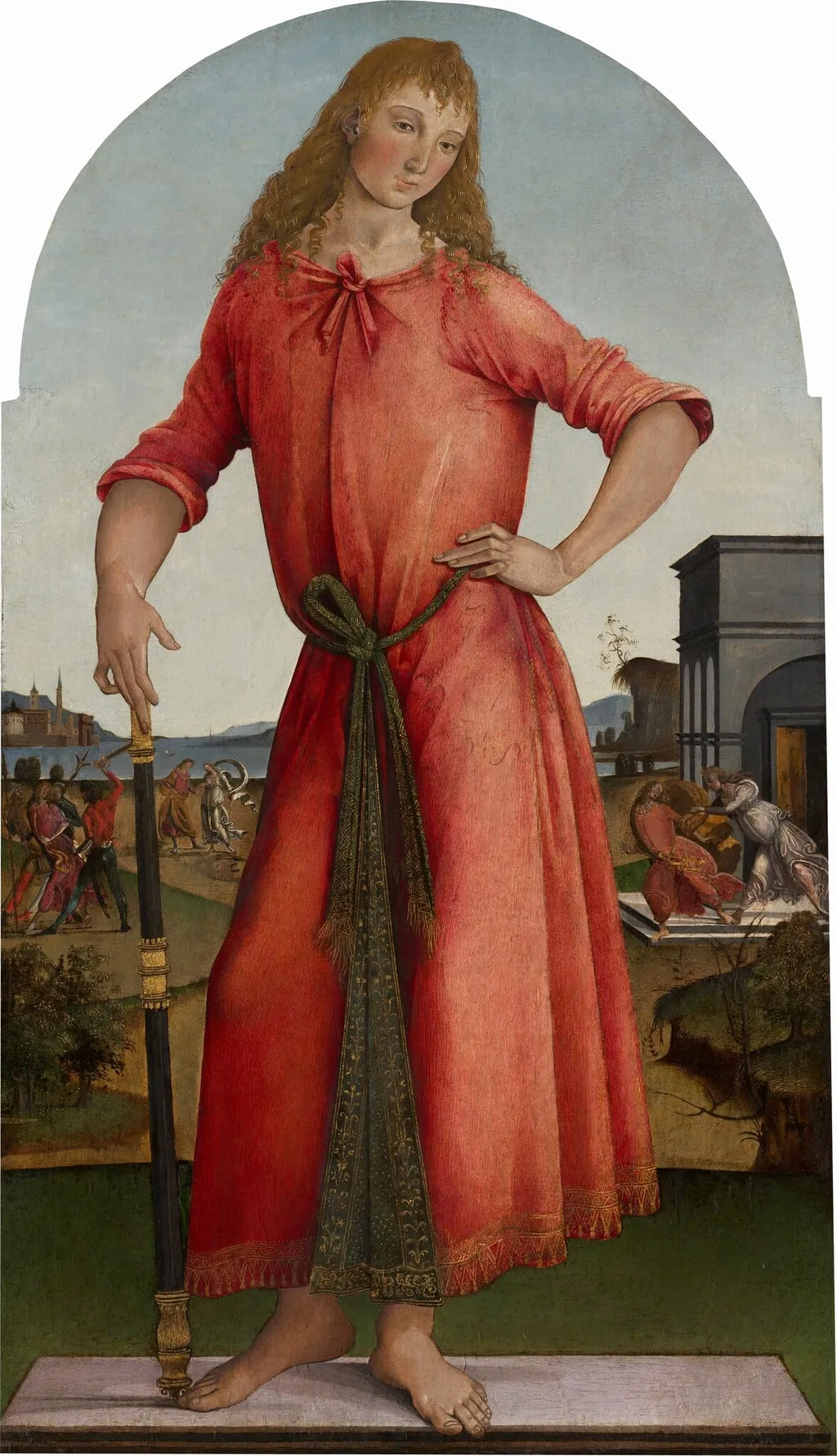
Joseph of Egypt is an oil painting by the Renaissance artist Master of the Griselda Legend. It dates from 1492 and is held in the collection of the National Gallery of Art.
About this work
Technique & Style
The painting is executed in oil on panel, a medium typical of late fifteenth-century Sienese practice, and has been transferred to canvas at an unknown date.
The painting is executed in oil on panel, a medium typical of late fifteenth-century Sienese practice, and has been transferred to canvas at an unknown date. Its handling aligns with the refined linearism and sculptural modeling associated with the Master of the Griselda Legend, combining crisp drapery folds with a restrained palette dominated by deep crimsons and earthy umbers. Stylistically, the figure of Joseph is rendered with volumetric solidity, his face characterized by a serene expression and sharply defined physiognomic features that emphasize both his maturity and spiritual authority.
The composition's clarity and the careful delineation of the background narrative scenes reflect the artist's adherence to a conservative, narrative-driven approach within the Sienese tradition.
History & Provenance
Created around 1492 by the Master of the Griselda Legend, this oil painting on panel was likely commissioned by the Piccolomini family in Siena. The work entered the documented ownership chain by 1858–1859, possibly passing through William Blundell Spence in Florence before reaching Rev. Walter Davenport Bromley at Wootton Hall. It was sold at Christie, Manson & Woods in London on 12–13 June 1863, subsequently appearing in the collections of Francis Baring, 3rd Baron Ashburton, and Bertram Ashburnham, 4th Earl of Ashburnham.
The painting later passed to William Compton, 4th Marquess of Northampton, and to Édouard Kann in Paris. After passing through several New York and London dealers, including Scott & Fowles and M. Knoedler & Co., it was sold to the Samuel H. Kress Foundation on 18 May 1945. The foundation gave the artwork to the National Gallery of Art in Washington, D.C., in 1952, where it is inventoried as 1952.5.2.
Overview
Created around 1492, this oil work, originally on panel and later transferred to canvas, was painted by the anonymous figure known as the Master of the Griselda Legend. It presents a youthful male figure in a narrative setting, rendered with a careful balance of color and spatial depth that reflects the transitional aesthetics of late‑15th‑century Northern European painting.
Subject & Meaning
The central figure is a young man with long, curled hair, dressed in a red tunic edged with an elaborate patterned hem and a green sash at the waist. He holds a black staff tipped with gold, a possible symbol of authority or pilgrimage, while his pose, hand on hip, barefoot on a white platform, suggests a moment of contemplation within a larger biblical or hagiographic story.
Context
The work belongs to a period when religious narratives were frequently depicted for devotional purposes, often incorporating contemporary dress and settings to make biblical figures more relatable. The inclusion of everyday elements, people, animals, buildings, and water, reflects the era’s interest in integrating sacred stories within recognizable, lived environments.
Artist & collection


![The Archangel Gabriel [middle left panel], by Cosimo Tura](https://artifactworldgallery.com/img/cosimo-tura--the-archangel-gabriel-middle-left-panel--c900f72d54477be2-w320.webp)