Artwork
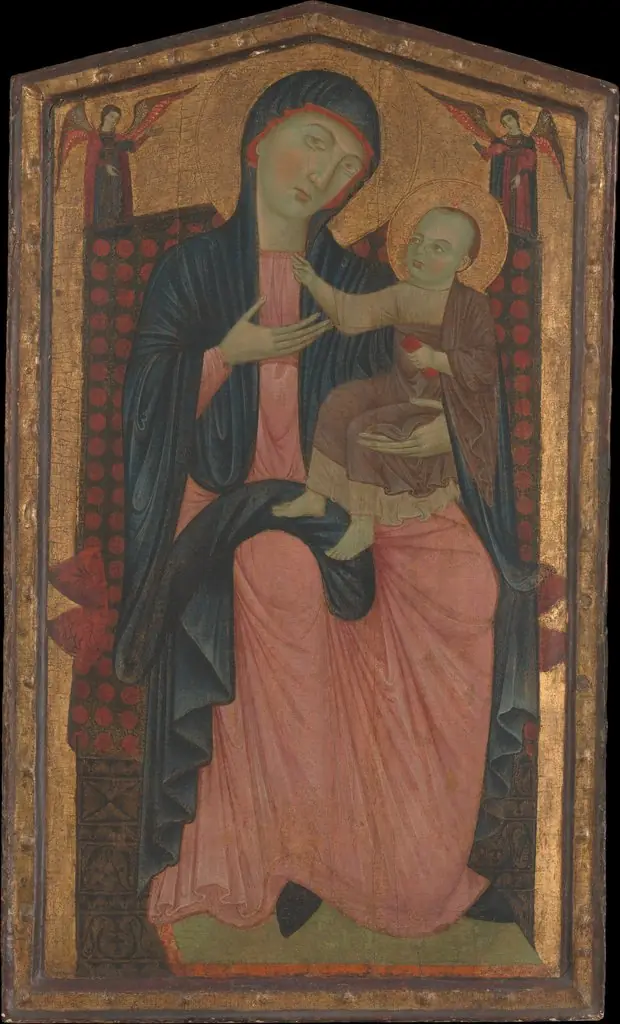
Madonna and Child Enthroned
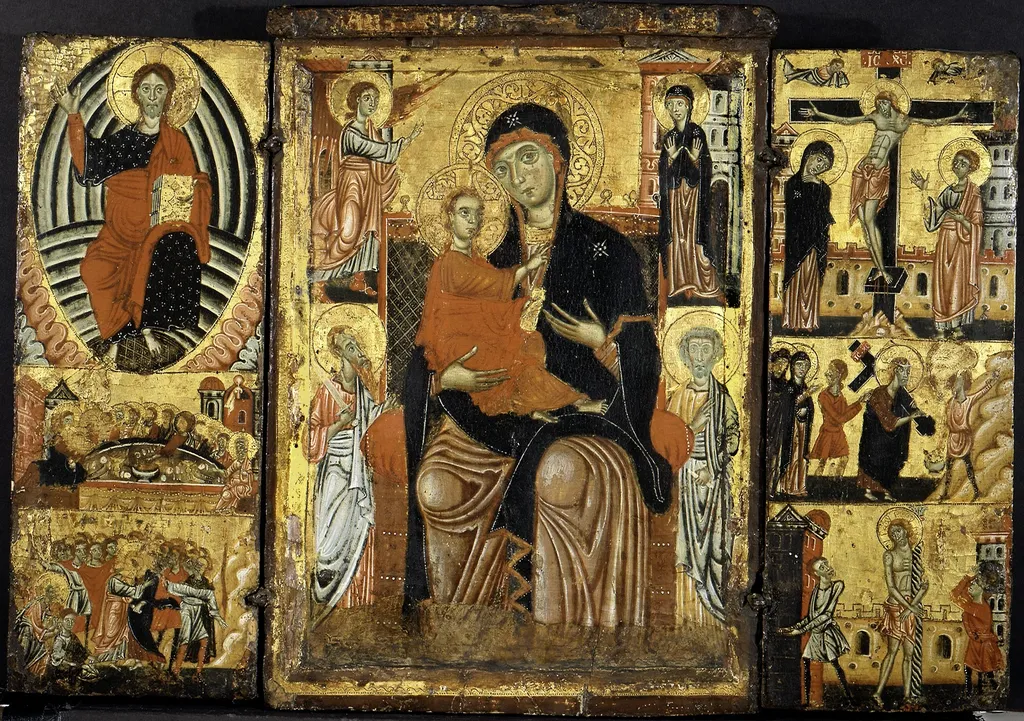
Madonna and Child Enthroned is a tempera painting by the Byzantine icon painting artist Master of the Magdalen. It dates from 1300 and is held in the collection of the Metropolitan Museum of Art.
About this work
Subject & Meaning
In this early fourteenth-century devotional panel the figures are rendered with gold leaf and tempera, emphasizing their sacred status.
The work portrays the Virgin Mary seated on a throne with the infant Christ, the central motif of a Madonna and Child composition. In this early fourteenth-century devotional panel the figures are rendered with gold leaf and tempera, emphasizing their sacred status. The iconography follows established patterns in which Mary functions as the heavenly intercessor and the Child embodies the Incarnation, reflecting the theological emphasis on maternal mediation within medieval Catholic spirituality.
As a religious painting, it served both devotional and didactic purposes, inviting viewers to contemplate the divine humanity of Christ through the familiar image of his mother.
Technique & Style
Created around 1300 by the Master of the Magdalen, this religious panel painting utilizes tempera and gold leaf applied to a wood support. The work measures approximately 40.6 × 28.3 cm. As a devotional image depicting the Madonna and Child, the piece exemplifies early Italian techniques characteristic of the late thirteenth and early fourteenth centuries. The integration of gold leaf with tempera on wood was a standard method for sacred imagery of this period, facilitating the luminous quality associated with Florentine art from the age of Dante.
The object is currently held in the collection of the Metropolitan Museum of Art, having been acquired through the George Blumenthal fund.
History & Provenance
The panel is attributed to the Master of the Magdalen and dated to circa 1300 on the basis of stylistic and technical analysis. It entered the Metropolitan Museum of Art as part of the George Blumenthal collection in 1941, accession number 41.100.8. The work has no documented commission record, but its iconography and style align with late Duecento Florentine devotional painting, situating its creation in the circle of Tuscan workshops active around 1300.
The painting has been exhibited under the titles "Florentine Paintings in the Metropolitan Museum," "Art in Florence in the Age of Dante (1250–1300)," and "Cimabue and Early Italian Devotional Painting."
Context
The Madonna and Child Enthroned, attributed to the Master of the Magdalen and dated to circa 1300, occupies a significant position within the trajectory of early Italian devotional painting. Executed in tempera and gold leaf on wood, the work exemplifies the religious art produced in Florence during the Age of Dante. Its scholarly importance is underscored by its inclusion in major exhibitions such as 'Cimabue and Early Italian Devotional Painting' and 'Florentine Paintings in the Metropolitan Museum,' which situate the piece alongside the foundational works of the period.
As a representative object of the Master of the Magdalen's oeuvre, the painting contributes to the understanding of artistic developments in Tuscany at the turn of the fourteenth century, bridging the stylistic gap between Cimabue and the subsequent generations of Florentine painters.
Overview
This panel painting, titled Madonna and Child Enthroned, is attributed to the anonymous Florentine artist known as the Master of the Magdalen. Created on wood around 1300, it presents the Virgin Mary holding the Christ Child, seated centrally on a throne. The work reflects the Byzantine iconographic traditions prevalent in late 13th-century Italian art and is housed in The Metropolitan Museum of Art.
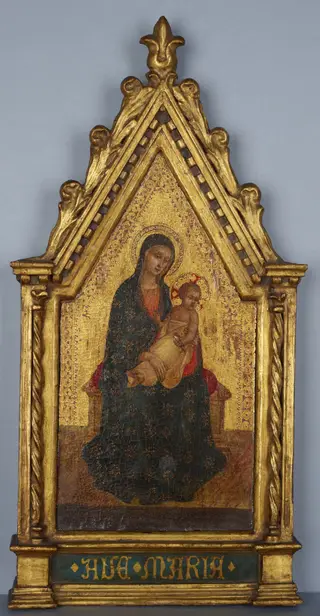
Own this work as a print
Artist & collection
Artist
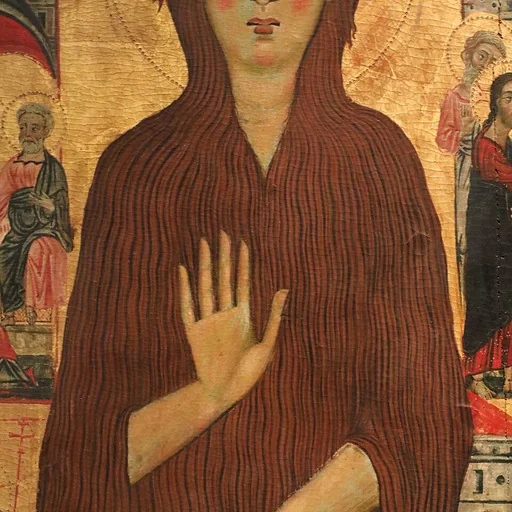
The Master of the Maddalena, Magdalen Master (and other variants) is an unnamed Florentine artist active in the second half of the 13th century.

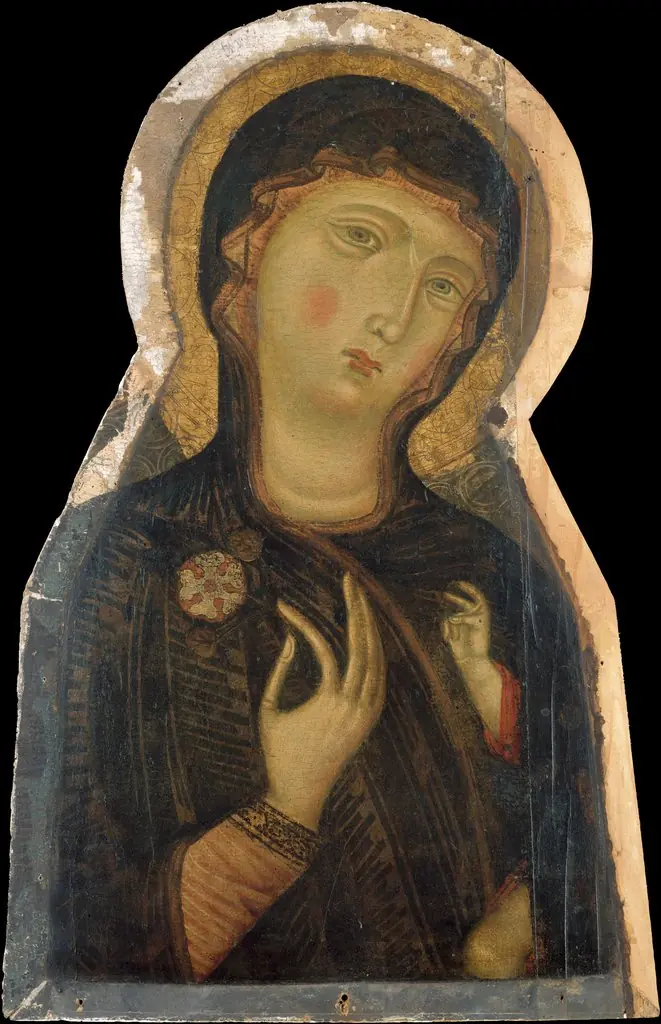
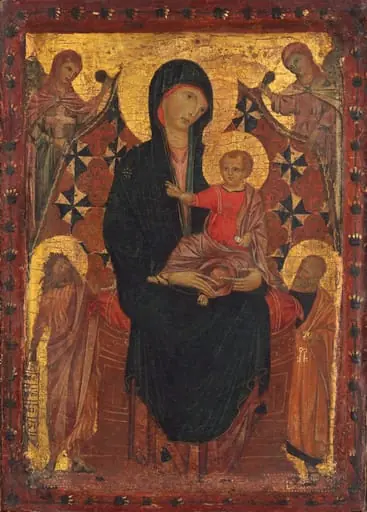 Madonna and Child with Saint John the Baptist, Saint Peter, and Two Angels
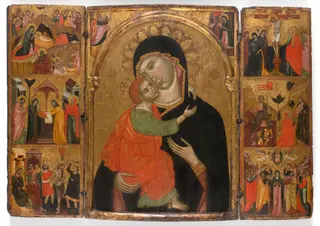 Triptych of the Virgin and Child with Scenes from the Life of Christ
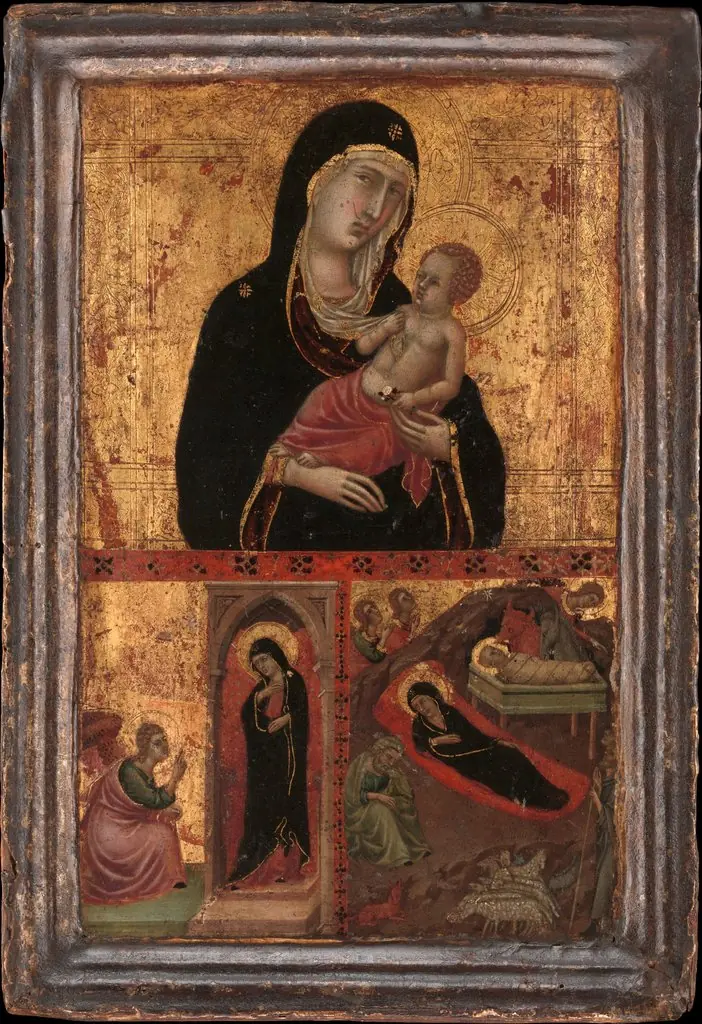 Madonna and Child with the Annunciation and the Nativity
 Madonna and Child with Saints
 The Virgin and Child
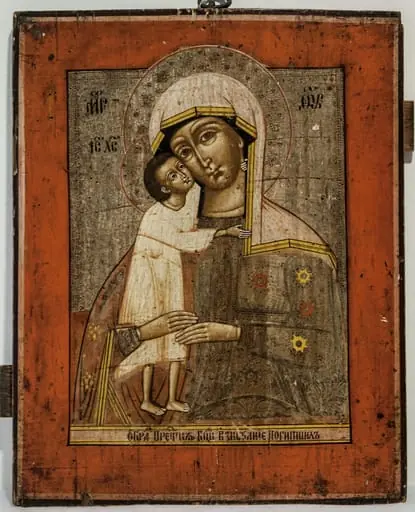 Maica Domnului, tipul Eleusa(dulcea sărutare, Mângâietoarea) îl ține strâns în brațe pe Iisus prunc, în picioare, cu obrazul lipit de cel al Maicii și o mână petrecută pe după gâtul ei. Iisus are nimbul cruciger, marcat cu motive florale punctate, Este înveșmântat într-o tunică 3/4 alb-gălbuie, care lasă să i se vadă picioarele. Maica poartă un maforion alb, bordat cu galben, partea din stânga a veșmântului din foiță metalică, decorată cu motive florale pictate cu roșu și galben, motive fitomorfe și geometrice incizate. În partea dreaptă veșmântul este roșu, decorat cu motive florale de culoare galbenă, foița fiind prezentă doar la mânecă. Nimbul decorat cu motive florale punctate în stratul de foiță metalică, Figurile modelate din culoare (alb, ocru) cu accente grafice fine, albe, sunt specifice icoanei rusești. Cromatica: alb, galben, roșu, auriu, brun, negru, foiță metalică, chenar roșu deschis, mărginit de două linii în nuanțe de roșu deschis și brun.Chenarul interior dublat de două șiruri de cercuri ștanțate în foiță. Inscripția dispusă pe o bandă dreptunghiulară în partea de jops a icoanei : Icoana Preacuratei Fecioare Prevăzând Jertfa (lui Iisus).
 Triptychon (Flügel fest)
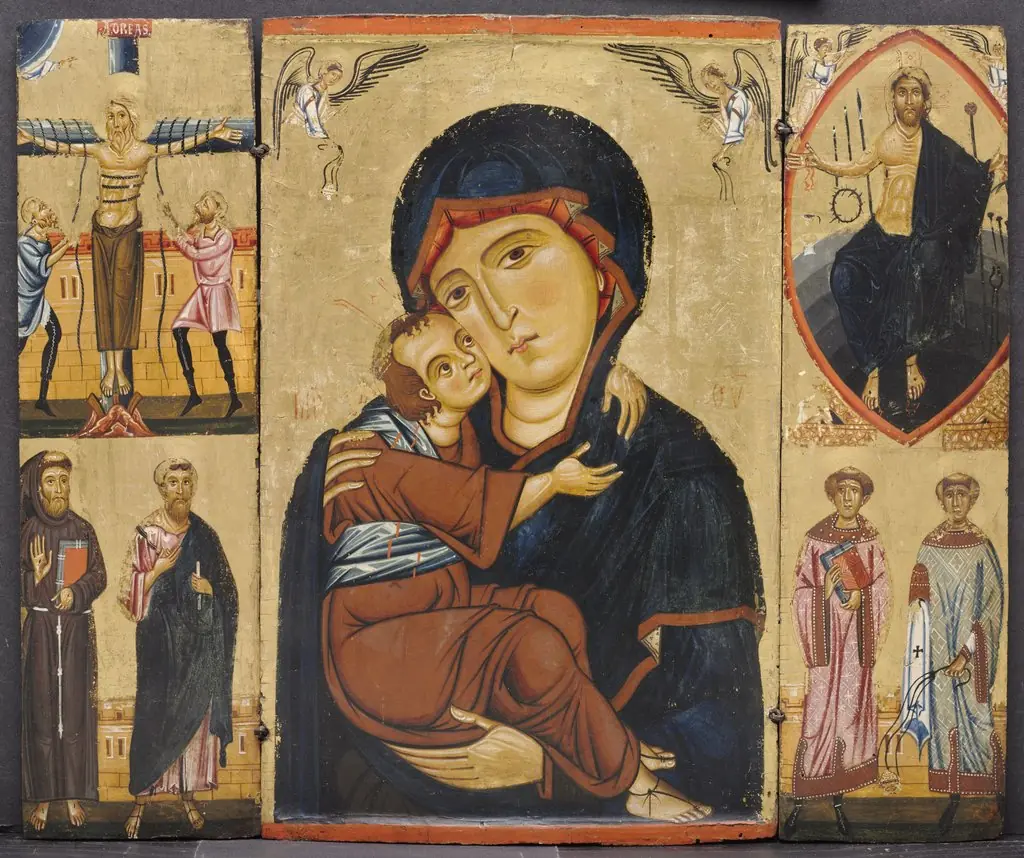 Virgin and Child with Saints
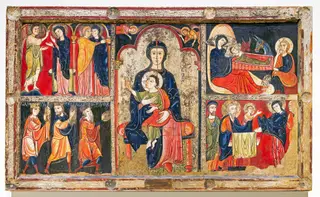 Altar frontal from Avià