Artwork
A World
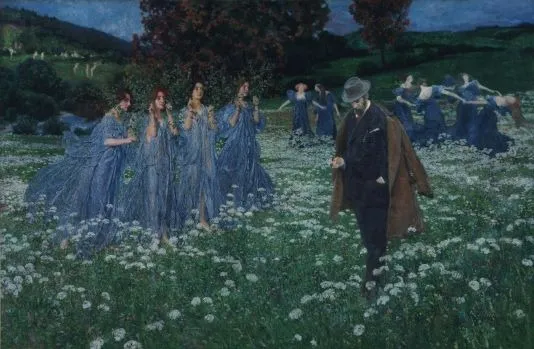
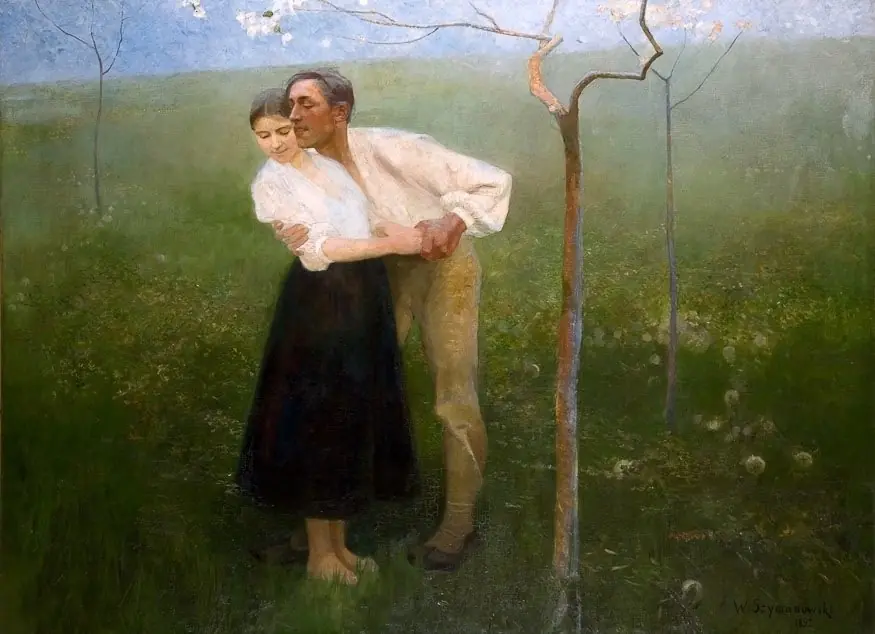
A World is an oil painting by the Art Nouveau artist Maximilian Lenz. It dates from 1900 and is held in the collection of the Hungarian National Gallery.
About this work
Overview
The painting resides in the Museum of Fine Arts, Budapest, and reflects his broader engagement with multiple media, including graphic arts and sculpture.
Painted in 1900 by Austrian artist Maximilian Lenz, A World is an oil-on-canvas work rooted in the Symbolist and Art Nouveau traditions. Lenz, a key figure in the Vienna Secession, used this piece to explore idealized natural harmony through figurative composition. The painting resides in the Museum of Fine Arts, Budapest, and reflects his broader engagement with multiple media, including graphic arts and sculpture.
Subject & Meaning
The painting portrays a solitary man in a brown coat and hat walking through a field of white blooms, encircled by women in blue garments who dance or play instruments. The figures suggest a ritualistic or mythic gathering, evoking themes of unity between humanity and nature. The absence of narrative detail invites contemplation rather than storytelling, aligning with Symbolist tendencies to prioritize mood over literal meaning.
Technique & Style
Lenz employed soft, blended brushwork and a restrained palette of white, blue, and earth tones to create a luminous, dreamlike atmosphere. The figures are stylized with flowing lines characteristic of Art Nouveau, while the background trees and sky are rendered with subtle gradations. Glazing techniques likely enhanced the luminosity of the skin and fabric, contributing to the painting’s ethereal quality.
History & Provenance
Created during Lenz’s most active Symbolist phase, A World entered the collection of the Museum of Fine Arts, Budapest, in the early 20th century. Its acquisition reflects the museum’s interest in Central European modernism. The work has remained largely undisturbed since, with no documented public exhibitions beyond institutional holdings until recent scholarly attention.
Context
In 1900, Vienna was a hub for artistic reform, with the Secessionists rejecting academic norms in favor of expressive, decorative forms. Lenz’s work aligned with contemporaries like Klimt and Moser, who sought to merge fine and applied arts. A World reflects this ethos, blending poetic symbolism with ornamental composition to express inner states through visual rhythm.
Legacy
Though less widely known than his Secessionist peers, Lenz’s A World remains a quiet exemplar of early 20th-century Austrian Symbolism. Its integration of movement, color, and stillness influenced later generations interested in non-narrative, emotionally resonant painting. The work continues to be studied for its synthesis of personal vision and broader artistic currents of its time.
Artist & collection
Artist
Maximilian Lenz (4 October 1860 – 19 May 1948) was an Austrian painter, graphic artist and sculptor.