Artwork
The Lamps of God
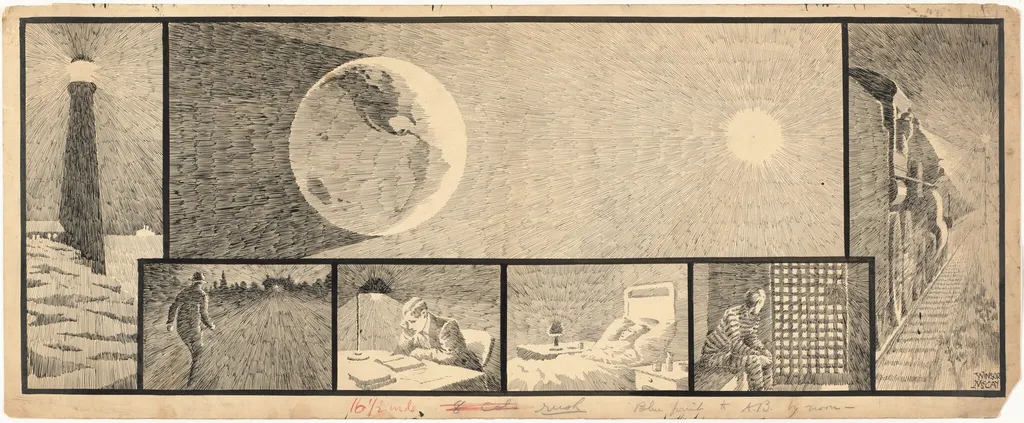
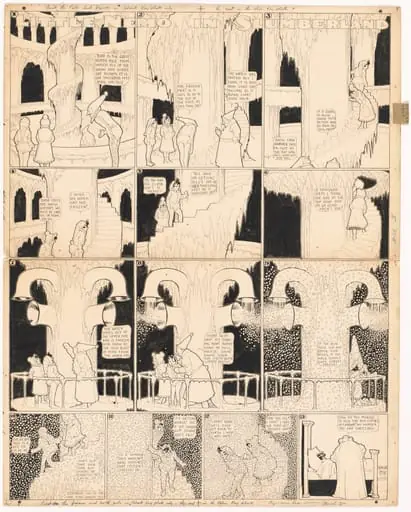
The Lamps of God is an ink drawing by the Art Nouveau artist Winsor McCay. It dates from 1922 and is held in the collection of the National Gallery of Art.
- Inscription
- Inscribed:lower right in pen and black and ink: Winsor / McCay; lower margin in red colored pencil: 16 1/2" wide; in graphite: 8 cols [scratched out in red colored pencil] rush [underlined] Blue print to A.B. by noon-; left verso in blue colored pencil: Editorial / 4/9/22
- Markings
- Marked:verso: partial remains of two stickers
About this work
Overview
Winsor McCay’s 1922 drawing titled The Lamps of God is executed in pen and black ink over a graphite underdrawing on paperboard. The composition is divided into six narrow panels arranged horizontally. Each panel is rendered with dense, intersecting lines that create a richly textured surface, ranging from stark black fields to delicate tonal gradations.
Subject & Meaning
The outer panels feature towering structures that frame the scene, while a luminous source, interpreted as a sun or celestial lamp, glows at the top centre. Interior panels depict a rolling landscape with a solitary tree, a winding road, and a checkerboard motif, evoking a nocturnal atmosphere punctuated by faint specks that suggest stars.
Technique & Style
McCay employs cross‑hatching, layering tightly packed strokes to model form and convey depth. In the darkest areas the ink lines converge to the point of appearing solid black, whereas lighter sections retain the paper’s tone. This meticulous line work produces a dreamlike, almost puzzle‑like quality, characteristic of McCay’s intricate pen work.
History & Provenance
Created in the early 1920s, The Lamps of God reflects McCay’s continued experimentation with drawing after his renowned animated films. The work remains in a private collection, having been exhibited in several retrospectives of early 20th‑century American illustration, where it is noted for its technical virtuosity and atmospheric composition.
Artist & collection