Artwork
Bain-froid chevrier, dit "de l'École" (Chevrier's Cold-Bath Establishment, Sometimes called the "School-Baths")
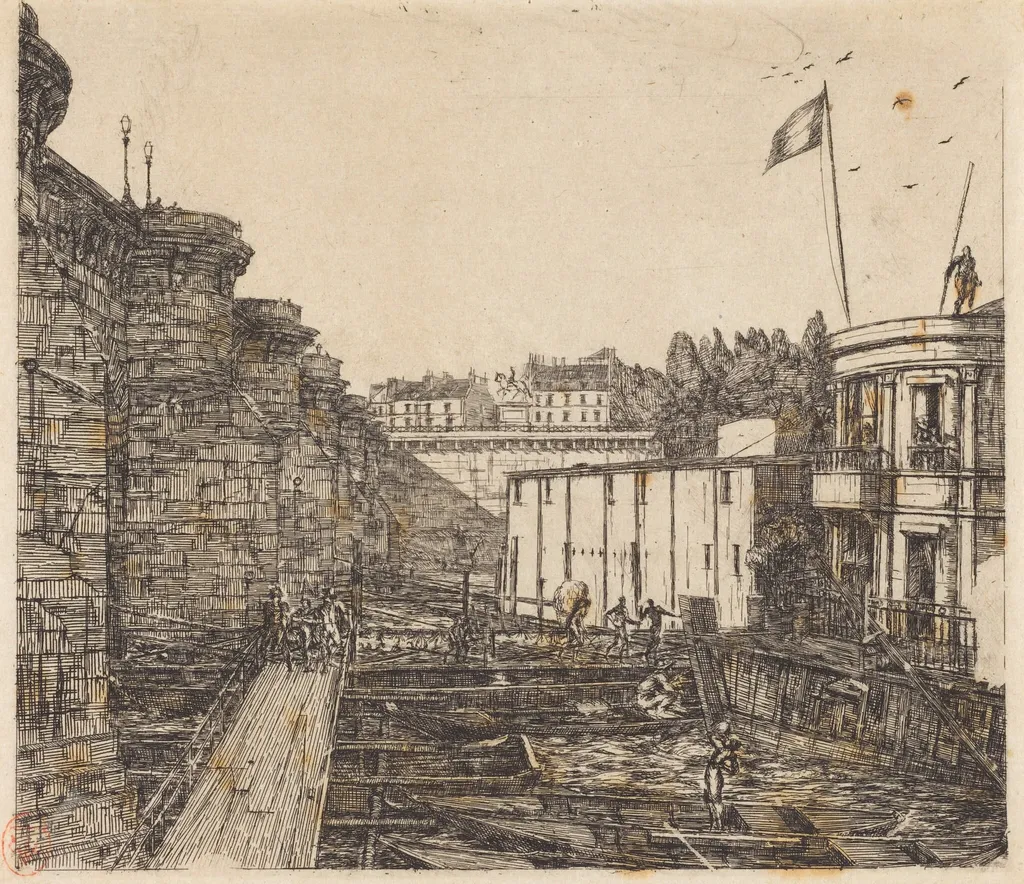
Bain-froid chevrier, dit "de l'École" (Chevrier's Cold-Bath Establishment, Sometimes called the "School-Baths") is an ink print by the Impressionist artist Charles Meryon. It dates from 1864 and is held in the collection of the National Gallery of Art.
- Inscription
- Inscribed:Not signed. Not dated. "93 a" verso, lower left sheet, graphite, unknown hand. "Haden" verso, lower right sheet, graphite, unknown hand.
- Markings
- Marked:(Philippe Burty collector's stamp) lower right margin, red stamped ink, (Lugt 413). "LRJ" verso, black stamped ink, stamped twice, (Lugt 1760b). "National Gallery of Art" verso, black stamped ink, (Lugt 1932d). "RG" (Louis-Remi Garnier collector's stamp) verso, black stamped ink, (Lugt 2211). (Cortland F. Bishop collector's stamp) verso, purple stamped ink, (Lugt 2770b).
About this work
Overview
Created in 1864, this wove‑paper etching by French printmaker Charles Meryon portrays the interior of a public cold‑bath house.
Created in 1864, this wove‑paper etching by French printmaker Charles Meryon portrays the interior of a public cold‑bath house. The composition captures a lively urban setting, with a large façade on the left, a smaller structure on the right, and a crowded street populated by figures in various poses. The work reflects Meryon’s interest in everyday Parisian life, rendered with a meticulous eye for architectural detail.
Subject & Meaning
The scene centers on a nude figure within the bathhouse, juxtaposed against the bustling street outside. By placing the intimate act of bathing amid public activity, Meryon highlights the intersection of private and communal spaces in mid‑nineteenth‑century Paris, suggesting a subtle commentary on the social dynamics of hygiene, class, and visibility.
Technique & Style
Meryon employed fine line work and varied hatching to differentiate textures, from the smooth skin of the nude to the rough stone of the surrounding buildings. The use of tonal gradations creates atmospheric depth, while the realistic rendering of architectural elements anchors the composition in a recognizable urban environment, characteristic of his precise etching practice.
History & Provenance
Meryon, whose career was marked by mental illness and eventual confinement in an asylum, produced this print during a period of intense output in the 1860s. The work is catalogued under the title Bain‑froid chevrier, dit « de l’École » and has circulated among collections of 19th‑century French prints, reflecting the artist’s enduring interest in the city’s lesser‑known locales.
Own this work as a print
Artist & collection
Artist
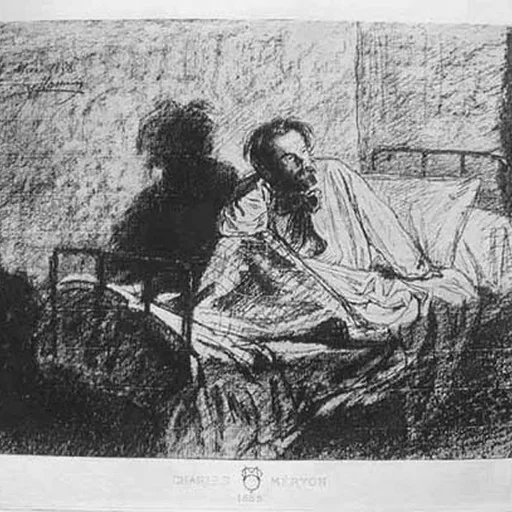
Charles Meryon (sometimes Méryon, 23 November 1821 – 14 February 1868) was a French artist who worked almost entirely in etching, as he had colour blindness.

 Port de la Plataine à Royan
 A Selection of Twenty of the Most Picturesque Views in Paris: View of the Pantheon taken from the Arsenal
 The Porte de Versailles at Pont du Jour
 Cleveland, Woodland Avenue and Eagle Street
 The Large Pool
 A Selection of Twenty of the Most Picturesque Views in Paris: View of the Palace and Village of Choisi on the Banks of the Seine
 Cleveland, Ohio
 Shipping
 Etchings of Paris: The Exchange Bridge