Artwork
Carlos III renuncia a la corona de Nápoles
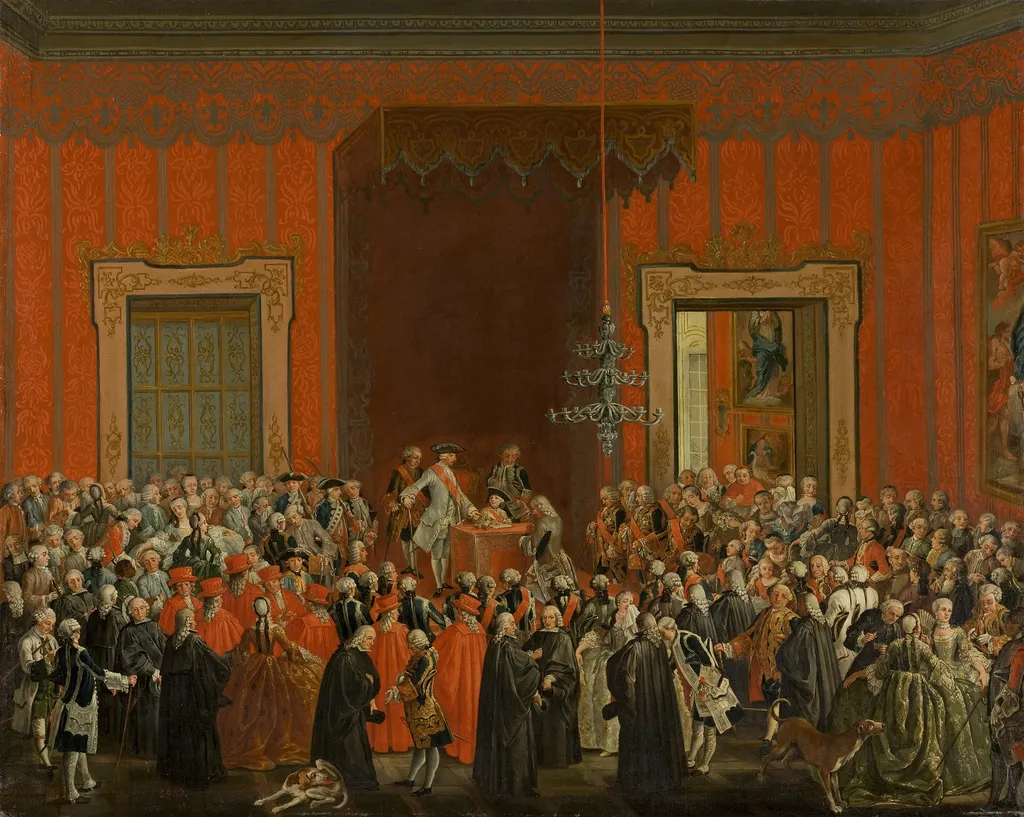
Carlos III renuncia a la corona de Nápoles is an oil painting by the Rococo painting artist Michele Foschini. It dates from 1759 and is held in the collection of the Museo del Prado.
About this work
Subject & Meaning
The central figure, Charles III, is shown in a ceremonial act of abdication, surrounded by courtiers and officials who witness the transfer of power.
The painting depicts the moment when Charles III of Spain renounces the throne of Naples in favor of his third son, Ferdinand I of the Two Sicilies. The central figure, Charles III, is shown in a ceremonial act of abdication, surrounded by courtiers and officials who witness the transfer of power. A small dog near the base of the composition may symbolize loyalty or domestic continuity amid political change, while the presence of a chandelier suggests the setting is an interior of significant importance, likely a royal palace. The inclusion of wigs and formal attire underscores the formality and dynastic stakes of the event.
Technique & Style
Executed in 1759 by Michele Foschini, this work is an oil painting on canvas. The composition measures 102.5 cm in height and 128.8 cm in width. Visually, the piece depicts a gathering of figures, several wearing wigs, alongside a dog and a chandelier, capturing the formal atmosphere of the historical event.
History & Provenance
The painting was created by Michele Foschini in 1759, executed in oil on canvas. According to the Wikidata record, the work entered the collection of Ferdinand VII of Spain, indicating royal Spanish ownership at that stage of its provenance. It is now held by the Museo del Prado, with its location recorded at the Royal Palace of Aranjuez, suggesting it was originally associated with the Spanish royal residences before passing into the museum's custody. No commission details or intermediate ownership transfers are documented in the available sources.
The work is held in the Museo del Prado, Royal Palace of Aranjuez, and is recorded under the inventory number P009686.
It entered the collection of Ferdinand VII of Spain and has been displayed in exhibitions at the Museo del Prado.
Exhibition history includes displays in the Royal Palace of Aranjuez.
Context
The painting Carlos III renuncia a la corona de Nápoles by Michele Foschini was created in 1759 and is housed in the Museo del Prado at the Royal Palace of Aranjuez, reflecting the Spanish court's political and artistic milieu during the reign of Ferdinand VII.
Scholarly analysis situates the work within the broader context of 18th-century Spanish portraiture, examining its role in diplomatic representation and royal iconography during a period of territorial reorganization in southern Europe.
The composition, featuring a dog, chandelier, and wig, aligns with contemporary conventions of aristocratic portraiture while subtly conveying themes of authority and succession.
Overview
Created in 1759, this oil painting by Italian artist Michele Foschini portrays a bustling interior scene in which a group of elegantly dressed men gather around a small table. The composition is dominated by vivid red walls trimmed in gold, a large chandelier overhead, and a dog reclining on the floor, all contributing to a sense of formal occasion.
Own this work as a print
Artist & collection
Artist
Michele Foschini (September 14, 1711 – c. 1770) was an Italian painter, active in a late Baroque style. He was born in Guardia Sanframondi. He studied under Niccola Maria Rossi, a pupil of Francesco Solimena. He was…

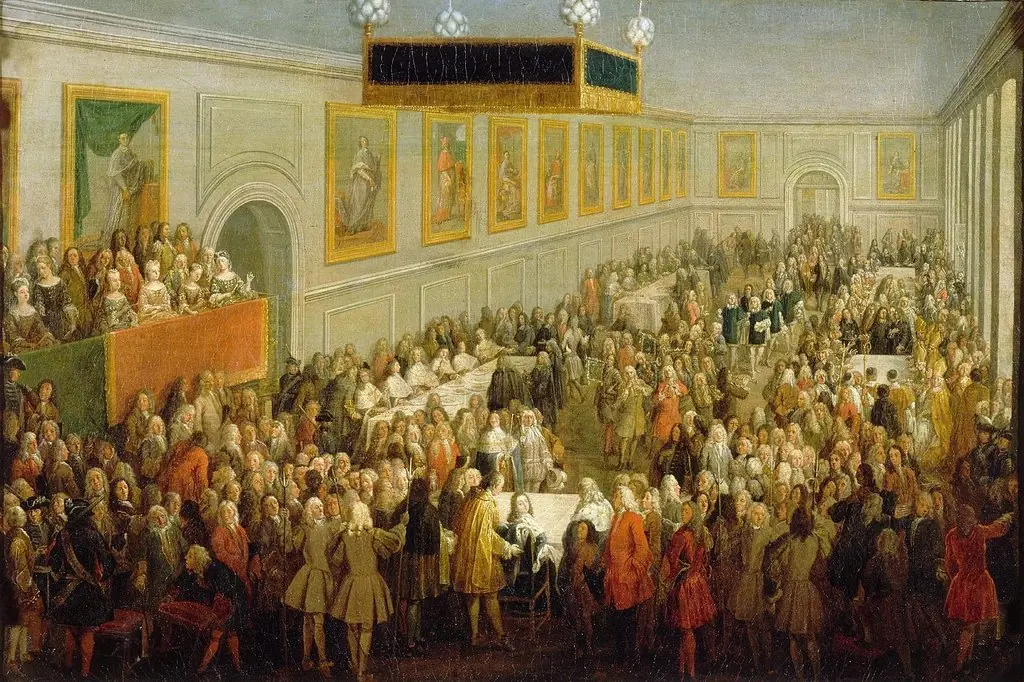
- Feast given after the coronation of Louis XV of France
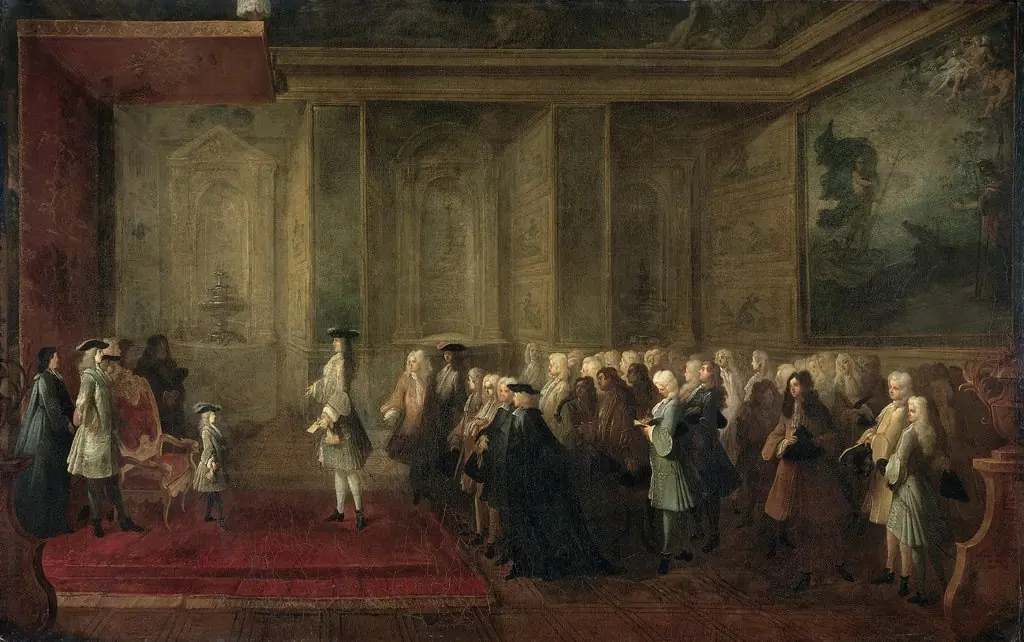 Reception of the Dutch ambassador Cornelis Hop by the French king Louis XV, 24 July 1724
 Untitled
 A Masquerade at the King's Theatre, Haymarket
 The Seat of Justice in the Parliament of Paris in 1723
 Anointing of a bishop
 Handkiss by the communities of Parma and Piacenza
 A Banquet at the Court of the German Emperor Charles VI
 The Union of Utrecht
 Mariage de Louis de France, duc de Bourgogne et de Marie-Adélaïde de Savoie, 7 décembre 1697
 Pope Pius VII in the Sistine Chapel
 A Banquet at the Court of the German Emperor Charles VI