Artwork
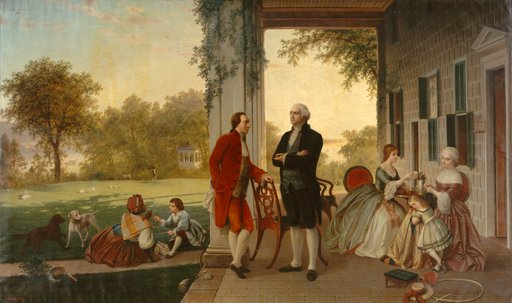
Washington and Lafayette at Mount Vernon, 1784 (The Home of Washington after the War)
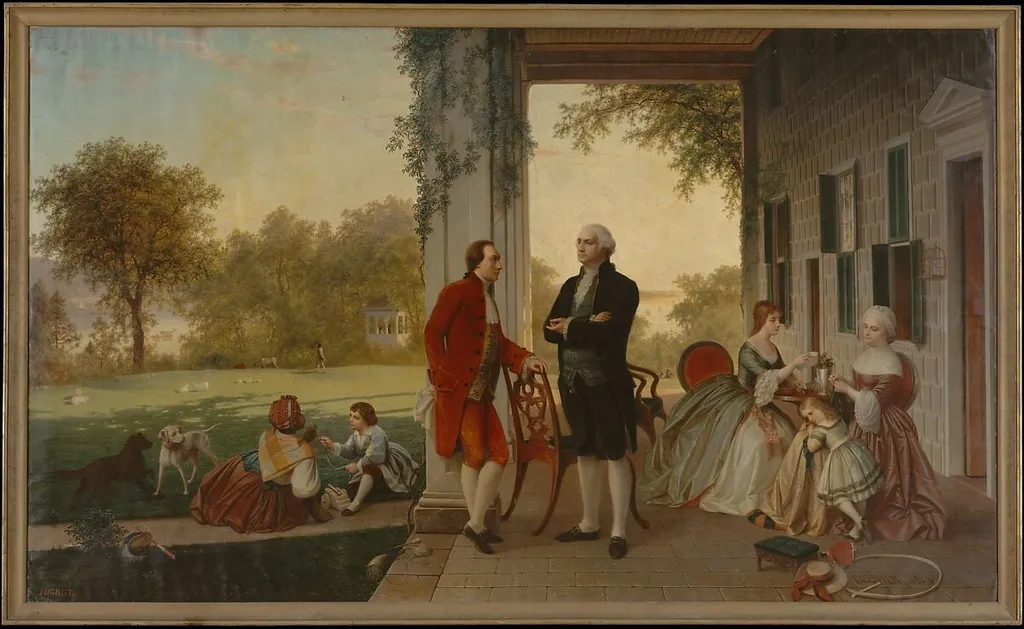
Washington and Lafayette at Mount Vernon, 1784 (The Home of Washington after the War) is an oil painting by the Realist artist Thomas Pritchard Rossiter. It dates from 1859 and is held in the collection of the Metropolitan Museum of Art.
About this work
On the porch at Mount Vernon in 1784, George Washington and the Marquis de Lafayette face each other in conversation while Martha Washington sews nearby.
On the porch at Mount Vernon in 1784, George Washington and the Marquis de Lafayette face each other in conversation while Martha Washington sews nearby. Painted twenty-five years after the visit, this 1859 collaboration between Thomas Pritchard Rossiter and Louis Remy Mignot stages a postwar reunion, made when the mansion itself was falling into ruin. The Metropolitan Museum of Art holds the large canvas, acquired through the bequest of William Nelson in 1905.
Overview
This expansive oil on canvas, completed in 1859, depicts an imagined reunion between George Washington and the Marquis de Lafayette at Mount Vernon in August 1784. The monumental work, measuring nearly seven and a half by twelve feet, presents a panoramic view of the post-Revolutionary War scene, capturing a moment of domestic tranquility and national reflection following Washington's resignation of his military commission.
Subject & Meaning
The painting stages a relaxed conversation between Washington and Lafayette on the piazza of Mount Vernon. Lafayette leans against a column, holding a newspaper, while Washington faces him. Nearby, Martha Washington engages in needlework, accompanied by her daughter-in-law and grandchildren, one of whom plays with a toy cannon under the care of an African American woman. This composition idealizes a moment of peace and domesticity after the war.
Technique & Style
Thomas Pritchard Rossiter, a history painter, collaborated with Louis Remy Mignot, known for his Hudson River School landscapes, on this large-scale work. Mignot, who had visited Mount Vernon in 1857, likely contributed the detailed architectural and landscape elements that frame the scene. This artistic partnership resulted in a grand, stage-like composition that combines historical narrative with a meticulously rendered setting.
Context
Completed in 1859, the painting emerged at a pivotal moment for Mount Vernon itself. That same year, the Mount Vernon Ladies' Association launched its efforts to acquire and restore the then-deteriorating estate. The artwork thus offered a nostalgic and idealized portrayal of the site's past glory, presenting a vision of domestic harmony and national pride that contrasted sharply with the physical decay of the actual mansion.
Legacy
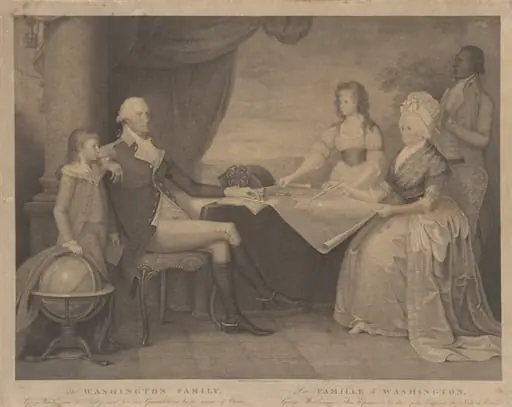
To accompany exhibitions, Rossiter published a descriptive pamphlet titled 'A Description of the Picture of the Home of Washington After the War.' The work's imagery was further disseminated in 1863 when British engraver Thomas Oldham Barlow produced a widely circulated steel engraving. The monumental canvas eventually entered the collection of The Metropolitan Museum of Art in 1905, acquired through the bequest of William Nelson.
Artist & collection
Artist
Thomas Prichard Rossiter (1818-1871) was an American painter born in New Haven, Connecticut.