Artwork
Θυμωμένη Θεά
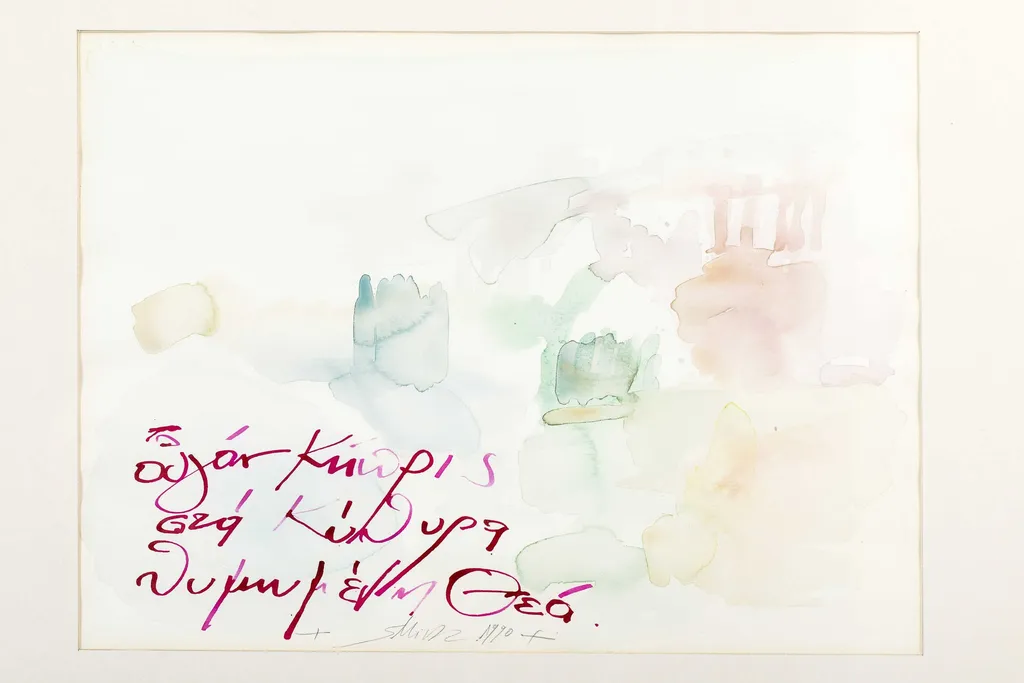
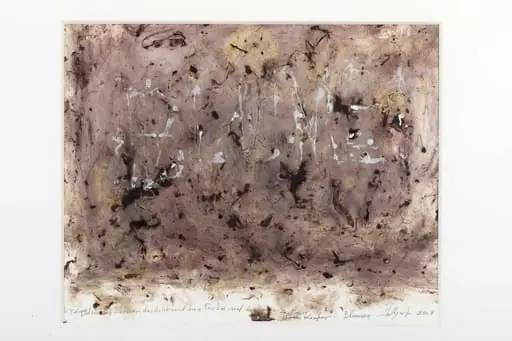
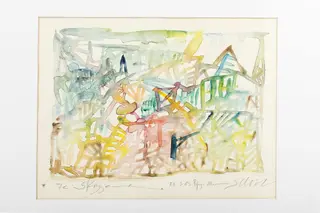
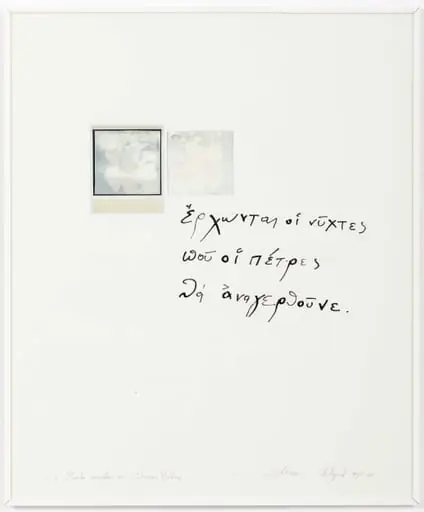
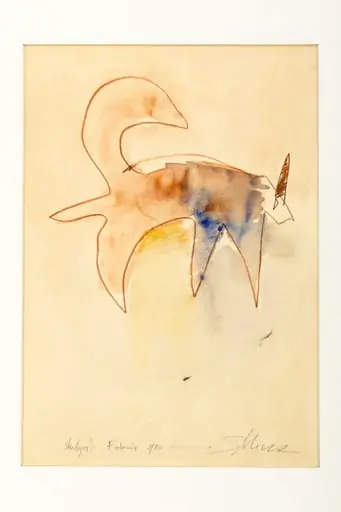
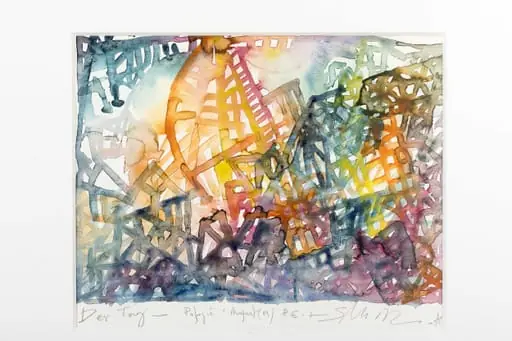
Θυμωμένη Θεά is an unspecified work on paper by the Contemporary Abstract artist Sotirios Michou. It dates from 1990 and is held in the collection of the Metropolitan Organisation of Museums of Visual Arts of Thessaloniki – MOMus.
About this work
The style of this painting is similar to work by other artists who use simple forms.
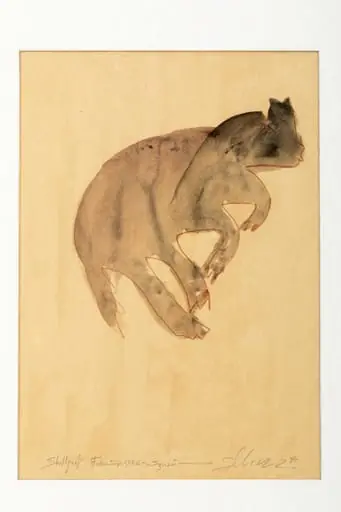
This painting shows a woman with a stern expression. She's dressed in ancient Greek clothing. Her face is the focus of the painting.
The woman's expression is what makes this painting interesting. It's not a happy face, but it's not sad either. The artist used simple lines and colors to create this expression.
The style of this painting is similar to work by other artists who use simple forms. Check out the work of artist: Michou, Sotirios (1936-2010).
Overview
Sotirios Michou, active from the 1960s until his death in 2010, developed a diverse practice spanning painting, collage, photography, and ceramics. His work evolved from figurative sketches and watercolors toward increasingly abstract compositions, often integrating text and mixed media. 'Θυμωμένη Θεά' reflects a phase where symbolic imagery and restrained visual language converge, emphasizing emotional resonance over narrative detail.
Subject & Meaning
The painting depicts a woman in archaic Greek attire, her face rendered with minimal strokes that convey a complex emotional state, neither overtly angry nor sorrowful, but intensely present. The title, meaning 'Angry Goddess,' suggests a mythic or symbolic figure, yet the ambiguity of her expression resists fixed interpretation. Michou invites contemplation of inner tension rather than storytelling, aligning the figure with broader themes of dignity and quiet resistance.
Technique & Style
Michou employs simplified forms and flat, unmodulated colors to isolate the figure’s expression. Lines are deliberate but unadorned, avoiding detail in favor of essential shapes. The background is neutral, directing focus to the face.
This reductionist approach echoes early 20th-century modernist tendencies, yet retains a personal, introspective quality. The work’s economy of means enhances its psychological weight without relying on dramatic contrast or texture.
History & Provenance
The painting is part of the MOMus-Museum of Contemporary Art’s collection, drawn from Michou’s broader oeuvre spanning nearly five decades. It belongs to a group of works from the 1980s–90s where the artist increasingly fused visual imagery with textual elements. While specific acquisition details are not documented, its inclusion in the museum’s permanent holdings reflects its significance within his mature period of symbolic figuration.
Context
Michou’s work emerged in post-war Greece amid shifting cultural identities and a reexamination of classical heritage. His engagement with ancient motifs was not nostalgic but critical, using mythic references to explore contemporary emotional landscapes. His integration of photography and collage alongside painting reflects broader international trends in postmodern art, while his focus on the individual psyche remains distinctly personal.
Legacy
Michou’s legacy lies in his quiet, persistent exploration of inner states through restrained visual language. He avoided spectacle, instead cultivating works that reward sustained attention. 'Θυμωμένη Θεά' exemplifies his ability to distill complex emotion into minimal form, influencing later Greek artists who seek depth through simplicity rather than elaboration.
Artist & collection
Museum
Metropolitan Organisation of Museums of Visual Arts of Thessaloniki – MOMus
Continue through works from the same source collection.