Artwork
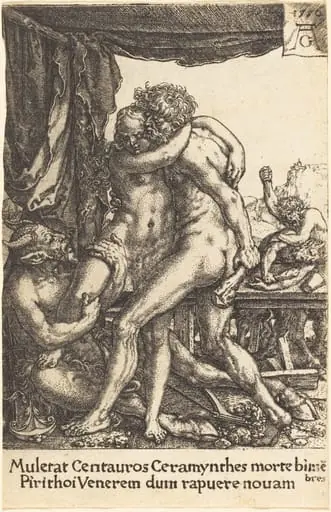
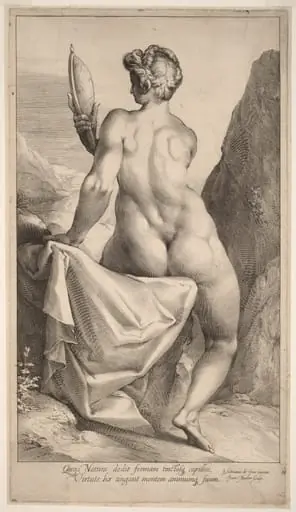
The Rape of a Sabine Woman (View from Behind)
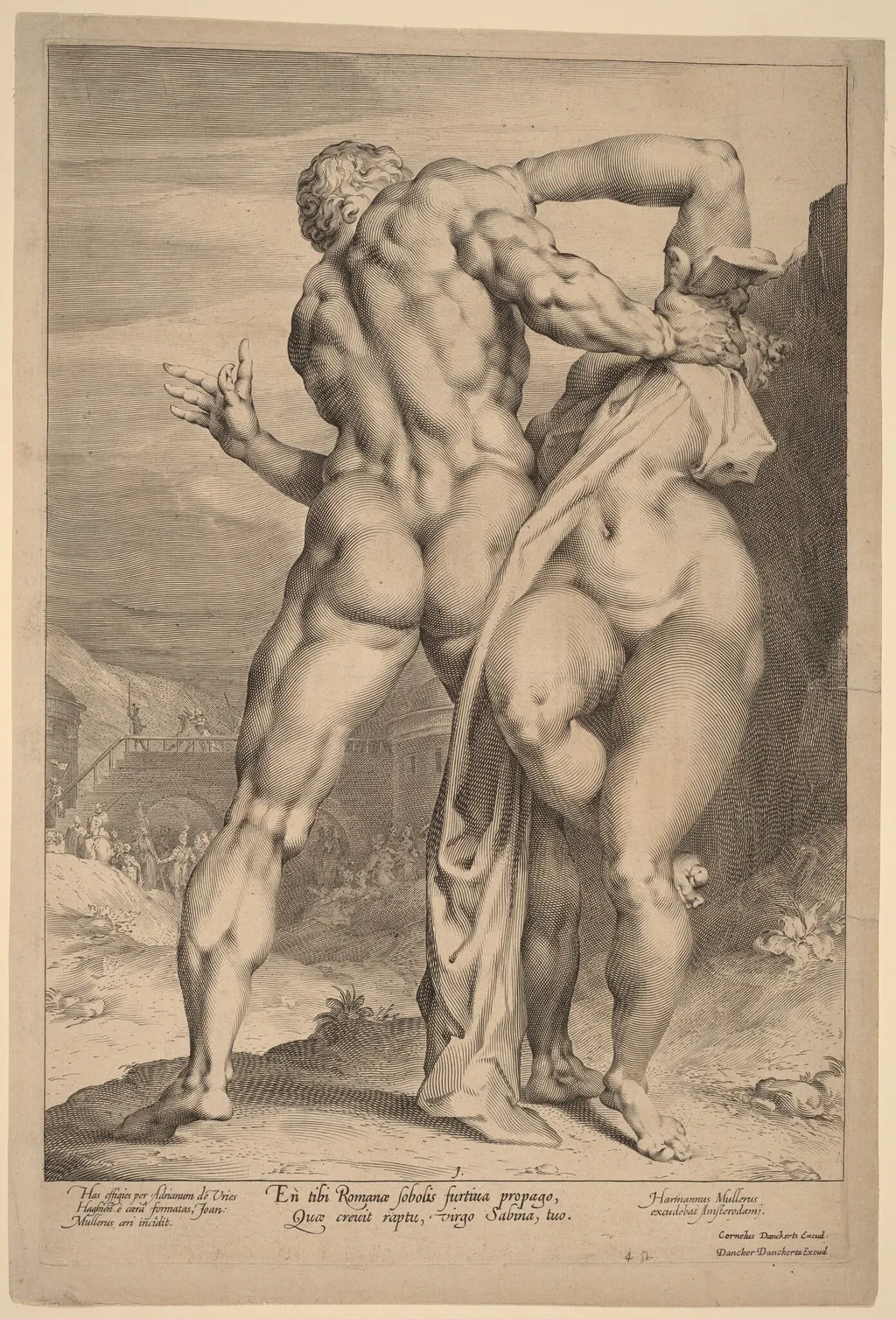
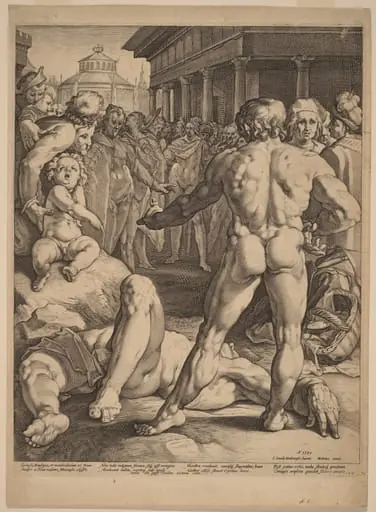
The Rape of a Sabine Woman (View from Behind) is an ink print by the Renaissance artist Jan Muller. It dates from 1598 and is held in the collection of the National Gallery of Art. Around 1598 Jan Harmensz.
- Inscription
- Inscribed:in image, at bottom centre: 1.; below image, at centre: En tibi Romanae sobolis furtiua propago, / Quae creuit raptu, virgo Sabina, tuo; below image, at left: Has effigies per Adrianum de Vries / Haghien è caerâ formatas, Joan: / Mullerus aeri incîdit.; below image, at right: Hatmannus Mullerus / excudebat Amsterodamj. / Cornelus Danckerts Excud. / Dancker Danckerts Excud; below image, in pen and brown ink, by later hand: 4 st.
About this work
Overview
Around 1598 Jan Harmensz. Muller, a Dutch artist active in Amsterdam, produced an engraving on laid paper titled The Rape of a Sabine Woman (View from Behind). The print captures a moment of violent struggle drawn from the Roman legend of the Sabine women’s abduction, focusing on the physical tension between the figures rather than on surrounding architecture.
Subject & Meaning
The composition centers on a male figure seizing a woman from behind; her torso twists as she reaches outward, emphasizing resistance. By isolating this dramatic encounter, Muller underscores themes of force and vulnerability inherent in the myth, inviting viewers to contemplate the human cost behind the celebrated foundation story of early Rome.
Technique & Style
Muller employs crisp, incisive lines to delineate musculature and hair, creating a stark chiaroscuro that heightens the sense of immediacy. The engraving’s contrast between deep shadows and bright highlights eliminates soft transitions, while the fine cross‑hatching on the laid paper renders texture and depth, exemplifying the precision of late‑sixteenth‑century Dutch printmaking.
History & Provenance
Trained within his family’s printing and publishing workshop, Muller honed his engraving skills before traveling to Italy, where exposure to Italian artistic currents refined his approach. After returning to Amsterdam, he inherited the family business and continued producing prints until his death in 1628. The work reflects the cross‑cultural influences that shaped his late‑Mannerist output.
Own this work as a print
Artist & collection

Artist
Jan Harmensz. Muller (1571–1628) was a Dutch engraver and painter. Muller was born in Amsterdam. His father was a book printer, engraver and publisher. He learned the engraving trade while working in the family…

![The Farnese Hercules, seen from behind [plate 4], by François Perrier](https://artifactworldgallery.com/img/francois-perrier--the-farnese-hercules-seen-from-behind-plate-4--075576b9459929be-w320.webp)
![The Borghese Gladiator, back view [plate 29], by François Perrier](https://artifactworldgallery.com/img/francois-perrier--the-borghese-gladiator-back-view-plate-29--e76fdd1927ce2d52-w320.webp)