Artwork
Mars and Venus
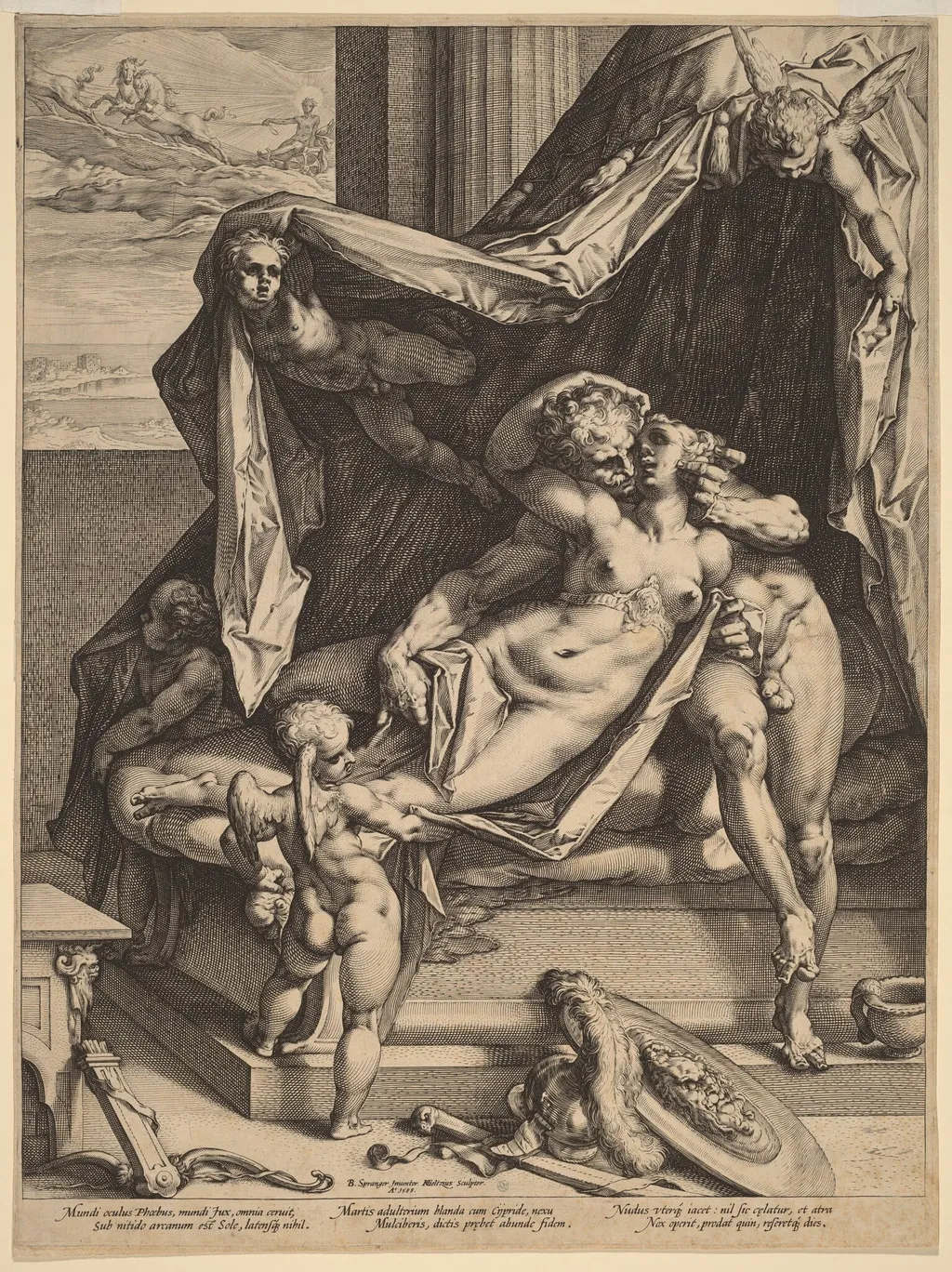
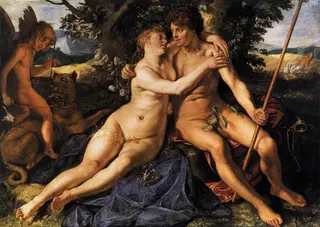
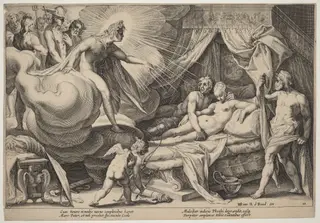
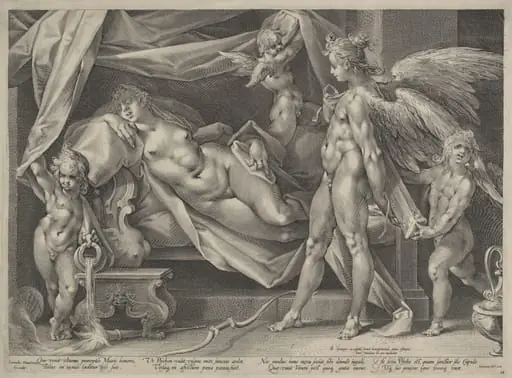
Mars and Venus is an ink print by the Renaissance artist Hendrick Goltzius. It dates from 1588 and is held in the collection of the National Gallery of Art.
- Inscription
- Inscribed:in image, at bottom centre: B. Spranger. Inuentor. H Goltzius sculptor. / Ao 1588; below image: Mundi oculus Phaebus, mundi Iux, omnia ceruit, / Sub nitido arcanum est Sole, latensqué nihil. / Martis adulterium blanda cum Ciipride, nexu / Mulciberis, dictis praebet abunde fidem. / Nudus uterqué iacet: nil sic caelatur, at atra / Nax operit, prodat quin, referetqué dies.
About this work
Overview
The work exemplifies the intricate, narrative-driven prints for which Goltzius was renowned in the late sixteenth century.
Hendrick Goltzius’s 1588 engraving titled Mars and Venus presents a densely composed mythological tableau on laid paper. The print, executed in black ink, captures a tangled group of nude figures dominated by a muscular male figure and a turning female figure, surrounded by smaller attendants and a distant landscape with ships. The work exemplifies the intricate, narrative-driven prints for which Goltzius was renowned in the late sixteenth century.
Subject & Meaning
The central scene draws on the classical story of the god of war, Mars, and the goddess of love, Venus, emphasizing their illicit encounter. The male figure’s dominant posture and the woman’s averted gaze suggest tension between desire and concealment, while the surrounding attendants, some bearing implements such as a hammer or shield, reinforce the martial and domestic aspects of the myth.
Technique & Style
Goltzius employs a rigorous system of cross‑hatching, layering fine, intersecting lines to generate deep shadows and the illusion of volume in flesh and drapery. The precision of his line work creates a tactile sense of muscle, fabric folds, and atmospheric depth, hallmarks of the Northern Mannerist style that prized virtuoso draftsmanship and complex compositional arrangements.
History & Provenance
Created in the Dutch Republic during Goltzius’s early career, the engraving was produced for the burgeoning market of collector’s prints. Although specific ownership records are scarce, the work has survived in several museum collections, attesting to its circulation among connoisseurs of fine prints in the late Renaissance and its continued scholarly interest.
Context
Mars and Venus emerges from a period when Dutch artists were adapting Italianate classicism to a Northern aesthetic, blending mythological themes with elaborate, often erotic, figuration. Goltzius, a German‑born artist who settled in Haarlem, was instrumental in advancing printmaking techniques that rivaled painting in narrative complexity, influencing contemporaries across Europe.
Own this work as a print
Artist & collection
Artist
Hendrick Goltzius (German: , Dutch: ; né Goltz; January or February 1558 – 1 January 1617) was a German-born Dutch printmaker, draftsman, and painter.