Artwork
Amphion and Zethus Tying Dirce to a Wild Bull
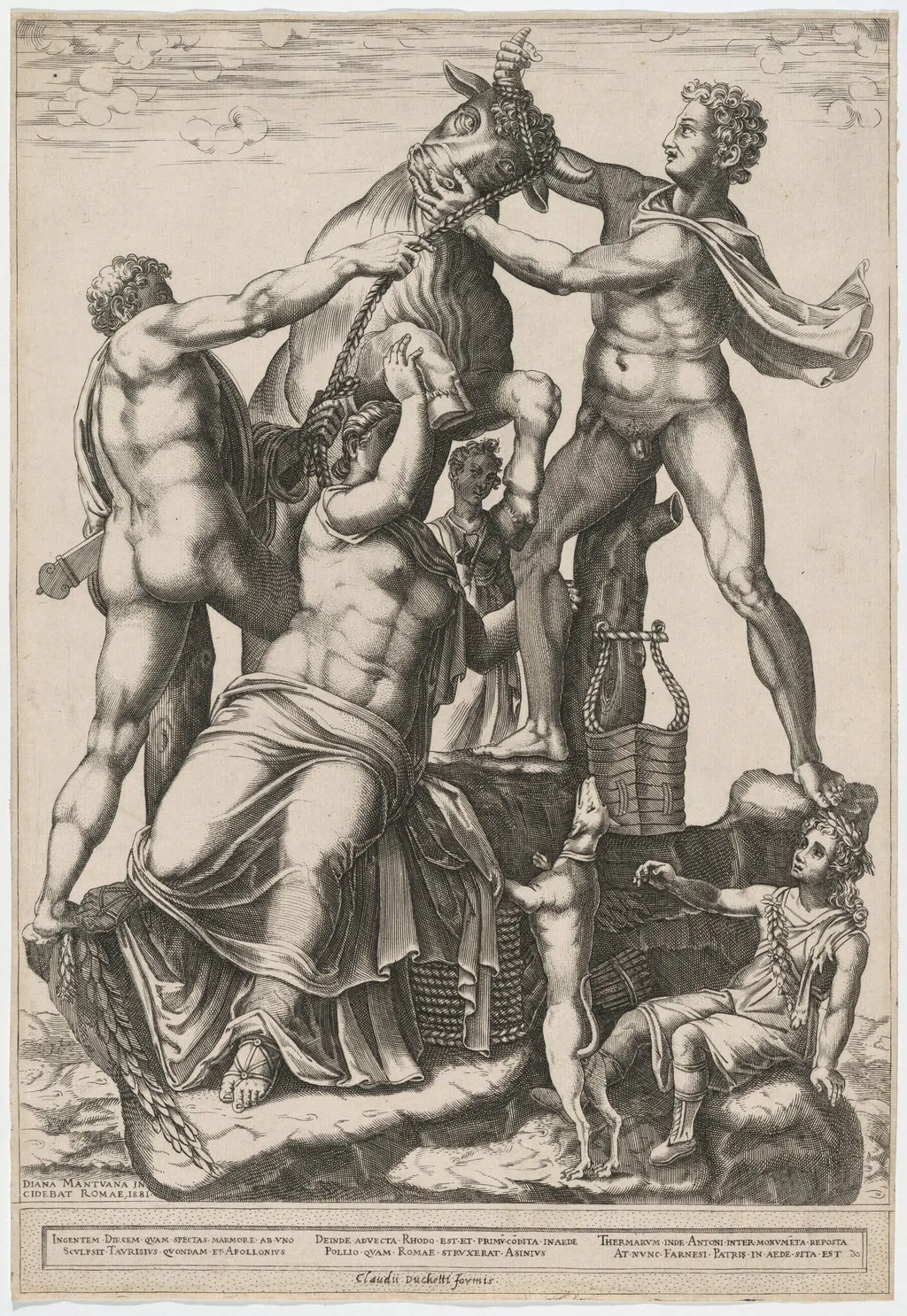
Amphion and Zethus Tying Dirce to a Wild Bull is an ink print by the Renaissance artist Diana Scultori. It is held in the collection of the National Gallery of Art.
- Inscription
- Inscribed:lower left in image: DIANA MANTVA IN / CIDEBAT ROMAE 1581; lower center in plate: INGENEM. DIRCEM QVAM SPECTAS MARMORE AB VNO / SCVLPSIT TAVRISIVS QVONDAM ET APOLLONIVS / DEINDE ADVECTA RHODO EST ET PRIMV CODITA IN AEDE / POLLIO QVAM ROMAE STVXERAT ASINVS / THERMARVM INDE ATNONI INTER MONVMETA REPOSTA / AT NVNC FARNESI PATRIS IN AEDE SITA EST; lower center in plate: Claudii Duchetti formis; by later hand in graphite, upper left verso: vue Cab. Cicognara / N. 1302; by later hand in graphite, lower left verso: Pr Epreuve magnifique / 100 francs / Première Epreuve / very rare / L 3.10.0 / Le Taureau Farnese / Bartsch XV. No 37
- Markings
- Marked:Dr. Pietro Malenza, Verona [died 1866] (Lugt 2101)
About this work
Overview
Diana Scultori’s 1581 engraving, titled Amphion and Zethus Tying Dirce to a Wild Bull, is a black‑and‑white print on laid paper. The work is part of the National Gallery of Art’s collection in Washington, D.C. It captures a violent mythological episode in a compact, highly detailed composition, using the graphic possibilities of the intaglio medium.
Subject & Meaning
The scene depicts the myth of Dirce, who is being forced onto a raging bull by five robust men, identified as Amphion and Zethus. The woman clings to the animal’s horns while the men pull at ropes and struggle with one another, emphasizing the brutality of the punishment and the chaotic energy of the moment.
Technique & Style
Scultori employs fine cross‑hatching and dense line work to model the muscular bodies and the bull’s shaggy hide. Sharp contours and deep shadows create a sense of three‑dimensionality, while the interplay of light and dark heightens the drama. The engraving’s precise line quality reflects the high level of skill typical of late‑Renaissance printmaking.
History & Provenance
Created in 1581, the print was produced during a period when Scultori, one of the few known female engravers of her time, was active in Rome. The work eventually entered the National Gallery of Art’s holdings, where it remains catalogued as part of the museum’s Renaissance print collection.
Context
The engraving belongs to a broader tradition of Renaissance artists illustrating classical myths for a learned audience. By choosing a violent episode from Greek legend, Scultori aligns herself with contemporaries who used mythological subjects to explore human emotions, moral lessons, and the virtuoso possibilities of the engraving medium.
Own this work as a print
Artist & collection