Artwork
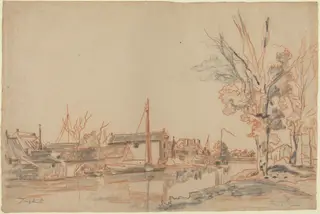
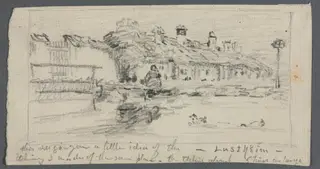
The Bridge, Schleissheim
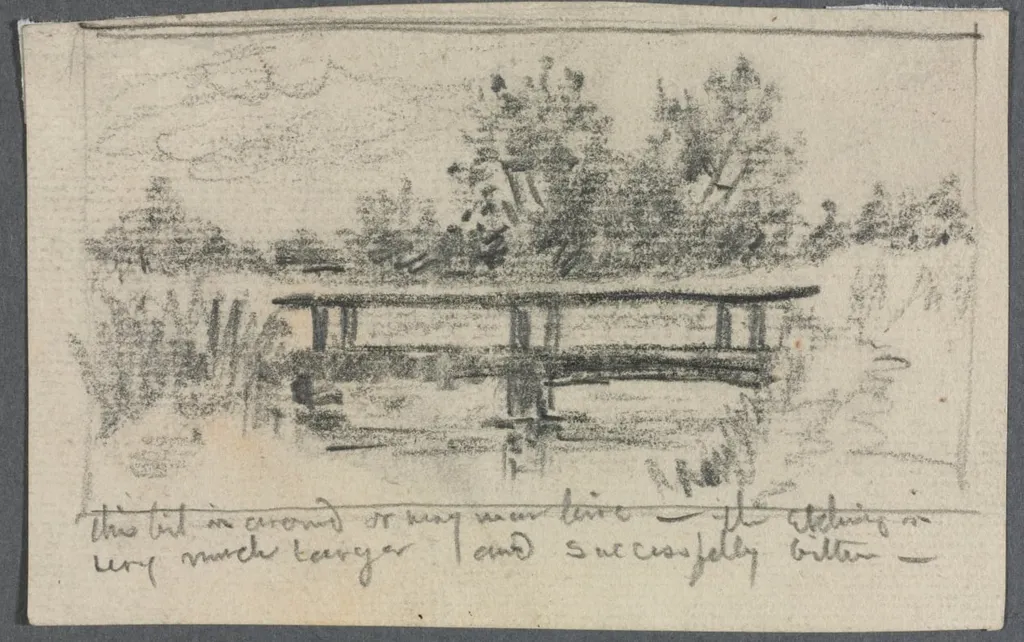
The Bridge, Schleissheim is a drawing by the Impressionist artist Otto H. Bacher. It dates from 1887 and is held in the collection of the Cleveland Museum of Art. Otto H.
- Accession no.
- 1921.235
About this work
Overview
Bacher, an American artist born in Cleveland in 1856, created this pencil or ink drawing in 1887 during a period when he was exploring European landscapes.
Otto H. Bacher, an American artist born in Cleveland in 1856, created this pencil or ink drawing in 1887 during a period when he was exploring European landscapes. Though known primarily for etchings and illustrations, he also produced intimate sketches in oil and on paper. The work, titled The Bridge, Schleissheim, is part of The Cleveland Museum of Art’s collection and reflects his interest in quiet, unadorned scenes from daily life.
Subject & Meaning
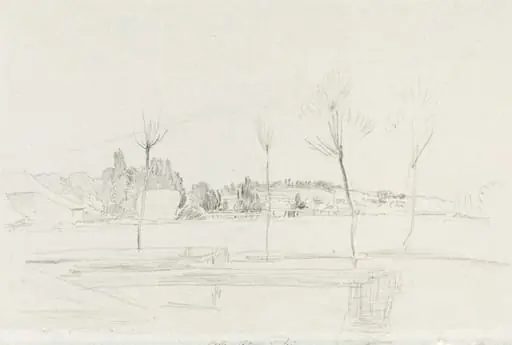
The drawing portrays a modest wooden bridge spanning a still stretch of water in Schleissheim, a village near Munich. Sparse trees frame the banks, and the sky is reduced to a thin horizon line, emphasizing the ground-level view. The absence of figures or dramatic elements suggests a contemplative observation of ordinary architecture and natural surroundings, valuing quiet presence over narrative.
Technique & Style
Bacher employed rapid, light strokes to suggest form rather than define it, creating a sense of immediacy. The bridge’s rough planks and the texture of the bank are rendered with minimal detail, avoiding polish or finish. This approach aligns with a sketchbook sensibility, where the act of recording a moment outweighs the need for polished composition, echoing the observational habits of emerging Impressionist practices.
History & Provenance
The drawing was made during Bacher’s time in Germany, likely while he was studying or traveling in the late 1880s. It entered The Cleveland Museum of Art’s collection through documented acquisition, preserving its connection to the artist’s early career. Its survival as a small, unassuming work reflects its role as a personal record rather than a commissioned piece.
Context
In the late 19th century, American artists increasingly traveled to Europe to study landscape and technique. Bacher’s sketch reflects this trend, capturing a rural German scene with the same directness seen in contemporary European plein air studies. Though not formally part of the Impressionist movement, his method shares its emphasis on transient light and unidealized subjects.
Legacy
The drawing stands as a quiet example of how American artists absorbed European visual habits without adopting their stylistic labels. Its informal character highlights Bacher’s broader practice: a commitment to observation over spectacle. As a work on paper, it offers insight into his process, revealing the preliminary thinking behind his more finished etchings and illustrations.
Artist & collection

Artist
Otto Henry Bacher (May 31, 1856, Cleveland - August 16, 1909, Bronxville, New York) was an American artist; primarily known for his etchings and illustrations. He also painted oils in a variety of genres.