Artwork
Lion's Head from the Capitoline Staircase
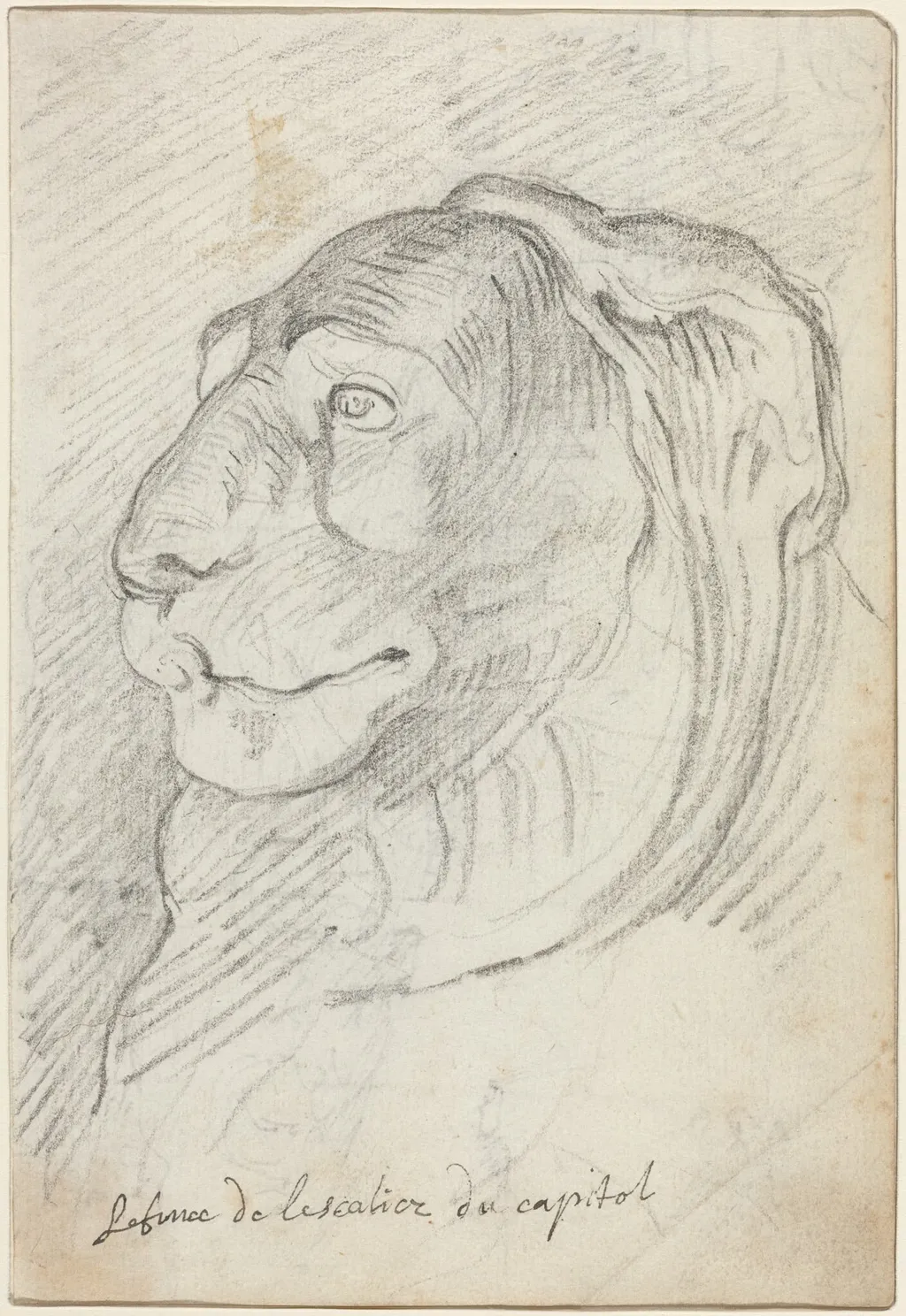
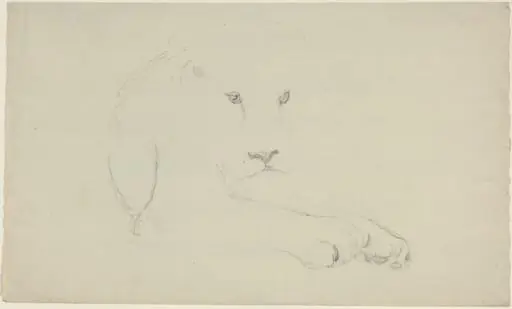
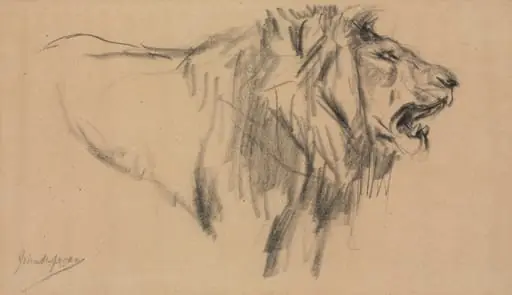
Lion's Head from the Capitoline Staircase is a chalk drawing by the Romanticist artist Augustin Pajou. It dates from 1754 and is held in the collection of the National Gallery of Art.
- Inscription
- Inscribed:lower center in ink: Lefinee de lescalier du capitol
About this work
Overview
Created in 1754, Lion's Head from the Capitoline Staircase is a study by the French sculptor Augustin Pajou executed in black chalk on laid paper.
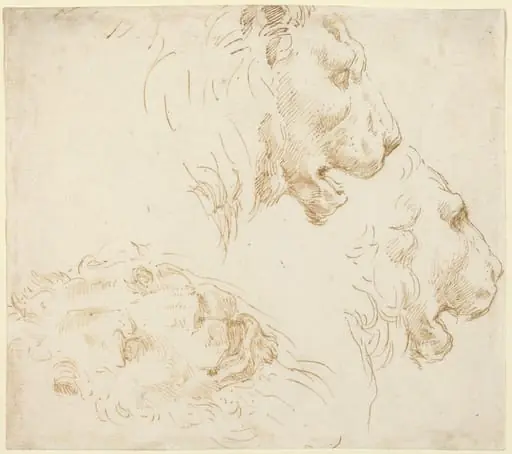
Created in 1754, Lion's Head from the Capitoline Staircase is a study by the French sculptor Augustin Pajou executed in black chalk on laid paper. The work depicts the head of a lion, rendered with loose, rapid strokes that capture the texture of the animal's rough fur. Pajou concentrates on the anatomical strength of the subject, emphasizing the powerful jawline and deep-set eyes through careful shading around the muzzle and orbital regions.
The drawing rests on paper with a warm, yellowish tone and bears a small signature at the bottom. This piece reflects Pajou's rigorous training in the French academic tradition, where detailed animal studies were essential for sculptors preparing for major commissions. The work likely served as a preparatory exercise or a record of observation, demonstrating the artist's ability to translate three-dimensional form and tactile surface qualities into a two-dimensional medium.
As an early work from the mid-18th century, it precedes Pajou's most famous neoclassical sculptures and highlights his foundational skill in capturing naturalistic detail and vitality.
Subject & Meaning
The study concentrates on the animal’s powerful jaw and the intensity of its deep-set eyes, conveying a sense of both ferocity and restraint. The composition suggests an observation of a sculptural lion, likely situated within an architectural setting.
Technique & Style
Pajou employs loose, rapid strokes to suggest the lion’s fur, using cross‑hatching to model shadow around the eyes and muzzle. The warm, yellowish tone of the laid paper provides a subtle background that enhances the contrast of the black chalk.
History & Provenance
Created in the mid‑18th century, the drawing bears the artist’s small signature at its lower edge. It reflects Pajou’s practice of producing preparatory studies for larger architectural or sculptural projects, though the specific source statue remains unidentified.
Own this work as a print
Artist & collection
Artist
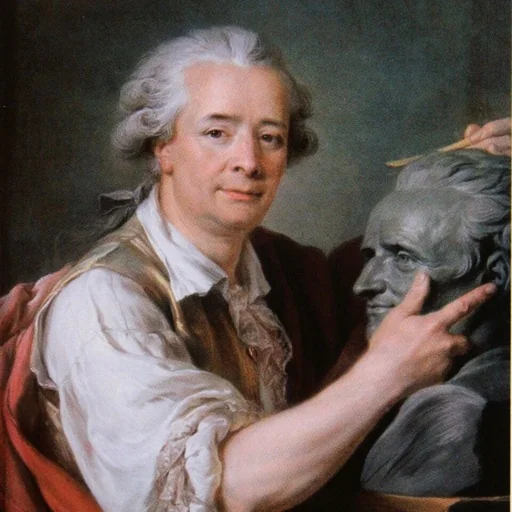
Augustin Pajou (French pronunciation:; 19 September 1730 – 8 May 1809) was a French sculptor, born in Paris. At eighteen he won the Prix de Rome, and at thirty exhibited his Pluton tenant Cerbère enchaîné (now in the Louvre).

![The Ripetta in Rome [verso], by Augustin Pajou](https://artifactworldgallery.com/img/augustin-pajou--the-ripetta-in-rome-verso--4bc04e9c9476a91b-w320.webp)
![Angel from the Assumption [recto], by Augustin Pajou](https://artifactworldgallery.com/img/augustin-pajou--angel-from-the-assumption-recto--59871eebf02790c8-w320.webp)