Artwork
Christian, Duke of Brunswick
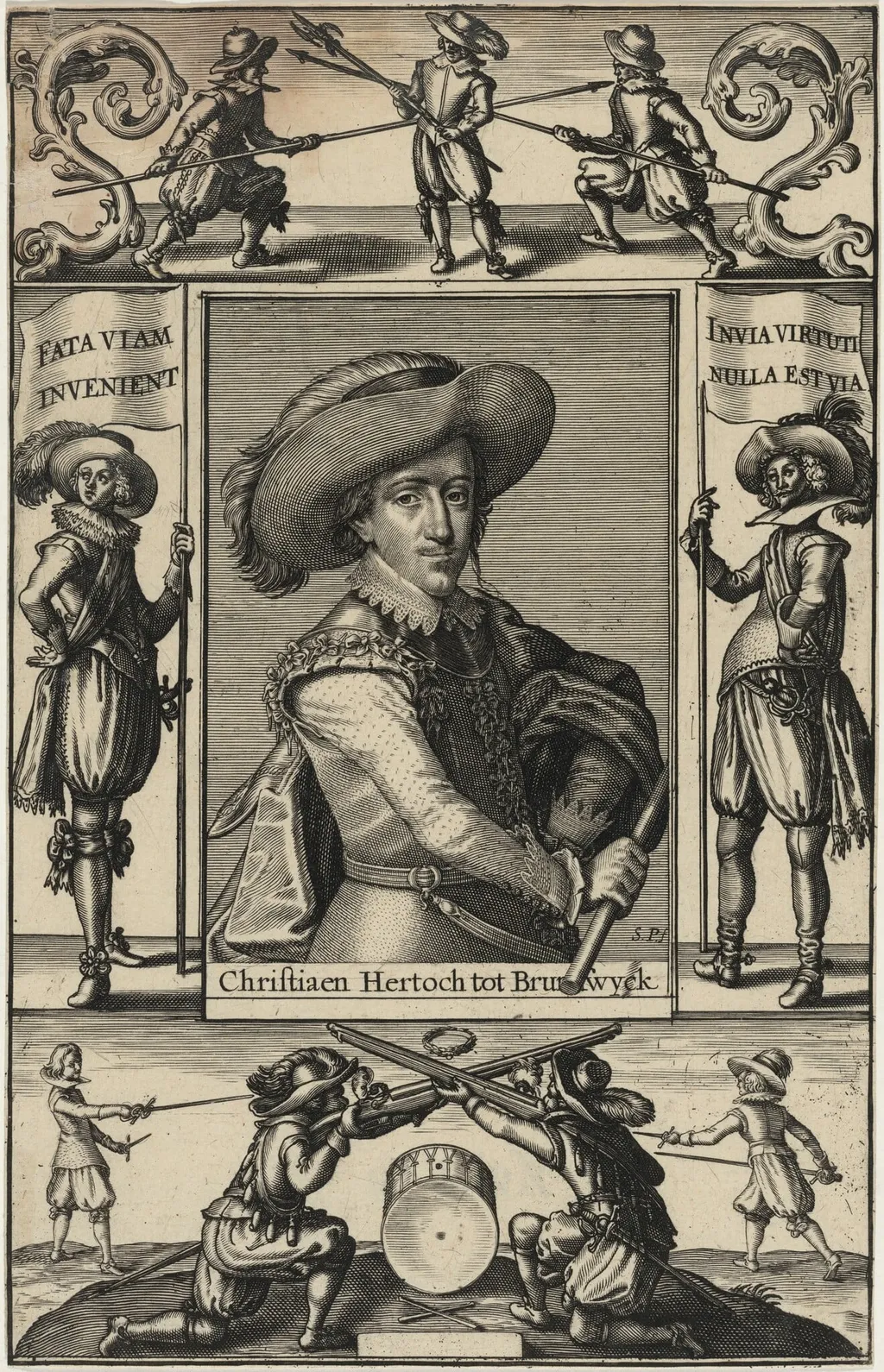
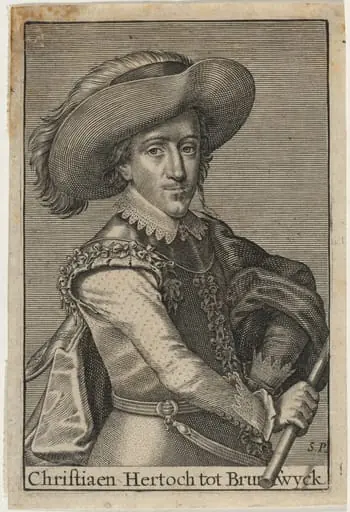
Christian, Duke of Brunswick is an ink print by the Renaissance artist Simon van de Passe. It dates from 1621 and is held in the collection of the National Gallery of Art.
About this work
Overview
The composition combines a formal likeness with symbolic scenes, characteristic of early 17th-century printed portraiture.
This 1621 engraving by Simon van de Passe depicts Christian, Duke of Brunswick, a German military leader. Rendered in fine linear detail, the portrait is centered within an ornate border containing smaller vignettes. The composition combines a formal likeness with symbolic scenes, characteristic of early 17th-century printed portraiture. The technique relies on precise engraving to achieve tonal depth and texture without color.
Subject & Meaning
Christian is portrayed with a stern expression, wearing a fur-trimmed coat and holding a sword, signaling his military authority. Surrounding miniatures illustrate scenes of warfare, drumming, and labor, suggesting his leadership across combat and administration. Latin inscriptions frame the image, reinforcing his status and the engraving’s function as a propagandistic or commemorative object. The arrangement implies a narrative of duty and command.
Technique & Style
Van de Passe employed fine, controlled lines to model form and texture, typical of Northern European engraving traditions. The main portrait uses delicate cross-hatching to suggest the weight of fabric and the sheen of metal, while the smaller scenes are rendered with equal precision but reduced scale. The border’s decorative elements and Latin text reflect the era’s fusion of art, heraldry, and textual authority in printed images.
History & Provenance
Created in 1621, the engraving was likely produced for distribution among Christian’s allies or patrons during the Thirty Years’ War. Simon van de Passe, a Dutch artist known for portrait prints, worked within a network of engravers supplying political and noble imagery. The print’s survival in multiple institutional collections indicates its circulation among European elites seeking to document or honor military figures of the time.
Context
During the early 1620s, Protestant leaders like Christian of Brunswick were central to the religious and political conflicts of the Thirty Years’ War. Engravings such as this served as tools of identity and propaganda, circulating images of commanders to bolster morale and legitimacy. The integration of allegorical scenes alongside portraiture was a common strategy to convey multifaceted leadership in an era before photography.
Legacy
Van de Passe’s engraving exemplifies the role of print in shaping public perception of early modern nobility. While not widely known today, such works were influential in their time, contributing to the visual language of military leadership. The piece remains a reference for studying how portraiture and symbolism were combined in print culture to communicate power and authority across Europe.
Own this work as a print
Artist & collection