Artwork
Madonna and Child
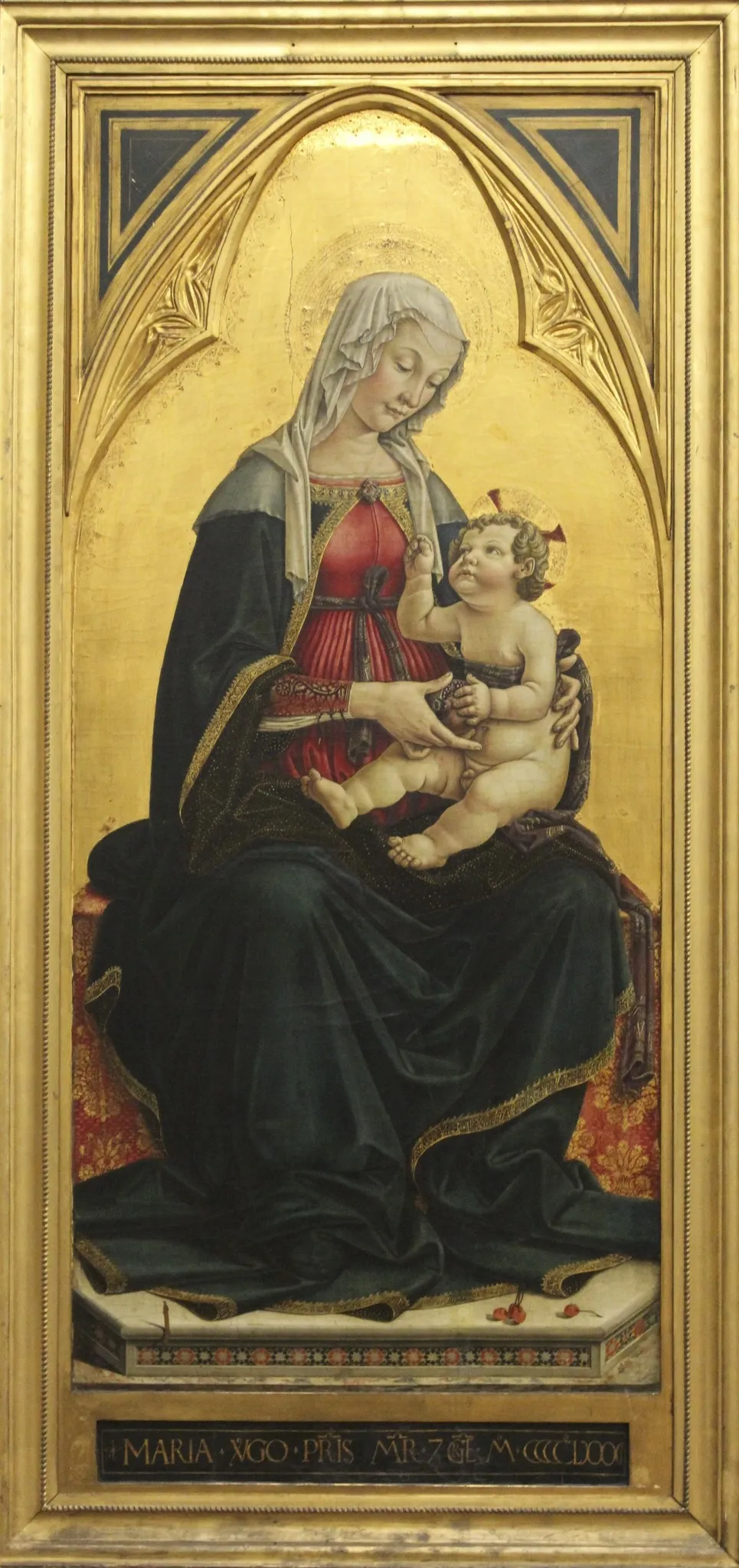
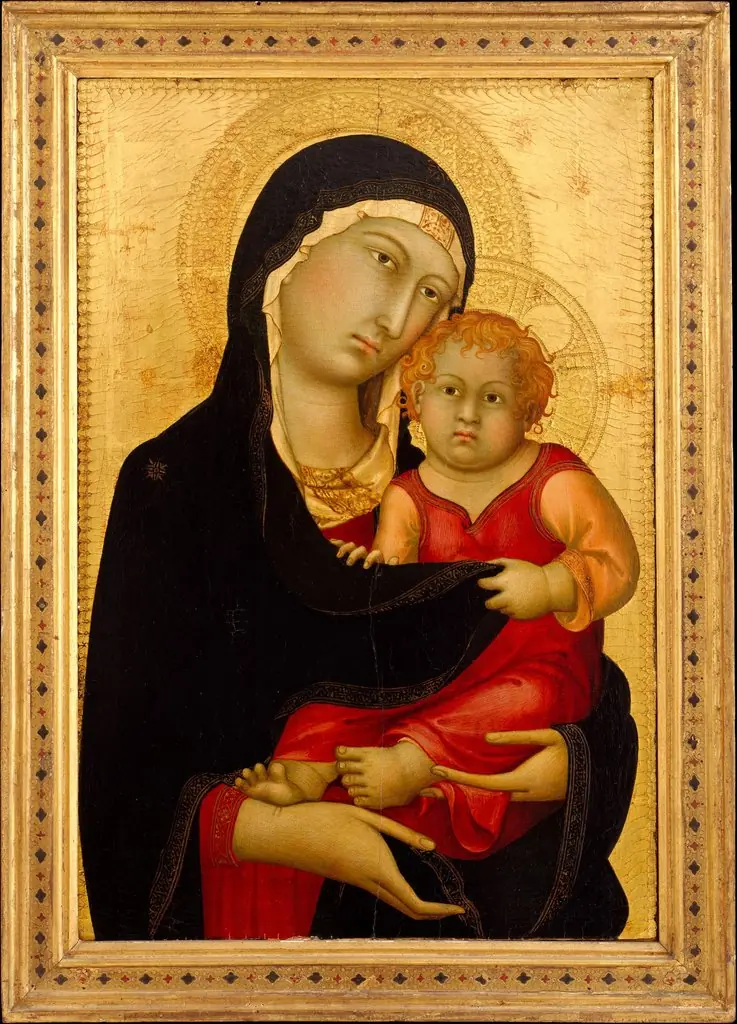
Madonna and Child is a paint painting by the Early Renaissance artist Piermatteo Lauro de' Manfredi da Amelia. It dates from 1491 and is held in the collection of the Gemäldegalerie Berlin.
About this work
Overview
Madonna and Child is a religious painting created in 1481 by the Italian Renaissance artist Piermatteo Lauro de' Manfredi da Amelia.
Madonna and Child is a religious painting created in 1481 by the Italian Renaissance artist Piermatteo Lauro de' Manfredi da Amelia. Executed in paint on a poplar panel, the work measures 144 cm in height and 66 cm in width. Originally forming the central section of a larger polyptych, the panel is now housed in the Gemäldegalerie Berlin, located in hall XVIII dedicated to Italian painting of the 13th to 15th centuries. The painting is significant both as a representative work of Piermatteo, who was formerly known by the conventional name Master of the Gardner Annunciation, and as a component of a dispersed Augustinian altarpiece.
Subject & Meaning
The painting depicts the Virgin Mary seated with the Christ Child on her lap beneath a pointed Gothic arch. Mary wears a red dress and a dark blue mantle fastened with a brooch adorned with pearls and red stones, symbols of her virginity and heavenly love. She gazes downward, smiling at the infant, who looks up at her with his right hand raised in a childish gesture. The Christ Child is nude except for a draped mantle and a leading band held by his mother, a departure from earlier traditions that depicted the child fully clothed, reflecting a shift toward a more human and intimate relationship between mother and child. The child holds a pomegranate, which he offers to Mary, symbolizing Christian fertility, unity, immortality, and resurrection. A small votive candle on the pedestal identifies Mary as a mediator between God and humanity, while red cherries resting on the white ledge symbolize good works. Both figures feature gold halos, with the child's halo shown in perspective to reveal the cross, a reference to his future Passion.
Technique & Style
The work is executed in tempera on a poplar panel, characterized by a smooth finish with minimal visible brushwork. Fine linear details define the drapery folds and the decorative gold edging on the garments. The composition places the figures in a shallow space against a flat gold background, with a patterned red and gold cushion behind them. Light falls evenly from the left, modeling the rounded forms of the faces and limbs. The palette is dominated by deep blue, vermilion red, and burnished gold. The gold background incorporates a nearly circular halo for Mary, while the child's cross-nimbus is rendered in foreshortening. A gold border with a black inscription panel frames the bottom of the scene.
History & Provenance
The panel was commissioned around 1480 by Augustinian monks for the high altar of the church of Sant'Agostino in Orvieto. Archival research published in 1992 confirmed Piermatteo's authorship and detailed the economic effort required to finance the altarpiece, including the sale of land and a house share, as well as borrowing funds. On August 17, 1481, the polyptych was delivered and accepted as made according to the rules of art, with Piermatteo receiving 245 florins alongside cloth and grain. The altarpiece was later dismantled and its panels scattered. The central Madonna and Child entered the Gemäldegalerie Berlin, accessioned under number 129. The side panels depicting Mary Magdalen and John the Baptist are now in the Lindenau-Museum in Altenburg, a panel of Saint Nicholas of Tolentino is in the Philadelphia Museum of Art, and a panel of Saint Augustine was sold at Christie's in 1967 and is presumed to be in private hands.
Context
Piermatteo d'Amelia was an Umbrian painter active during the Italian Renaissance. He began his career in the circle of Filippo Lippi in Spoleto between 1467 and 1469, and later worked in Rome painting the starry ceiling of the Sistine Chapel from 1479 to 1480, a fresco subsequently covered by Michelangelo. While engaged in Orvieto Cathedral projects between 1480 and 1482, he accepted the Sant'Agostino commission. Art historians Umberto Gnoli, Roberto Longhi, and Bernhard Berenson initially grouped his works under the name Master of the Gardner Annunciation, after a series of paintings acquired by Isabella Stewart Gardner in 1880. In 1953, Federico Zeri identified the anonymous master as Piermatteo, a conclusion confirmed in 1985 by the discovery of a notarial contract dated September 29, 1483. Zeri situated Piermatteo among the great painters of the fifteenth century, noting his later stylistic proximity to Antoniazzo Romano.
Legacy
The identification of Piermatteo d'Amelia by Federico Zeri rescued the artist from anonymity and established his place within the narrative of Renaissance painting. The Madonna and Child, as the central panel of the dispersed Sant'Agostino Polyptych, remains a crucial piece for understanding his oeuvre and the broader circulation of Umbrian art. The dismantling of the altarpiece led to the international distribution of its components across major museums in Berlin, Altenburg, and Philadelphia, embedding his work in prominent European and American collections. Piermatteo's legacy continues to be celebrated in his native region, evidenced by a multidisciplinary project dedicated to him in Amelia and surrounding Umbrian communes in 2025, which included photographic documentation and a musical composition structured around the Fibonacci sequence.
Artist & collection
Artist
Piermatteo Lauro de' Manfredi da Amelia
Piermatteo Lauro de' Manfredi da Amelia (1445–1508) was an artist, born in Amelia.