Artwork
Madonna and Child Enthroned
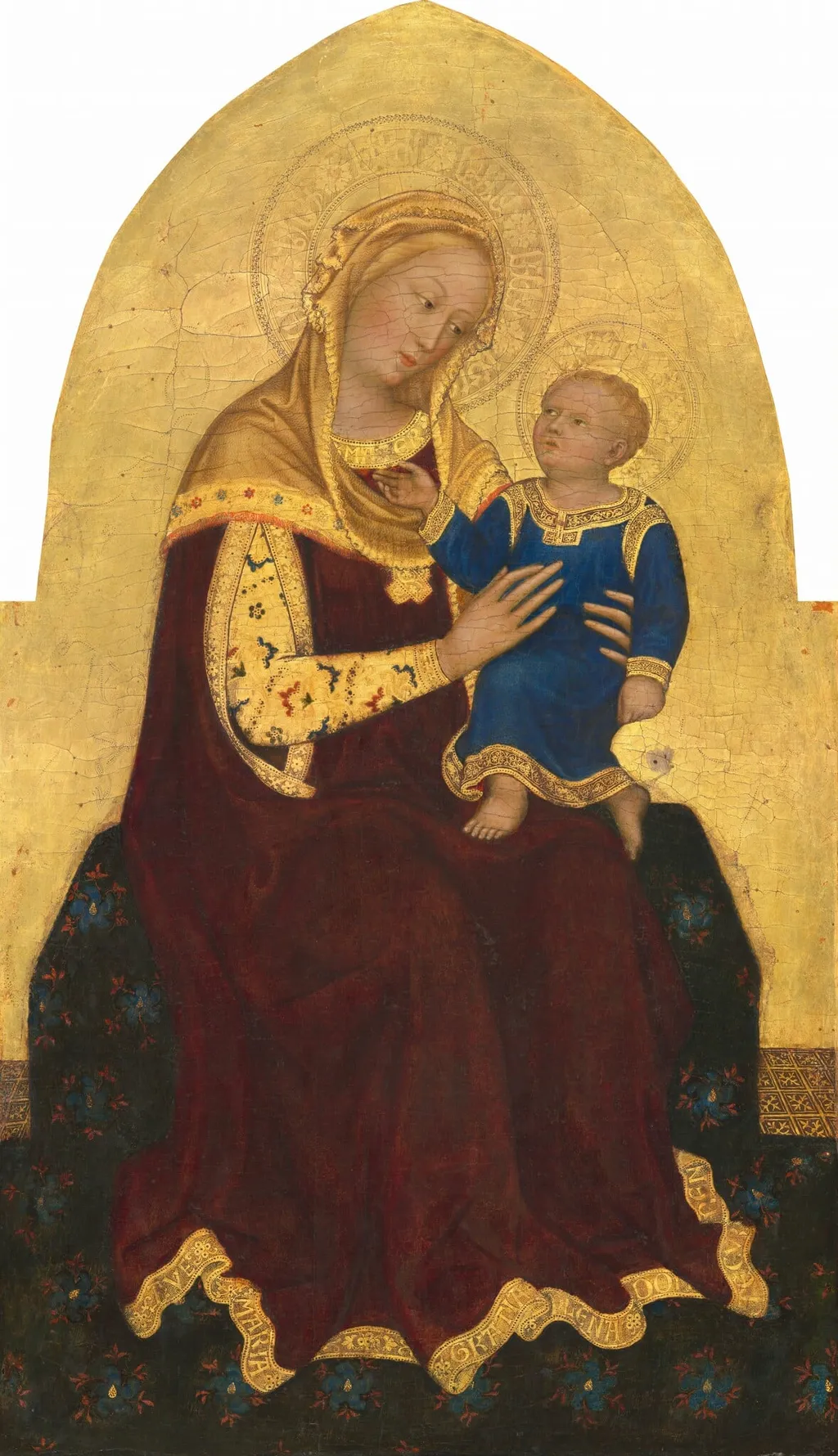
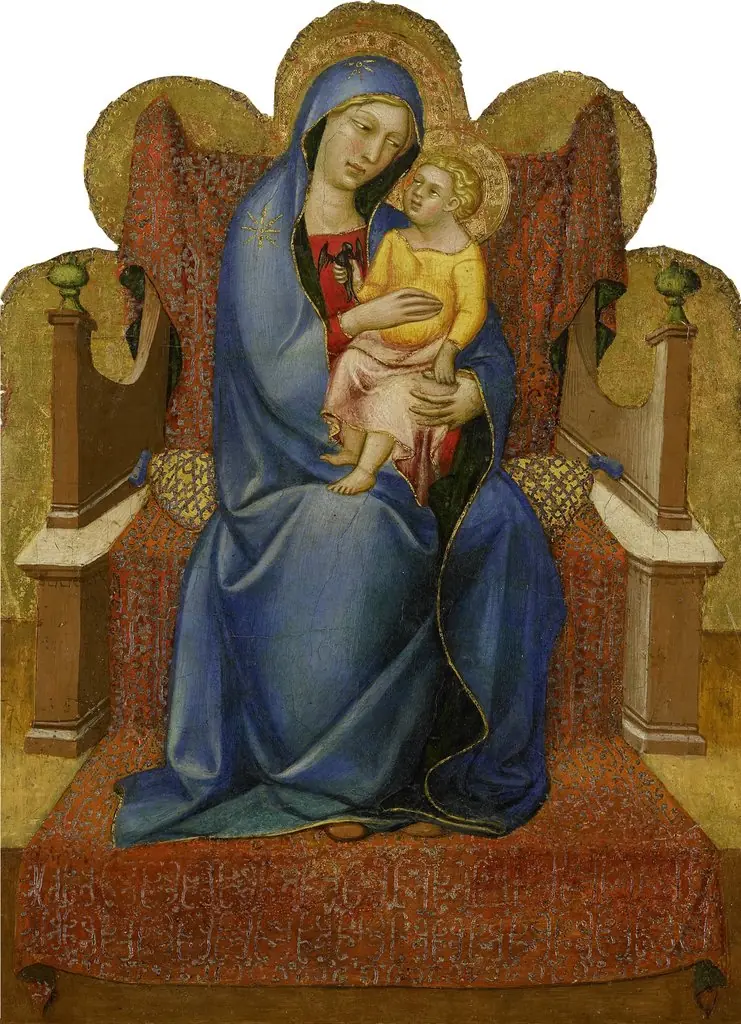
Madonna and Child Enthroned is a tempera painting by the Early Renaissance artist Gentile da Fabriano. It dates from 1420 and is held in the collection of the National Gallery of Art.
- Inscription
- Inscribed:upper center on the Virgin's collar: MATER (Mother) [DEI]; across bottom on the hem of her dress: AVE MARIA GRATIA PLENA DOM[INVS] TECV[M] BEN[EDICTA] (Hail, Mary, full of grace, the Lord is with thee, blessed), from Luke 1:28
About this work
Inscribed along her hem with the words Ave Maria Gratia Plena, the Virgin sits on a wide bench against a tooled gold ground, the Christ Child on her lap. Gentile da Fabriano painted the panel around 1420, soon after the master from the Marche reached Florence, bringing the lustrous fabrics and rhythmic line of International Gothic to the city that would soon produce Masaccio.
Subject & Meaning
Inscriptions on her garment read “Ave Maria Gratia Plena” and “Mater Dei,” explicitly linking her to the Annunciation and her identity as Mother of God.
The painting depicts the Virgin Mary seated on a simple cubic throne, holding the Christ Child against a gold ground incised with angelic figures. Its subject is the Madonna and Child, a central Christian icon. Iconographically, Mary’s purple robe, a color of royalty, and the gold ground signify her role as Queen of Heaven.
Inscriptions on her garment read “Ave Maria Gratia Plena” and “Mater Dei,” explicitly linking her to the Annunciation and her identity as Mother of God. The Child’s finely decorated tunic and his active pose, as if to climb onto Mary’s lap, emphasize the intimate psychological bond between mother and son, humanizing the divine figures. Some references mention a pomegranate, a symbol of the Resurrection, but this detail may reflect an earlier restoration and is not definitively present.
The simple throne and perspectival tiles in the background show the artist’s engagement with Tuscan spatial rationality, grounding the sacred scene in a more immediate reality.
Technique & Style
Executed in tempera and gold leaf on a poplar panel, the Madonna and Child Enthroned employs a gold ground that, characteristic of Gentile da Fabriano's work, is incised with delicate angelic figures visible only in backlight. Mary sits on a simple cubic block covered with an embroidered floral drape, a departure from the ornate Gothic thrones of the artist's earlier Venetian period. Her purple dress is trimmed with velvet reverses and extensive gold detailing, including an inscribed hem reading 'Ave Maria Gratia Plena...' and a collar with 'Mater [Dei].'
The Christ Child wears a finely decorated tunic. The composition emphasizes the psychological interaction between mother and son. The background features a band of tiles rendered in intuitive perspective, reflecting the influence of Tuscan spatial culture on the artist.
History & Provenance
The painting was executed by Gentile da Fabriano around 1420–1423, soon after his arrival in Florence in the summer of 1420, and is considered one of his first works in the city. It may have served as the central panel of a now-lost polyptych. The earliest recorded mention of the work is from 1874, when it was auctioned in London from the collection of Alexander Barker, who likely acquired it in Florence.
Subsequent owners included E.J. Sartoris, and the dealers Nathan Wildenstein and René Gimpel. In 1918 it was purchased by Henry Goldman, and later handled by Duveen Brothers, who sold it in 1937 to the Samuel H. Kress Foundation. The Kress Foundation donated the panel to the National Gallery of Art in Washington, D.C., in 1939.
The painting is held in the National Gallery of Art in Washington, D.C., as part of the Samuel H. Kress Collection (gifted in 1939). It was exhibited at the Royal Academy of Arts, London in 1876 (Winter Exhibition of Works by the Old Masters), at the Musée des Arts Décoratifs in Paris in 1910, and at the Metropolitan Museum of Art in New York in 1920 (Fiftieth Anniversary Exhibition).
Context
The work is generally regarded as among Gentile da Fabriano's earliest Florentine productions, executed circa 1420–1423 shortly after his arrival in the city and concurrent with his work on the Pala Strozzi. It may have originally been the central panel of a lost polyptych (3,4). Scholars have noted a shift from the artist's earlier Venetian Gothic style toward a simpler, more monumental composition: Mary sits on a plain cubic seat rather than an elaborate throne, while the gold ground retains delicate incised angels (4).
The painting displays richly detailed goldwork with inscriptions, but the core emphasis is the tender, psychological exchange between mother and child (4). The inclusion of perspectivally rendered tiles in the background reveals Gentile's engagement with Tuscan spatial conventions, marking a significant moment in his stylistic evolution (4).
Overview
This tempera and gold panel, painted by Gentile da Fabriano around 1420–1423, depicts the Madonna and Child enthroned. Now housed in the National Gallery of Art, Washington, D.C., it represents a key moment in the artist's career, marking his arrival in Florence. The work showcases the refined aesthetic of the International Gothic style, which Gentile introduced to the burgeoning artistic center.
Artist & collection

Artist
Gentile da Fabriano was a traveler who followed the money. Around 1420 he landed in Florence chasing richer patrons than his Umbrian hometown could offer. He liked gold leaf more than gold coins, his paintings shimmer…