Artwork
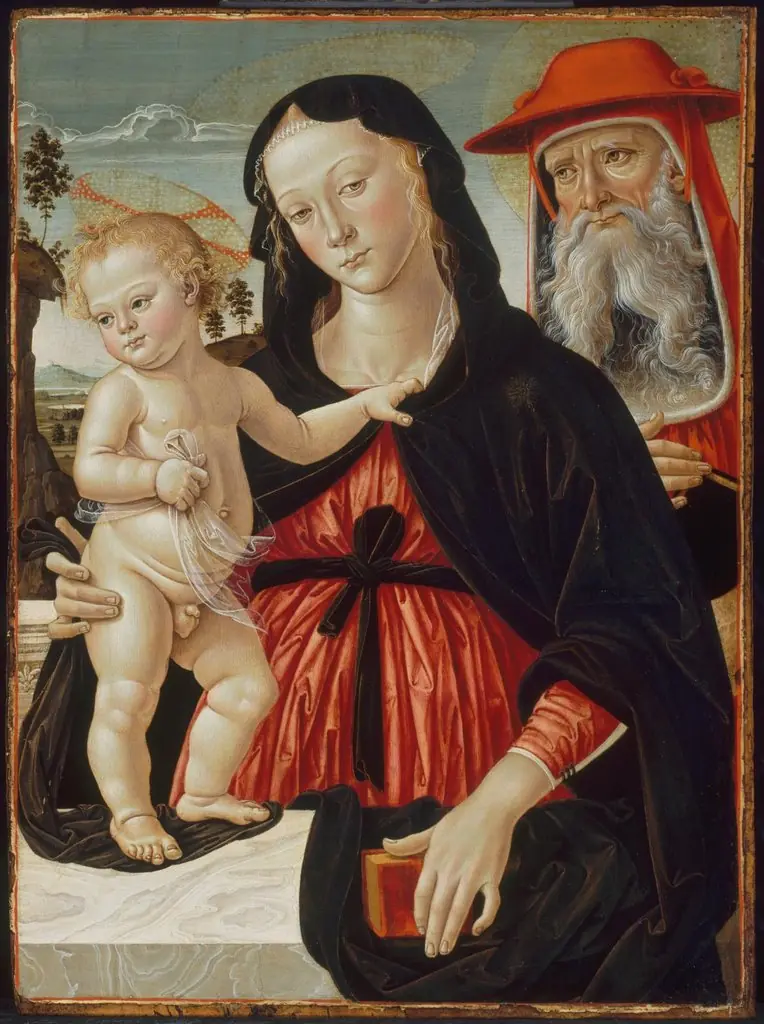
Madonna and Child with Saint Jerome
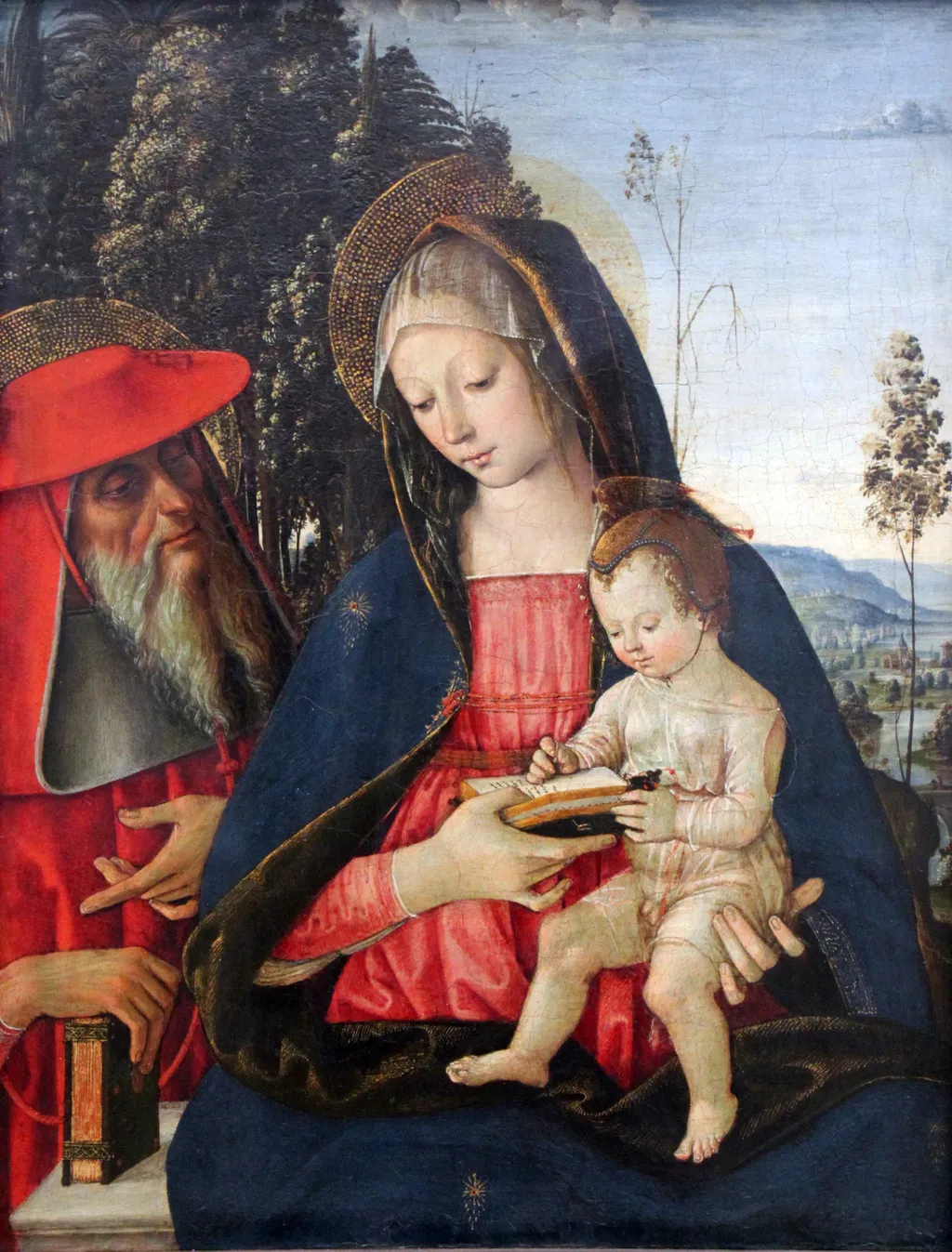
Madonna and Child with Saint Jerome is an oil painting by the Early Renaissance artist Pinturicchio. It dates from 1490 and is held in the collection of the Gemäldegalerie Berlin.
About this work
This painting is called Madonna and Child with Saint Jerome. It was made by Pinturicchio in the 15th century. The artist created it using oil paint, a common medium at the time.
Pinturicchio was an Italian painter, which might have influenced his work. You can learn more about the style of this painting by looking at the work of Pinturicchio.
Subject & Meaning
The composition includes an expansive landscape fading into the distance on the right, a characteristic element of the Umbrian school of Renaissance painting.
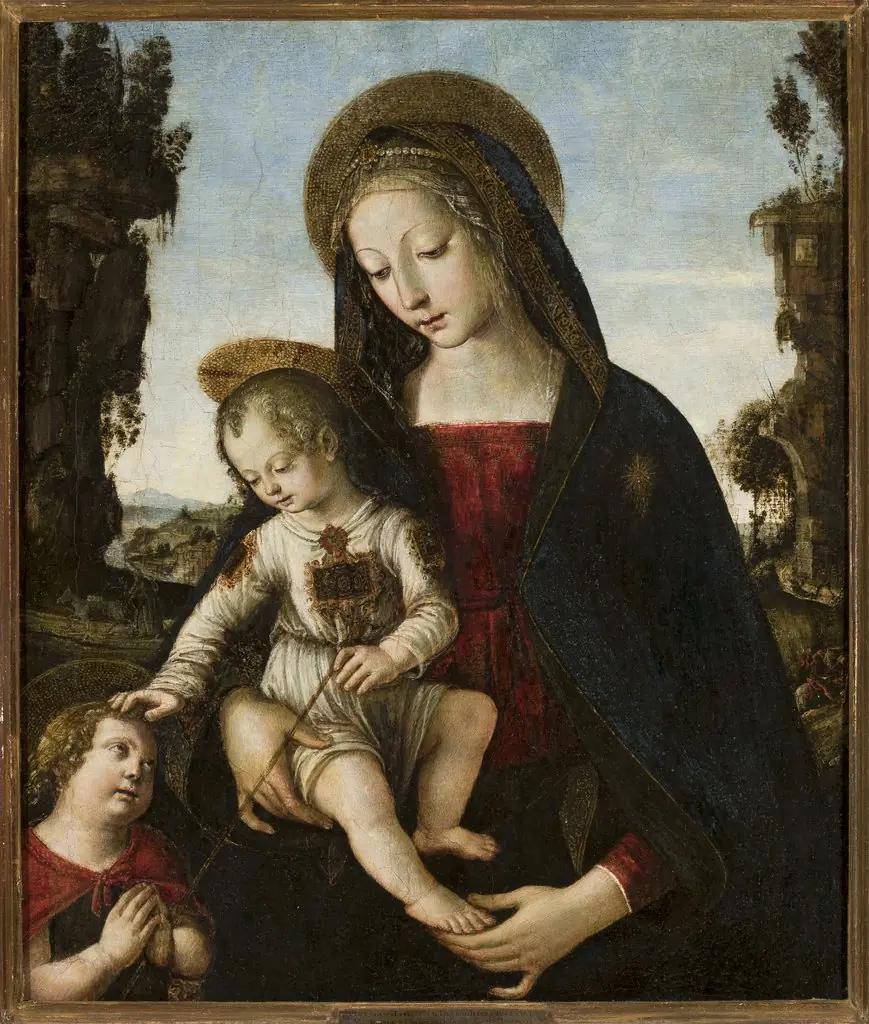
This painting presents an uncommon iconography in which the Virgin Mary holds the Christ Child, who is depicted writing in a book. This specific action serves as an allusion to the Child's future intervention in the Holy Scriptures. To the right stands Saint Jerome, identifiable by his cardinal's vestments, holding a book that symbolizes his status as a man of learning and culture. He is shown resting this attribute on the marble throne occupied by the Madonna.
The Christ Child wears a distinctive coif lined with pearls, a stylistic detail also found in Pinturicchio's earlier works and those of Fiorenzo di Lorenzo, before the artist shifted to depicting the figure with free, curly hair. The composition includes an expansive landscape fading into the distance on the right, a characteristic element of the Umbrian school of Renaissance painting.
Technique & Style
The work is executed in oil paint on panel, a support choice consistent with Pinturicchio's practice in the early 1480s. The painting is small in scale, measuring 49.5 by 38 cm.
Stylistically, the composition belongs to the Umbrian school of the Italian Renaissance. The Virgin is seated on a marble throne, beside which Saint Jerome in cardinal dress rests a book, while the Christ Child writes in a volume, an allusion to his role in the Holy Scriptures. The Child wears a pearl-lined coif, a refined motif that Pinturicchio also employed in the Crucifixion Between Saints Jerome and Christopher (c. 1475, Borghese Gallery) and that was shared with the contemporary Umbrian painter Fiorenzo di Lorenzo, before Pinturicchio later abandoned it in favour of freely curling hair. An open, atmospheric landscape recedes on the right, a hallmark of Umbrian Renaissance painting.
Context
Painted by Pinturicchio around 1481, the work is recognized for its uncommon iconography where the Christ Child writes in a book, symbolizing his role in the Holy Scriptures. This specific depiction of the Child wearing a pearl-lined coif connects the piece to the artist's earlier Crucifixion Between Saints Jerome and Christopher and reflects a motif also utilized by Fiorenzo di Lorenzo before Pinturicchio shifted toward depicting the Child with free, curly hair. The painting exemplifies the Umbrian school through its inclusion of an open landscape fading into the distance.
Held in the Gemäldegalerie in Berlin, the work illustrates the artist's engagement with religious themes and the intellectual attributes of Saint Jerome during the Italian Renaissance.
Legacy
The painting Madonna and Child with Saint Jerome by Pinturicchio, created around 1480–1481, influenced later depictions of the Virgin and Child in scholarly contexts through its unique compositional choices. The motif of the Christ Child writing on a book, symbolizing theological insight, appears in subsequent Renaissance works and was noted by scholars such as Cristina Acidini as a distinctive element of Pinturicchio's style. This iconography was later abandoned by the artist in favor of more naturalistic hair treatments, as observed in comparative analysis of his works, including those in the Borghese Gallery.
The painting's composition, featuring Saint Jerome in cardinal attire with a book on a marble throne and an open landscape background, became a reference point for the depiction of learned saints in sacred art. Its stylistic elements, such as the pearl-lined coif on the Child and the Umbrian landscape tradition, contributed to the visual language of religious imagery in the late 15th century.
The work is housed in the Gemäldegalerie in Berlin and is documented in both Italian and English language sources, including academic publications and museum catalogues.
Overview
Created in 1481, the work titled Madonna and Child with Saint Jerome is an oil painting by the Italian Renaissance artist Pinturicchio. The composition brings together the Virgin Mary with the infant Jesus and the scholarly saint Jerome, set within a balanced, devotional scene. Today the panel forms part of the collection of the Gemäldegalerie in Berlin, where it is displayed among other works of the period.
History & Provenance
After its completion in the early 1480s, the painting entered private collections before eventually being acquired by the Gemäldegalerie in Berlin, where it has been conserved as part of the museum’s Renaissance holdings. Its documented provenance traces a path from Italian patronage to German institutional care, illustrating the broader movement of Italian artworks across Europe in the centuries following their creation.
Own this work as a print
Artist & collection

Artist
Pinturicchio, or Pintoricchio (US: Italian:; born Bernardino di Betto; 1454–1513), also known as Benetto di Biagio or Sordicchio, was an Italian Renaissance painter.