Artwork
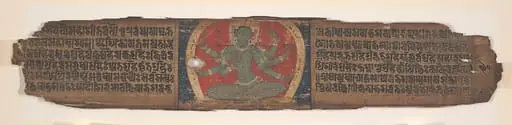
Prajnaparamita flanked by a white female figure and a white bodhisattva, folio 90 (recto), from a Manuscript of the Perfection of Wisdom in Eight Thousand Lines (Ashtasahasrika Prajnaparamita-sutra)

Prajnaparamita flanked by a white female figure and a white bodhisattva, folio 90 (recto), from a Manuscript of the Perfection of Wisdom in Eight Thousand Lines (Ashtasahasrika Prajnaparamita-sutra) is an unspecified painting. It dates from 1119 and is held in the collection of the Cleveland Museum of Art. The recto of folio 90 from a 12th‑century manuscript of the Ashtasahasrika Prajnaparamita‑sutra presents a triptych composition.
About this work
To learn more about the techniques used in this painting, look up the term "chiaroscuro".
This painting shows three figures on a long, narrow piece of material. The middle figure is a woman with a crown, sitting cross-legged. She has four arms and is holding objects in her hands.
On either side of her are smaller figures, also sitting cross-legged. They are all painted in shades of red, white, and blue.
The figures are surrounded by text in a foreign language. The text is written in black ink and is arranged in rows on either side of the figures.
The painting is an example of religious art from the 12th century. To learn more about the techniques used in this painting, look up the term "chiaroscuro".
History & Provenance
The manuscript folio was created in 1119, as indicated by its canonical date.
Its early provenance is undocumented, but by the 20th century it had entered the collection of the Cleveland Museum of Art, where it is held today. The work was accessioned by the museum as part of its holdings of Asian paintings, with no record of private ownership or sale prior to its museum acquisition.
The manuscript folio is held in the collection of the Cleveland Museum of Art, located in Cleveland. The institution acquired the work, which dates to 1119, as part of its holdings of Asian art. The provided sources confirm the current location and collection status of the painting but do not contain specific inventory or accession numbers. Furthermore, no information regarding the exhibition history of this specific folio is available in the referenced materials.
Overview
The recto of folio 90 from a 12th‑century manuscript of the Ashtasahasrika Prajnaparamita‑sutra presents a triptych composition. A central, crowned female deity with four arms occupies the middle, while two smaller, cross‑legged figures flank her on either side. The scene is rendered in a limited palette of red, white and blue, and is framed by rows of black‑ink Sanskrit text.
Subject & Meaning
The central figure represents Prajñāpāramitā, the personification of transcendent wisdom in Mahāyāna Buddhism. Her four arms hold symbolic implements that denote the various aspects of enlightened insight. The attendant figures, identified as a white female attendant and a white bodhisattva, serve as supportive presences, emphasizing the communal transmission of the sutra’s teachings.
Technique & Style
Executed on a narrow, elongated support, the painting employs flat washes of pigment with subtle gradations that suggest three‑dimensional form without full modeling. The use of chiaroscuro is restrained, relying on contrasts between the vivid reds and the lighter whites and blues to articulate volume. Black ink outlines define the figures and integrate them with the surrounding script.
Context
During the medieval period, Buddhist manuscripts often combined textual transmission with visual exegesis. The depiction of Prajñāpāramitā alongside attendant figures reflects a didactic purpose, guiding readers toward an embodied understanding of the sutra’s abstract concepts through iconography.

Artist & collection

 Text, folio 3 (recto), from a Manuscript of the Perfection of Wisdom in Eight Thousand Lines (Ashtasahasrika Prajnaparamita-sutra)
 Text, folio 186 (recto), from a Manuscript of the Perfection of Wisdom in Eight Thousand Lines (Ashtasahasrika Prajnaparamita-sutra)
 Perfection of Wisdom in Eight Thousand Lines: Ashtasahasrika Prajnaparamita: Decorated Leaf
 Prajnaparamita flanked by two female figures, folio 1 (verso), from a Manuscript of the Perfection of Wisdom in Eight Thousand Lines (Ashtasahasrika Prajnaparamita-sutra)
 Text, Folio 5 (recto), from a Manuscript of the Perfection of Wisdom in Eight Thousand Lines (Ashtasahasrika Prajnaparamita-sutra)
 Text, Folio 6 (recto), from a Manuscript of the Perfection of Wisdom in Eight Thousand Lines (Ashtasahasrika Prajnaparamita-sutra)
 Perfection of Wisdom in Eight Thousand Lines: Ashtasahasrika Prajnaparamita: Decorated Leaf
 Untitled
- Prajnaparamita flanked by a white female figure and a white bodhisattva, folio 90 (recto), from a Manuscript of the Perfection of Wisdom in Eight Thousand Lines (Ashtasahasrika Prajnaparamita-sutra)
 Three female figures, folio 89 (verso), from a Manuscript of the Perfection of Wisdom in Eight Thousand Lines (Ashtasahasrika Prajnaparamita-sutra)
 Three female figures, folio 89 (verso), from a Manuscript of the Perfection of Wisdom in Eight Thousand Lines (Ashtasahasrika Prajnaparamita-sutra)
 Text, Folio 33 (recto), from a Manuscript of the Perfection of Wisdom in Eight Thousand Lines (Ashtasahasrika Prajnaparamita-sutra)