Artwork
Text, folio 3 (recto), from a Manuscript of the Perfection of Wisdom in Eight Thousand Lines (Ashtasahasrika Prajnaparamita-sutra)

Text, folio 3 (recto), from a Manuscript of the Perfection of Wisdom in Eight Thousand Lines (Ashtasahasrika Prajnaparamita-sutra) is an unspecified painting. It dates from 1119 and is held in the collection of the Cleveland Museum of Art.
About this work
Technique & Style
The specific materials, pigments, and current physical condition of the folio are not detailed in the available records.
Created in 1119 at Vikramaśīla, this work is a folio from a religious manuscript of the Ashtasahasrika Prajnaparamita-sutra (the Perfection of Wisdom in Eight Thousand Lines). The support is the recto of a page bearing the calligraphic text of the sutra. The object is currently held in the Cleveland Museum of Art, where it is catalogued under accession number 1938.301.3.a.
The specific materials, pigments, and current physical condition of the folio are not detailed in the available records.
History & Provenance
This folio from a manuscript of the Perfection of Wisdom in Eight Thousand Lines was created in 1119 at Vikramaśīla. The work was produced by an unidentified scribe as a piece of religious art. It eventually entered the collection of the Cleveland Museum of Art, where it is held under accession number 1938.301.3.a.
Overview
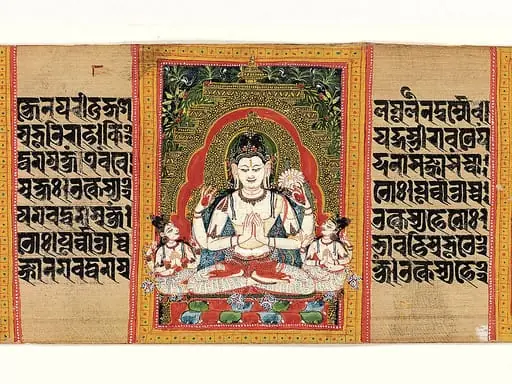
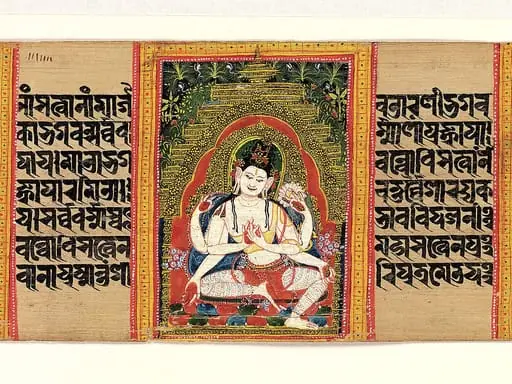
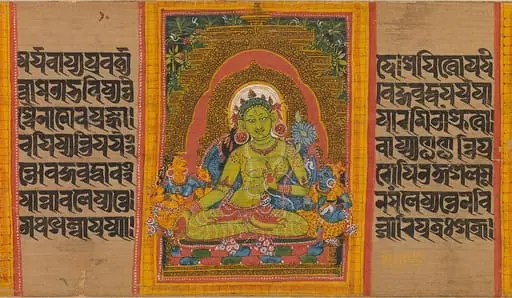
This artwork is folio 3 (recto) from a manuscript of the Ashtasahasrika Prajnaparamita-sutra, also known as the Perfection of Wisdom in Eight Thousand Lines. As a painted manuscript page, it combines calligraphic text with illustrative imagery. The long, narrow sheet features three distinct pictorial sections, each depicting a seated figure, interspersed with lines of script. The overall appearance suggests an ancient and well-used devotional or scholarly object.
Subject & Meaning
The central image on the folio portrays a four-armed figure seated cross-legged, encircled by a white halo against a blue ground. This iconography often represents a significant deity or bodhisattva within Buddhist traditions, embodying aspects of wisdom or compassion. Flanking this central image, two additional figures are depicted in similar meditative postures, each set against a red background, contributing to the manuscript's visual narrative related to the Perfection of Wisdom teachings.
Context
Over time, the manuscript folio has acquired visible signs of age and use. The paper itself has yellowed, indicating its antiquity. Furthermore, the surface exhibits several tears and small holes, which attest to its extensive handling and the passage of centuries. These physical imperfections offer a tangible record of the object's long history and its journey through time.

Artist & collection

 Perfection of Wisdom in Eight Thousand Lines: Ashtasahasrika Prajnaparamita: Decorated Leaf
 Prajnaparamita flanked by a white female figure and a white bodhisattva, folio 90 (recto), from a Manuscript of the Perfection of Wisdom in Eight Thousand Lines (Ashtasahasrika Prajnaparamita-sutra)
 Perfection of Wisdom in Eight Thousand Lines: Ashtasahasrika Prajnaparamita: Decorated Leaf
 Three female figures, folio 89 (verso), from a Manuscript of the Perfection of Wisdom in Eight Thousand Lines (Ashtasahasrika Prajnaparamita-sutra)
 Perfection of Wisdom in Eight Thousand Lines: Ashtasahasrika Prajnaparamita
 Perfection of Wisdom in Eight Thousand Lines: Ashtasahasrika Prajnaparamita: Decorated Leaf (recto)
 Prajnaparamita flanked by a white female figure and a white bodhisattva, folio 90 (recto), from a Manuscript of the Perfection of Wisdom in Eight Thousand Lines (Ashtasahasrika Prajnaparamita-sutra)
 Untitled
 Untitled
 Untitled