Artwork
Text, Folio 5 (recto), from a Manuscript of the Perfection of Wisdom in Eight Thousand Lines (Ashtasahasrika Prajnaparamita-sutra)

Text, Folio 5 (recto), from a Manuscript of the Perfection of Wisdom in Eight Thousand Lines (Ashtasahasrika Prajnaparamita-sutra) is an unspecified painting. It dates from 1119 and is held in the collection of the Cleveland Museum of Art.
About this work
Subject & Meaning
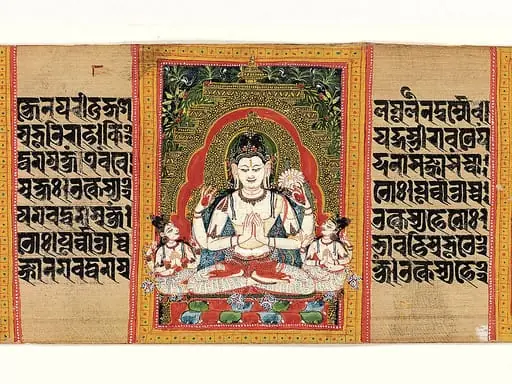
The composition centers on a seated Buddha figure framed by stylized lotus motifs, symbolizing spiritual awakening and the transcendence of worldly attachments.
The recto of folio five depicts a Buddhist manuscript page illustrating the Perfection of Wisdom in Eight Thousand Lines, a foundational Mahāyāna sūtra. The composition centers on a seated Buddha figure framed by stylized lotus motifs, symbolizing spiritual awakening and the transcendence of worldly attachments. The surrounding script, rendered in elegant Newari script, reinforces the text's sacred function, while the iconography of the vajra and dharmachakra underscores doctrinal teachings about the indestructible nature of wisdom and the turning of the wheel of Dharma.
Technique & Style
The recto of folio 5, created around 1119 at Vikramaśīla University, depicts a religious scene in a painting technique characteristic of early Buddhist manuscript illumination. The work was produced on paper using mineral pigments typical of Indian manuscript painting from the 12th century, with fine line work and flat areas of color applied in a stylized, symbolic manner. The composition follows a vertical narrative format common in Ashtasahasrika Prajnaparamita-sutra manuscripts, where each folio illustrates a distinct doctrinal concept through hieratic figures arranged in a hieroglyphic register.
The formal style emphasizes frontal, iconic representation over naturalism, reflecting the religious function of the text rather than artistic individualism. The surface shows minor cracking consistent with age, but no significant pigment loss or restoration is noted.
The painting’s handling reflects manuscript conventions: it was likely unrolled for ritual recitation and stored flat in a silk pouch, a practice documented in similar Perfection of Wisdom sutras. The Cleveland Museum of Art holds the folio as part of its Asian art collection, accessioned under the identifier 1938.301.5.a, confirming its provenance from a North Indian monastic context.
The medium is tempera and ink on paper, with gold leaf accents used sparingly to highlight sacred elements, a technique consistent with Pala-period Buddhist manuscript production. The stylistic qualities include a restrained palette of lapis lazuli blue, vermilion red, and ochre yellow, applied in flat, unshaded fields that prioritize symbolic clarity over spatial depth. The figures are rendered with elongated bodies and almond-shaped eyes, adhering to established iconographic standards for bodhisattvas and deities in Mahayana Buddhist art.
History & Provenance
The folio originates from a manuscript of the Perfection of Wisdom in Eight Thousand Lines, produced circa 1119 at Vikramaśīla University and later entered the collection of the Cleveland Museum of Art.
The work is classified as a painting within the religious art genre and is attributed to an unknown artist.
No further commission details, ownership transfers, or exhibition history are documented in the provided sources.
Overview
The work is a painted scroll fragment from a manuscript of the Perfection of Wisdom in Eight Thousand Lines (Ashtasahasrika Prajnaparamita‑sutra). It presents three circular depictions of a seated figure, each rendered in a calm pose with hands resting on the lap. The images are set against a muted brown ground and interspersed with hand‑written text in orderly columns.

Artist & collection

 Perfection of Wisdom in Eight Thousand Lines: Ashtasahasrika Prajnaparamita: Decorated Leaf
 Perfection of Wisdom in Eight Thousand Lines: Ashtasahasrika Prajnaparamita
 Perfection of Wisdom in Eight Thousand Lines: Ashtasahasrika Prajnaparamita: Decorated Leaf
 Perfection of Wisdom in Eight Thousand Lines: Ashtasahasrika Prajnaparamita: Decorated Leaf (recto)
 Three female figures, folio 89 (verso), from a Manuscript of the Perfection of Wisdom in Eight Thousand Lines (Ashtasahasrika Prajnaparamita-sutra)
 Perfection of Wisdom in Eight Thousand Lines: Ashtasahasrika Prajnaparamita: Decorated Leaf
 Prajnaparamita flanked by a white female figure and a white bodhisattva, folio 90 (recto), from a Manuscript of the Perfection of Wisdom in Eight Thousand Lines (Ashtasahasrika Prajnaparamita-sutra)
 Untitled
 Text, folio 186 (recto), from a Manuscript of the Perfection of Wisdom in Eight Thousand Lines (Ashtasahasrika Prajnaparamita-sutra)
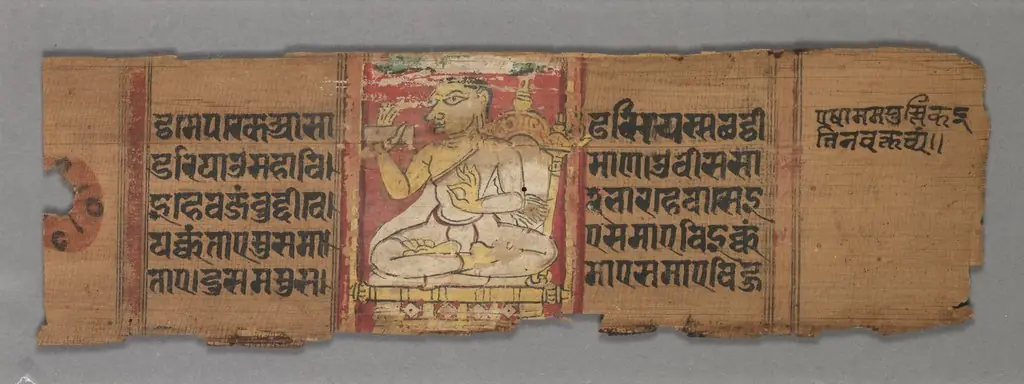 Leaf from a Jain Manuscript: Kalpa-sutra: text (verso)