Artwork
Untitled
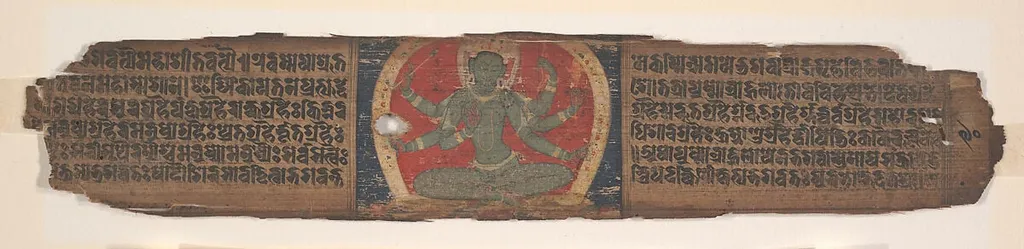
Untitled is a gouache painting. It dates from 1200 and is held in the collection of the Metropolitan Museum of Art.
- Accession no.
- 1987.246
- Credit line
- Gift of Arnold and Susan Lieberman, 1987
About this work
Subject & Meaning
Its depiction of a goddess functions symbolically, embodying spiritual qualities and serving as an object of veneration in early Himalayan Buddhist practice.
The work, dated to around 1200 and created in Nepal, portrays a Buddhist goddess within a religious context. Executed in opaque watercolor (also identified as gouache) on a palm-leaf support, the painting belongs to the genre of religious art and shows a divine female figure associated with Buddhist iconography. Its depiction of a goddess functions symbolically, embodying spiritual qualities and serving as an object of veneration in early Himalayan Buddhist practice. The piece is housed in the Metropolitan Museum of Art.
Technique & Style
Created in Nepal around 1200, this religious painting depicts a Buddhist goddess using opaque watercolor, also identified as gouache. The artist applied these pigments onto a palm-leaf support, a traditional medium for manuscripts in the region. The work measures approximately 5.3 cm in height and 27.3 cm in width, a distinctively narrow, horizontal format.
As an anonymous creation, the piece exemplifies the stylistic conventions of early Nepalese religious art, using dense, opaque coloration to render sacred figures.
History & Provenance
The untitled painting, dated to around 1200, was created in Nepal as an opaque watercolor (gouache) on palm leaf, measuring approximately 5.3 × 27.3 cm. The work portrays a Buddhist goddess and belongs to the religious genre of painting. It is attributed to an anonymous painter and entered the Metropolitan Museum of Art's collection, where it remains. No documentation of a commission, previous owners, or transfer of title is provided in the available records, so the full provenance and ownership chain remain unspecified. No specific accession or inventory number and no exhibition history are documented in the available sources.
Legacy
The work Untitled, attributed to an anonymous painter and dated to around 1200, is recognized as a significant example of early religious art depicting a Buddhist goddess. Its legacy is reflected in scholarly attention to its material, opaque watercolor on palm leaf, and its representation of early Himalayan painting traditions. The painting’s inclusion in the collection of the Metropolitan Museum of Art has contributed to its reputation as an important artifact of Nepalese artistic heritage, influencing studies of Buddhist iconography and the development of religious visual culture in South Asia.
Overview
This untitled painting, rendered in opaque watercolor on a palm leaf, depicts a slender goddess standing atop a lotus blossom. Her gestures include a raised hand offering a blessing and another holding a vase. Adorned in a red robe and a golden crown, the figure occupies a long, narrow strip of palm leaf, characteristic of its original format as a page from a larger manuscript.
Context
This small-scale painting was conceived not for display on a wall, but for personal interaction. It functioned as an individual page within a larger sacred manuscript, designed to be held and viewed sequentially. This format aligns with traditional methods of preserving and disseminating religious texts, particularly those associated with Buddhist practices, where such illuminated leaves facilitated study and devotion.

Artist & collection

- Three female figures, folio 89 (verso), from a Manuscript of the Perfection of Wisdom in Eight Thousand Lines (Ashtasahasrika Prajnaparamita-sutra)
 Prajnaparamita flanked by a white female figure and a white bodhisattva, folio 90 (recto), from a Manuscript of the Perfection of Wisdom in Eight Thousand Lines (Ashtasahasrika Prajnaparamita-sutra)
 Perfection of Wisdom in Eight Thousand Lines: Ashtasahasrika Prajnaparamita: Decorated Leaf
 Text, Folio 5 (recto), from a Manuscript of the Perfection of Wisdom in Eight Thousand Lines (Ashtasahasrika Prajnaparamita-sutra)
 Prajnaparamita flanked by two female figures, folio 1 (verso), from a Manuscript of the Perfection of Wisdom in Eight Thousand Lines (Ashtasahasrika Prajnaparamita-sutra)
 Perfection of Wisdom in Eight Thousand Lines: Ashtasahasrika Prajnaparamita
 Text, folio 3 (recto), from a Manuscript of the Perfection of Wisdom in Eight Thousand Lines (Ashtasahasrika Prajnaparamita-sutra)
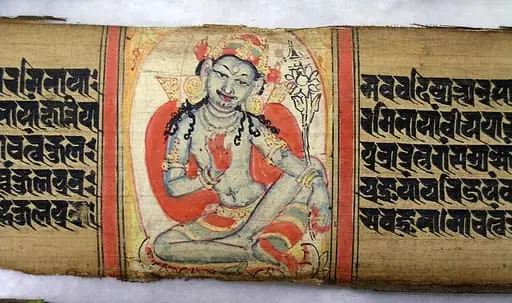 Untitled
 Bodhisattva Manjushri with two forms of Avalokiteshvara, folio 348 (recto) from a Gandavyuha-sutra (Scripture of the Supreme Array)
 Perfection of Wisdom in Eight Thousand Lines: Ashtasahasrika Prajnaparamita: Decorated Leaf (recto)
 Prajnaparamita flanked by a white female figure and a white bodhisattva, folio 90 (recto), from a Manuscript of the Perfection of Wisdom in Eight Thousand Lines (Ashtasahasrika Prajnaparamita-sutra)
 Perfection of Wisdom in Eight Thousand Lines: Ashtasahasrika Prajnaparamita: Decorated Leaf