Artwork
Perfection of Wisdom in Eight Thousand Lines: Ashtasahasrika Prajnaparamita: Decorated Leaf

Perfection of Wisdom in Eight Thousand Lines: Ashtasahasrika Prajnaparamita: Decorated Leaf is an unspecified painting. It dates from 1119 and is held in the collection of the Cleveland Museum of Art. This painted leaf, titled Perfection of Wisdom in Eight Thousand Lines: Ashtasahasrika Prajnaparamita, dates to 1119.
About this work
If you're interested in learning more about this style of art, you might want to check out the work of the artist, whose name is unfortunately not provided.
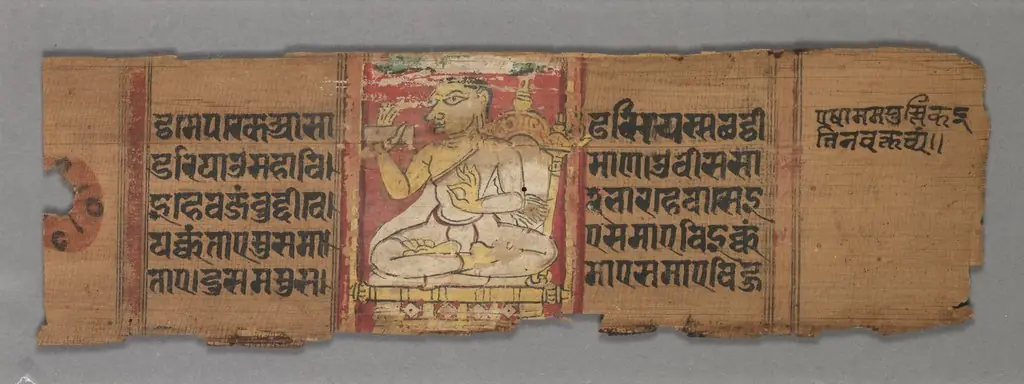
This painting shows a long, narrow strip of paper with text and images. The text is written in a foreign language and is arranged in blocks, with some images of people in between.
The images are colorful and depict people sitting in various poses. The text and images are arranged in a way that suggests a story or message is being conveyed.
The painting is quite old, dating back to 1119, and is held at The Cleveland Museum of Art. If you're interested in learning more about this style of art, you might want to check out the work of the artist, whose name is unfortunately not provided.
Subject & Meaning
The painting illustrates the Buddhist scripture titled Perfection of Wisdom in Eight Thousand Lines, known as the Ashtasahasrika Prajnaparamita. Its central motif is a richly decorated leaf that serves as a visual element of the sutra's manuscript tradition. The work is classified as religious art and was created in 1119 at Vikramaśīla University, a center of Buddhist learning in eastern India. The iconography reflects the doctrinal focus on the perfection of wisdom within Mahayana Buddhism.
Technique & Style
The work is categorized as a painting and belongs to the religious genre. It was produced in 1119 at Vikramaśīla University. The piece forms part of the Cleveland Museum of Art collection, catalogued under accession number 1938.301.5.
As a decorated leaf, the composition combines intricate line work with symbolic iconography typical of Buddhist manuscript illumination, reflecting a refined use of pigment and brushstroke that emphasizes spiritual narrative.
History & Provenance
The decorated leaf from the Ashtasahasrika Prajnaparamita manuscript was created around 1119, as indicated by the date recorded in the Cleveland Museum of Art's holdings. Its creation is associated with Vikramaśīla University, a major center of Buddhist learning in eastern India during the Pala period, suggesting a monastic or institutional commission rather than a private one. The work's religious genre and Pala-period style align with the manuscript's function as a devotional object within a monastic context.
Context
The decorated leaf of the Ashtasahasrika Prajnaparamita, produced circa 1119 at Vikramaśīla University in eastern India, exemplifies early medieval Buddhist manuscript painting of the Pala period. Scholarship identifies the work as part of a larger manuscript tradition that transmitted the Perfection of Wisdom texts across Buddhist communities, with its iconography reflecting contemporary doctrinal emphases. The attribution to an anonymous artist underscores the collaborative nature of monastic artistic workshops, while its inclusion in the Cleveland Museum of Art highlights curatorial interest in preserving South Asian Buddhist art.
Overview
This painted leaf, titled Perfection of Wisdom in Eight Thousand Lines: Ashtasahasrika Prajnaparamita, dates to 1119. It is a single page from a larger manuscript, characterized by its elongated format. The artwork combines blocks of text in an unidentified script with vibrant figural illustrations.
Currently, this ancient artifact is preserved within the collection of The Cleveland Museum of Art, offering insight into early manuscript illumination.

Artist & collection

- Perfection of Wisdom in Eight Thousand Lines: Ashtasahasrika Prajnaparamita: Decorated Leaf
 Perfection of Wisdom in Eight Thousand Lines: Ashtasahasrika Prajnaparamita
 Perfection of Wisdom in Eight Thousand Lines: Ashtasahasrika Prajnaparamita: Decorated Leaf (recto)
 Perfection of Wisdom in Eight Thousand Lines: Ashtasahasrika Prajnaparamita: Decorated Leaf
 Prajnaparamita flanked by two bodhisattvas, folio 187 (recto), from a Manuscript of the Perfection of Wisdom in Eight Thousand Lines (Ashtasahasrika Prajnaparamita-sutra)
 Leaf from a Jain Manuscript: Kalpa-sutra: text (verso)
 Prajnaparamita flanked by two female figures, folio 1 (verso), from a Manuscript of the Perfection of Wisdom in Eight Thousand Lines (Ashtasahasrika Prajnaparamita-sutra)
 Prajnaparamita flanked by a white female figure and a white bodhisattva, folio 90 (recto), from a Manuscript of the Perfection of Wisdom in Eight Thousand Lines (Ashtasahasrika Prajnaparamita-sutra)
 Text, folio 4 (recto), from a Manuscript of the Perfection of Wisdom in Eight Thousand Lines (Ashtasahasrika Prajnaparamita-sutra)
 Text, folio 186 (recto), from a Manuscript of the Perfection of Wisdom in Eight Thousand Lines (Ashtasahasrika Prajnaparamita-sutra)
 Text, Folio 5 (recto), from a Manuscript of the Perfection of Wisdom in Eight Thousand Lines (Ashtasahasrika Prajnaparamita-sutra)
 Text, folio 3 (recto), from a Manuscript of the Perfection of Wisdom in Eight Thousand Lines (Ashtasahasrika Prajnaparamita-sutra)