Artwork
Apollo in Love with Daphne
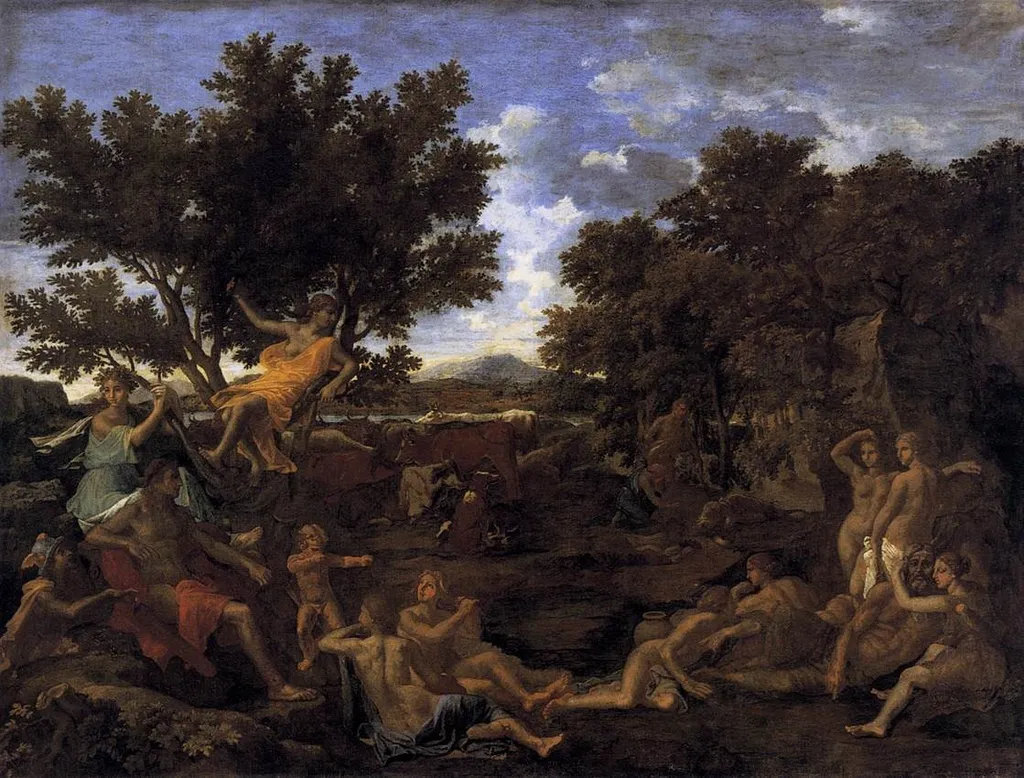
Apollo in Love with Daphne is an oil painting by the High Baroque Italian artist Nicolas Poussin. It dates from 1664 and is held in the collection of the Department of Paintings of the Louvre.
About this work
Overview
Apollo in Love with Daphne is an oil on canvas painting by Nicolas Poussin, executed between 1661 and 1664, shortly before the artist's death.
Apollo in Love with Daphne is an oil on canvas painting by Nicolas Poussin, executed between 1661 and 1664, shortly before the artist's death. Measuring 155 by 200 cm, the work is held in the Department of Paintings at the Louvre in Paris, where it is displayed in the Richelieu wing. The painting represents one of Poussin's final mythological compositions and stands as a significant late work that synthesizes the artist's lifelong engagement with classical subject matter, landscape settings, and narrative complexity. Its dating to the very end of Poussin's career lends it the quality of a culminating statement from one of the most influential French painters of the seventeenth century.
Subject & Meaning
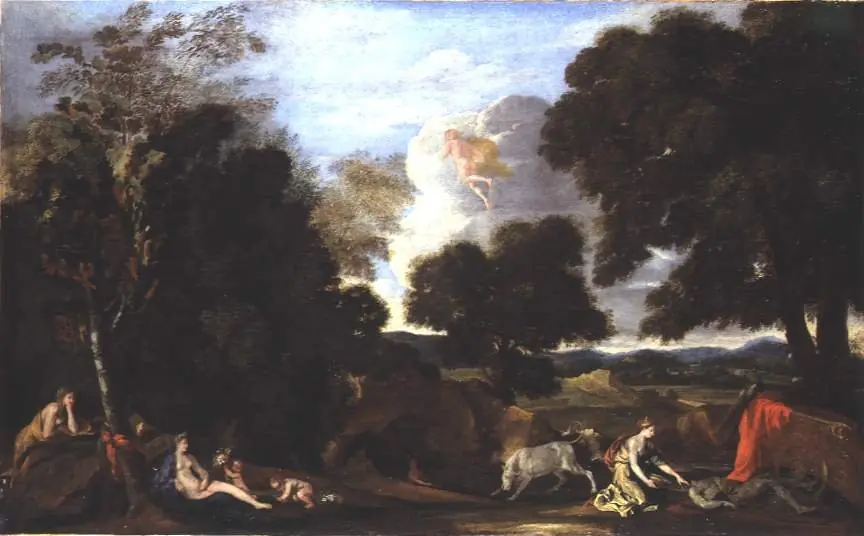
The painting depicts the myth of Apollo and Daphne drawn from Ovid's Metamorphoses, though Poussin treats the subject with characteristic interpretive freedom. At left, Apollo sits crowned with laurel upon rocks, his red toga partially draped, gazing toward Daphne, who shelters in the arms of her father, the river god Peneus, at the right. Between and around these principal groups, Poussin distributes a complex array of figures: nymphs bathing and reclining, Mercury identifiable by his petasos stealing an arrow from Apollo's quiver, and Cupid as a small nude aiming his bow across the composition toward Daphne. A dog lies near the lower left, and cattle rest in the middle distance. The French Wikipedia source notes that Poussin chose to represent the moment when Cupid daringly steals Apollo's arrows, though the painting remains technically unfinished in this respect, neither arrows nor bow being fully realized. Daphne already turns away from Apollo, suggesting she is already under the effect of Cupid's leaden arrow of aversion, while Apollo remains curiously peaceful, perhaps not yet struck by the golden arrow of love. This departure from strict mythological sequence allows for multiple interpretive possibilities. The background includes a figure lying on the ground, interpreted as the dead Hyacinth, another youth beloved by Apollo, introducing yet another mythological reference. Poussin's biographer and scholar Anthony Blunt characterized the artist as a 'mythologue,' weaving myths together to form a natural cycle rather than illustrating single episodes. The composition thus generates what one scholar calls a 'mysterious and perceptible tension' through the opposition of warm left side, dominated by Apollo's red toga and the yellow and blue garments of attendant nymphs, and the darker right side where Daphne merges with the background landscape.
Technique & Style
The work is executed in oil on canvas, with dimensions of 155 by 200 cm. Visually, the painting presents a broad landscape composition with figures arranged across a wooded foreground opening onto distant hills. The palette consists of deep greens and browns for the trees, warm ochres and russets for flesh and drapery, and a pale blue sky with soft white clouds. Light falls from the upper left, illuminating the central seated figure of Apollo while casting much of the foreground in shadow. The brushwork appears smooth and layered, with careful modeling of bodies and looser handling in the foliage and sky. The horizon sits low, emphasizing the expansive sky and canopy of trees that occupy the upper half of the canvas. The overall composition follows an broadly oval arrangement, with all figures disposed within an elongated circle that harmonizes with the surrounding decor. The central void is filled by water, giving the entire painting an aquatic character: nymphs wring out wet hair, some are nude and ready to dive, and the color of the water is reflected in the sky. This integration of figure and landscape exemplifies Poussin's late manner, where nature and humanity complement and coexist, though here with an added element of tension between opposed groups.
History & Provenance
The painting was created between 1661 and 1664, in the final years of Poussin's life. The artist gave it to Cardinal Camillo Massimi, from whose collection it passed to that of the painter Guillaume Guillon Lethière. By 1832, it had entered the collection of Sébastien Érard, the renowned piano manufacturer and instrument collector. In that year, it was sold from Érard's collection to Charles Paillet, expert commissioner for the French royal collections. Paillet proposed that the Musée des Beaux-Arts de Rouen purchase the work, but this suggestion was rejected. The painting was instead acquired by the Louvre in 1869, where it remains today as part of the French national collection. The work is currently located in the Department of Paintings of the Louvre, in the Richelieu wing. Scholarly attention to the painting's provenance has been documented by Marie Pessiot and Pierre Rosenberg in a 1998 article for La Revue du Louvre et des musées de France.
Context
Apollo in Love with Daphne belongs to the final phase of Poussin's career, when the artist increasingly integrated expansive landscape settings with mythological narrative. The work has attracted significant scholarly attention, with studies addressing its genesis, iconography, and interpretive challenges. Nicolas Milovanovic examined the painting's genesis in a 2017 Revue de l'art article, while Clélia Nau analyzed its metaphorical structures in Tangence (2002). Adele Tutter contributed a psychoanalytic reading in The International Journal of Psychoanalysis (2001), examining the theme of metamorphosis and loss. Oskar Bätschmann discussed the work as a 'testament' of the painter-poet in the proceedings of the 1994 Louvre colloquium on Poussin. Françoise Graziani situated the painting within the context of Poussin's 'marinist' imagery. The painting exists in relation to an earlier version by Poussin from 1626, now in the Alte Pinakothek in Munich, allowing scholars to trace the evolution of the artist's treatment of the subject across four decades. The Louvre painting's complexity, its multiple mythological references, and its deliberate departures from straightforward narrative have made it a focal point for debates about Poussin's method as a 'mythologue' who recombines and reinterprets classical sources.
Legacy
As one of Poussin's final paintings, Apollo in Love with Daphne has been interpreted as a culminating work that encapsulates the artist's mature approach to mythological narrative and landscape integration. Its place in the Louvre's collection, secured in 1869, has ensured its visibility and influence within the canon of French seventeenth-century painting. The work's cultural afterlife is marked by ongoing scholarly debate about its interpretation, its relationship to Ovidian source material, and its place within Poussin's broader artistic development. The painting's unfinished elements, particularly the absent arrows and bow that would complete the narrative of Cupid's theft, have invited speculation about the artist's intentions in his final years. Its acquisition by the French state for the national museum system, after the rejection by Rouen, reflects the nineteenth-century institutional recognition of Poussin's central importance to French art history. The work continues to serve as a key document for understanding the evolution of Poussin's mythological painting from his early career through to his death.
Artist & collection
Artist
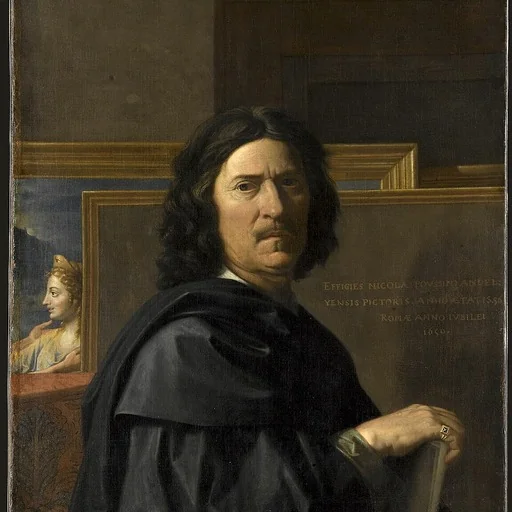
Nicolas Poussin (UK: US: French:; June 1594 – 19 November 1665) was a leading painter of the classical French Baroque style, although he spent most of his working life in Rome.

Museum
Department of Paintings of the Louvre
Continue through works from the same source collection.