Artwork
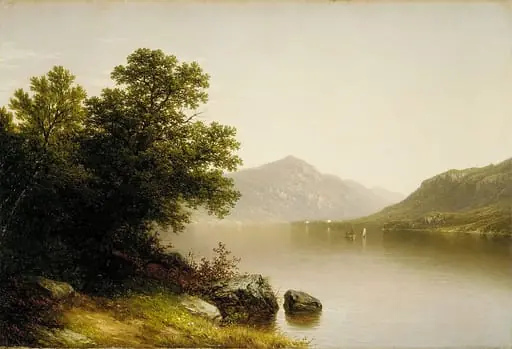
Lake George
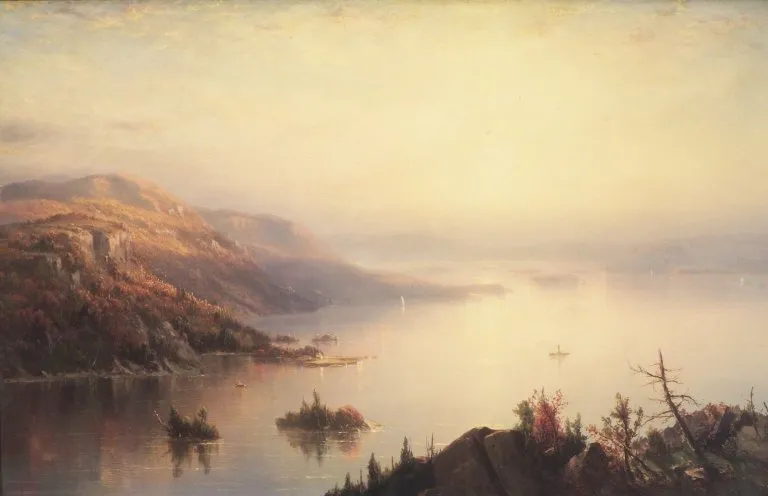
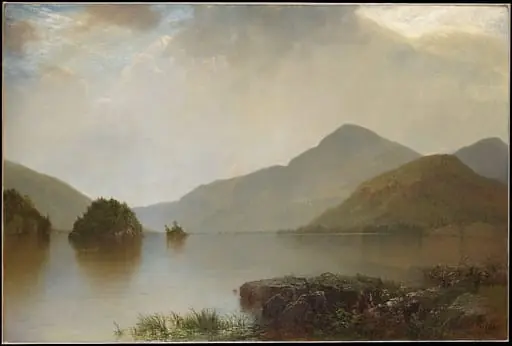
Lake George is an oil painting by the American Impressionist artist Régis François Gignoux. It dates from 1868 and is held in the collection of the Brooklyn Museum.
About this work
Subject & Meaning
The inclusion of a small figure and a sunlit horizon underscores themes of exploration and the spiritual resonance of nature characteristic of the movement.
Lake George depicts a tranquil view of the lake framed by sky, clouds, hills, shoreline, trees, and a solitary boat, reflecting the Hudson River School's emphasis on the sublime American landscape. The inclusion of a small figure and a sunlit horizon underscores themes of exploration and the spiritual resonance of nature characteristic of the movement. The painting is housed in the Brooklyn Museum, where it remains part of their American landscape collection.
Technique & Style
Painted in oil on canvas in 1868, the work belongs to the Hudson River School and depicts Lake George under an expansive sky. The handling emphasizes luminous atmospheric effects, with finely blended strokes that render cloud formations and water reflections. Vegetation along the shore and distant hills is described through layered glazes, while the small boat and figures are rendered with quieter detail, reinforcing the scene’s tranquil scale and light-filled atmosphere.
History & Provenance
Lake George is an oil painting on canvas created in 1868 by Régis François Gignoux. The work was commissioned by the Brooklyn Museum and remains part of its permanent collection, where it has been exhibited as a representative example of the Hudson River school landscape genre. The painting measures 74 cm in height by 115.4 cm in width and portrays the lake with sky, clouds, a hill, sun, shoreline, trees, a boat, and a human figure.
Its creation and early history are documented in museum records and scholarly references to the artist’s output in the late nineteenth century.
The painting is held by the Brooklyn Museum, New York, where it remains in the permanent collection.
Its inventory record is not specified in the cited sources. The work entered the museum’s holdings by an undocumented date prior to the information captured by the cited sources.
No exhibition history is recorded in the provided sources.
Legacy
Lake George (1868) by Régis François Gignoux, a Hudson River school landscape in the Brooklyn Museum collection, influenced subsequent regional landscape painting through its luminous atmospheric treatment and compositional emphasis on natural light. The work's depiction of Lake George's terrain established compositional motifs later adopted by artists interpreting Adirondack scenery, particularly its integration of sky and water surfaces. Its inclusion in major Hudson River school retrospectives during the early twentieth century cemented its reputation as a representative example of the movement's early phase, contributing to scholarly reassessments of Gignoux's role in shaping American landscape aesthetics.
Overview
Régis François Gignoux’s 1868 oil painting titled Lake George presents a tranquil view of the New York lake framed by gentle hills. The composition captures a calm water surface under a low, warm sun, with a small boat drifting near the horizon and a lightly clouded sky above. The work belongs to the Brooklyn Museum’s permanent collection.
Context
Created during a period when American artists were increasingly adopting Impressionist techniques, the work reflects transatlantic artistic exchange. Gignoux’s training in France and his long residence in the United States positioned him to merge European brushwork with the distinct light and scenery of the American Northeast, exemplifying the era’s evolving landscape genre.
Artist & collection
Artist
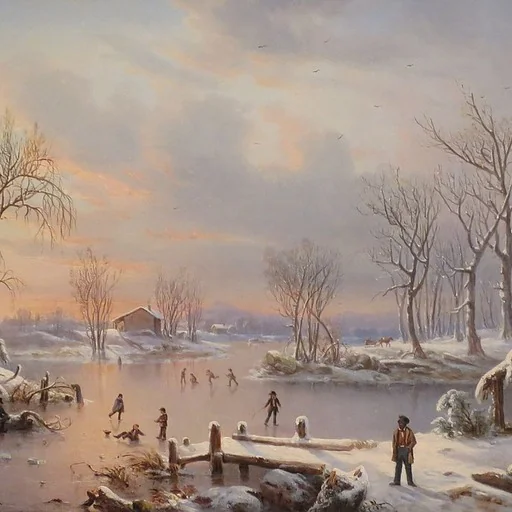
Régis François Gignoux (1816–1882) was a French painter who was active in the United States from 1840 to 1870. (Aliases: Marie-François-Régis Gignoux; Régis Francois Gignoux; Régis François Gignoux; Régis-François Gignoux)