Artwork
Lake George
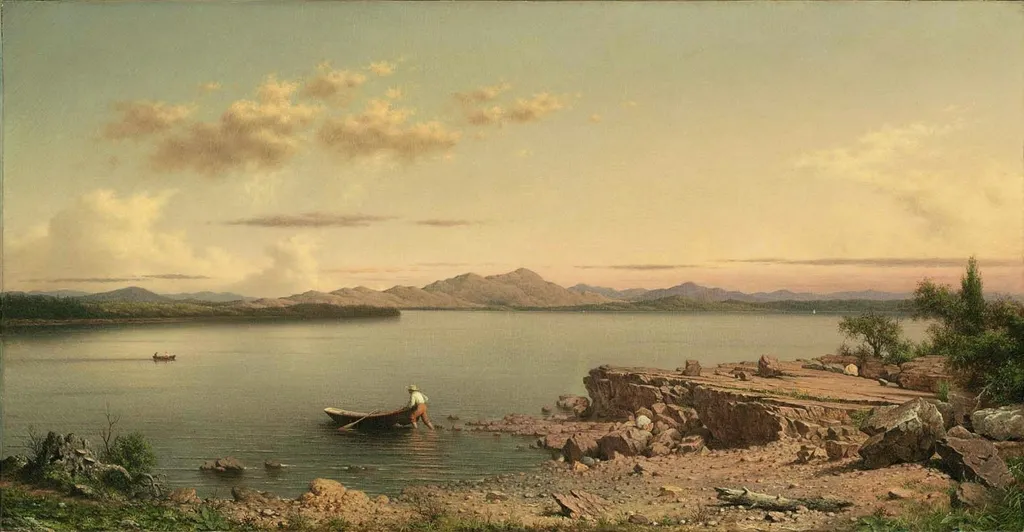
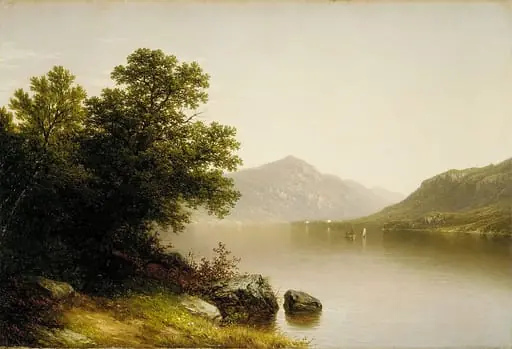
Lake George is an oil painting by the American Impressionist artist Martin Johnson Heade. It dates from 1862 and is held in the collection of the Museum of Fine Arts Boston.
About this work
Subject & Meaning
The painting conveys the harshness of nature, unsentimentalized by shadow or pleasant incident, and suggests that human existence must endure the same severity.
Lake George depicts a view of Lake George in New York State, a subject previously treated by other Hudson River School painters such as Thomas Cole, Asher Brown Durand, Jasper Francis Cropsey, and John Frederick Kensett. Although the scene was observed from the Fort William Henry Hotel, Heade rejected the conventional picturesque treatment of the lake's calm waters, misty atmosphere, and majestic mountains. Instead, he rendered a flat, brightly lit terrain in its primitive state, stripped of idyllic detail.
Dead tree trunks lie fallen near the shore, shrubs struggle to survive among bare rocks, and the lake's surface barely reflects its surroundings.
Human presence is minimal: a man crouches in the water near the shore, attempting to free a boat from the rocks, while a pair of distant figures in a rowing boat on the left appear oblivious to his effort. The painting conveys the harshness of nature, unsentimentalized by shadow or pleasant incident, and suggests that human existence must endure the same severity. The work also reflects Pre-Raphaelite principles, expressing a desire for objectivity in which "unbeauty" becomes a new standard for beauty.
Technique & Style
Lake George is an oil painting on canvas measuring 66.04 × 125.41 cm, executed in 1862 and signed "M.J Heade |62." in the lower right. The work belongs to the Hudson River School and specifically to the branch known as American luminism.
Stylistically, the painting departs from the conventional treatment of Lake George by earlier Hudson River painters. Rather than majestic mountains and misty atmosphere, Heade rendered a flat shoreline in unusually clear, almost hallucinatory light, with warm, dry colors. The composition includes dead fallen tree trunks, scrubby bushes clinging to bare rocks, and water that barely reflects its surroundings, conveying a deliberately unidealized, prosaic vision of nature.
Two small boats appear in the distance, with a man struggling to free a boat from rocks near the shore and two figures in a rowing boat on the left.
The handling of the rocks shows a Pre-Raphaelite quality, possibly influenced by Charles Herbert Moore. The work reflects Heade's engagement with the British Pre-Raphaelite exhibitions held in New York, Philadelphia, and Boston in 1857 and 1858, and the ideas of John Ruskin, embracing objectivity and making "non-beauty" a new standard of beauty.
History & Provenance
Martin Johnson Heade executed the oil painting Lake George in 1862, a work signed and dated in the lower right corner. The creation of this canvas occurred during a significant period of the artist's residence in Boston between 1861 and 1863, a time when he produced his most ambitious landscapes to date. Heade visited the actual location in New York State during a journey that also took him through Maine and to Lake Champlain.
Unlike earlier Hudson River School depictions that emphasized majestic mountains and mist, Heade portrayed the site with a stark, prosaic clarity, featuring fallen tree trunks and bare rocks. The work measures 66.04 by 125.41 cm and is currently held in the collection of the Museum of Fine Arts, Boston.
Lake George is held by the Museum of Fine Arts Boston, where it is catalogued in the museum’s collection. The work measures 66.04 cm by 125.41 cm and dates to 1862. It was created by Martin Johnson Heade as an oil on canvas landscape.
No specific accession number is recorded in the available sources. The painting is part of the museum’s permanent collection. The work has not been documented in publicly listed exhibition histories within the provided references.
Context
Lake George (1862) is an oil on canvas measuring 66.04 by 125.41 centimeters in the Museum of Fine Arts, Boston. The work exemplifies the Hudson River School’s luminist tendency, combining precise atmospheric detail with a modest, unidealized shoreline. It was produced during Heade’s Boston stay (1861‑1863), a period in which he explored coastal scenery and moved away from romanticized vistas.
Scholarship notes the influence of Pre‑Raphaelite theory and John Ruskin’s emphasis on objective observation, which is evident in the painting’s clear light and unadorned natural elements. The composition reflects Heade’s interest in the unvarnished texture of the landscape rather than the picturesque, situating the piece within broader American 19th‑century landscape discourse.
Overview
Martin Johnson Heade, an American painter, completed Lake George in 1862 using oil paint. This landscape captures a tranquil view of Lake George, featuring a small boat with a solitary figure. Heade, known for his diverse subjects including landscapes, seascapes, and still lifes, often developed a distinctive style that diverged from the prevailing romantic trends of his era. The work is now part of the collection at the Museum of Fine Arts Boston.
Artist & collection

Artist
Martin Johnson Heade (August 11, 1819 – September 4, 1904) was an American painter known for his salt marsh landscapes, seascapes, and depictions of hummingbirds, often depicted with orchids, as well as lotus blossoms and other still lifes.