Artwork
Werl Triptych
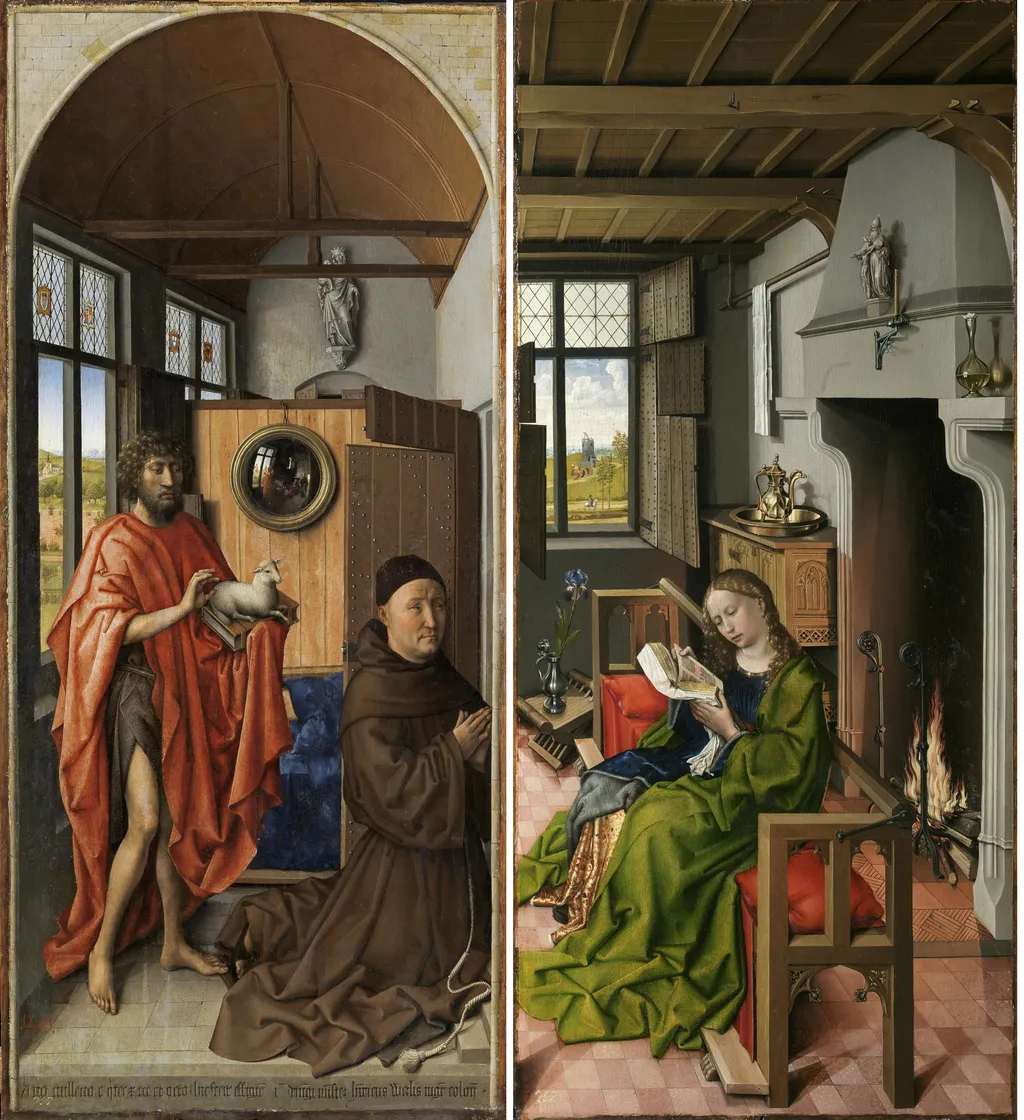
Werl Triptych is an oil painting by the Northern Renaissance artist Robert Campin. It dates from 1438 and is held in the collection of the Museo del Prado.
About this work
Subject & Meaning
Saint Barbara is shown imprisoned yet absorbed in reading a gilded holy book, recalling her legend of secret Christian faith despite paternal persecution.
The Werl Triptych is a devotional work centered on the veneration of Saint Barbara and the donor's piety. Saint Barbara is shown imprisoned yet absorbed in reading a gilded holy book, recalling her legend of secret Christian faith despite paternal persecution. The room's furnishings, an extinguished candle, a Trinity sculpture above the hearth, and a vase with a white bloom, connote both her martyrdom and purity, while the warm fire evokes purification and divine justice.
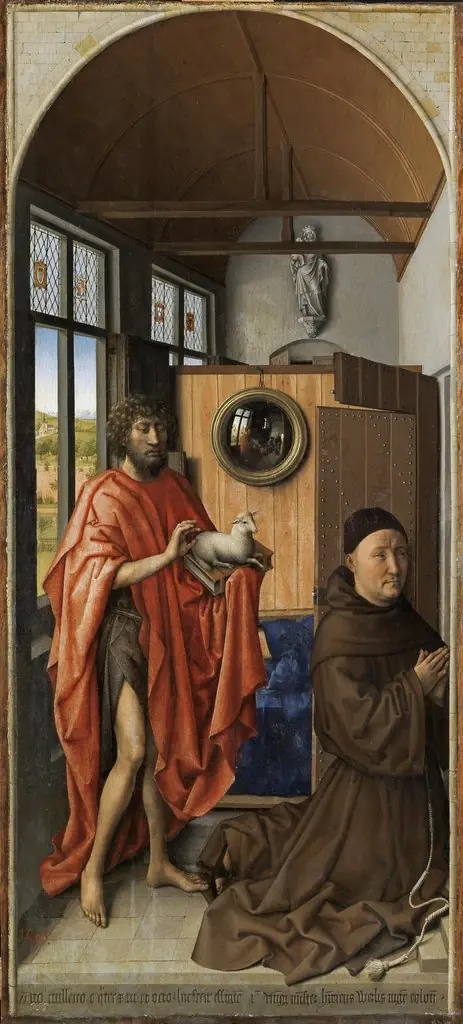
The left panel pairs the donor Heinrich von Werl, a Franciscan theologian, with John the Baptist, who points to the lost central scene with an inscribed lamb, identifying Christ as the Lamb of God. A convex mirror reflects two additional figures, extending the sacred space into the viewer's world and echoing van Eyck's compositional strategies. The triptych's iconography merges domestic realism with theological narrative, underscoring devotion within an intimate, middle-class setting rather than overt luxury.
Technique & Style
The Werl Triptych is executed in oil paint on oak panel, with each surviving wing measuring 101 × 47 cm. The two extant panels are renowned for their complex treatment of light and form.
In the right wing, Saint Barbara is seated on a wooden bench draped with deep red velvet cushions, wearing a sumptuous green dress with heavy angular folds. Her figure is considered anatomically weak, her shoulders and knees appear unrealistic, yet the panel is richer in detail and regarded as the superior piece. The room is illuminated by two contrasting sources: a warm reddish glow from the open fireplace and relatively hard light falling from a latticed and shuttered window.
Objects including a glass flask, an extinguished candle sconce, and a sculpture of the Trinity are shaped and contrasted against the generally golden, polished surfaces. The perspective is unusually steep, positioning the viewer on a higher floor and looking down, achieved through the tilt of the bench, sideboard, fireplace line, and shutters, with multiple vanishing points emphasizing depth.
The left wing shows the donor Heinrich von Werl kneeling on steps in a brown Franciscan robe, accompanied by Saint John the Baptist. A convex mirror hangs against the wooden wall partition, reflecting two additional Franciscans and the room behind. The panel's lighting and the decorative Gothic inscription show clear influence from Jan van Eyck, while the slender, elegantly posed Baptist reflects Rogier van der Weyden.
History & Provenance
The Werl Triptych was commissioned in 1438 by Heinrich von Werl, provincial head of the Franciscan order in Cologne and a noted theologian, as recorded by a Gothic inscription on the left wing that translates as: "In the year 1438 Minister Heinrich von Werl, master of Cologne, has this image painted." Von Werl is depicted kneeling in prayer alongside Saint John the Baptist in the left wing, which measures 101 × 47 cm. The triptych was painted in oil on oak panels and is attributed to Robert Campin, though some scholars consider it a workshop or follower work.
The original center panel is lost without surviving copies or descriptions, but its placement is inferred from architectural continuities and light direction shared by the surviving wings. The two extant panels entered the Museo del Prado in Madrid, where they remain. The work's influence grew from the mid-15th century onward among Northern European artists, before Early Netherlandish painting fell from favor until its 19th-century rediscovery.
The two surviving wings of the Werl Triptych are held by the Museo del Prado, Madrid, where they carry the inventory numbers 1430 and 1431. The panels have been exhibited at the Prado in the museum's permanent displays of Early Netherlandish painting.
Context
The Werl Triptych occupies a contested yet pivotal place in the canon of Early Netherlandish painting. Long attributed to the anonymous Master of Flémalle, the panels are now generally assigned to Robert Campin, though this identification remains debated among scholars. The work's stylistic debt to Jan van Eyck, evident in the convex mirror's perspectival play and the luminous handling of domestic space, has fueled discussions of Campin's relationship to Eyckian naturalism.
Its influence on mid- to late-fifteenth-century artists underscores its role in transmitting Campin's integration of symbolic detail with illusionistic interiority.
The triptych's lost center panel and donor portraiture arrangement reflect broader devotional shifts in northern European altarpiece design, where private patrons occupied side wings rather than central scenes. Erwin Panofsky's iconological reading frames the work as a dialogue between bourgeois domesticity and sacred exemplarity, a tension that shaped later Flemish narrative painting.
Legacy
The Werl Triptych became a reference point for later Early Netherlandish painters, whose complex handling of light and domestic detail was emulated from the mid-15th century onward.
After the disappearance of the central panel, the surviving wings were praised in the 19th century for their technical mastery. Scholars note that the work's innovative use of perspective and mirrored space helped shape devotional imagery in the following century, cementing its reputation as a pivotal transitional piece.
Its presence in the Museo del Prado has kept its legacy visible, while art historians continue to debate whether Campin or a workshop follower created it, a discussion that itself reflects the work's enduring scholarly relevance.
Overview
The Werl Triptych is an oil painting, originally an altarpiece completed in Cologne in 1438. Only its two side panels survive today, housed in the Prado Museum in Madrid, while the central devotional scene remains lost. This work is recognized for its sophisticated handling of light and form, which contributed to its influence on subsequent artists during the 15th and early 16th centuries.
Own this work as a print
Artist & collection
Artist
Robert Campin (Valenciennes (France) c. 1375 - Tournai (Belgium) 26 April 1444) now usually identified with the Master of Flémalle (earlier the Master of the Merode Triptych, before the discovery of three other similar…