Artwork
Mérode Altarpiece
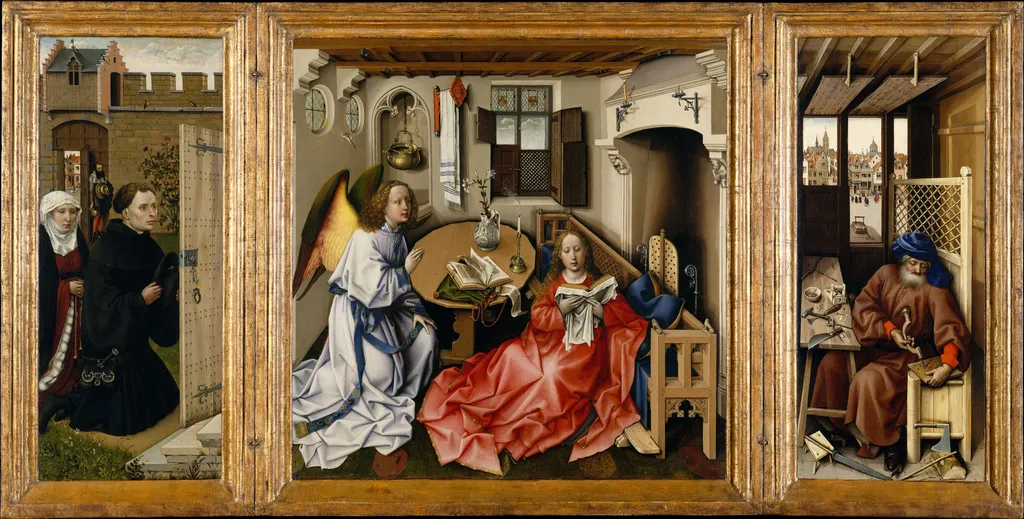
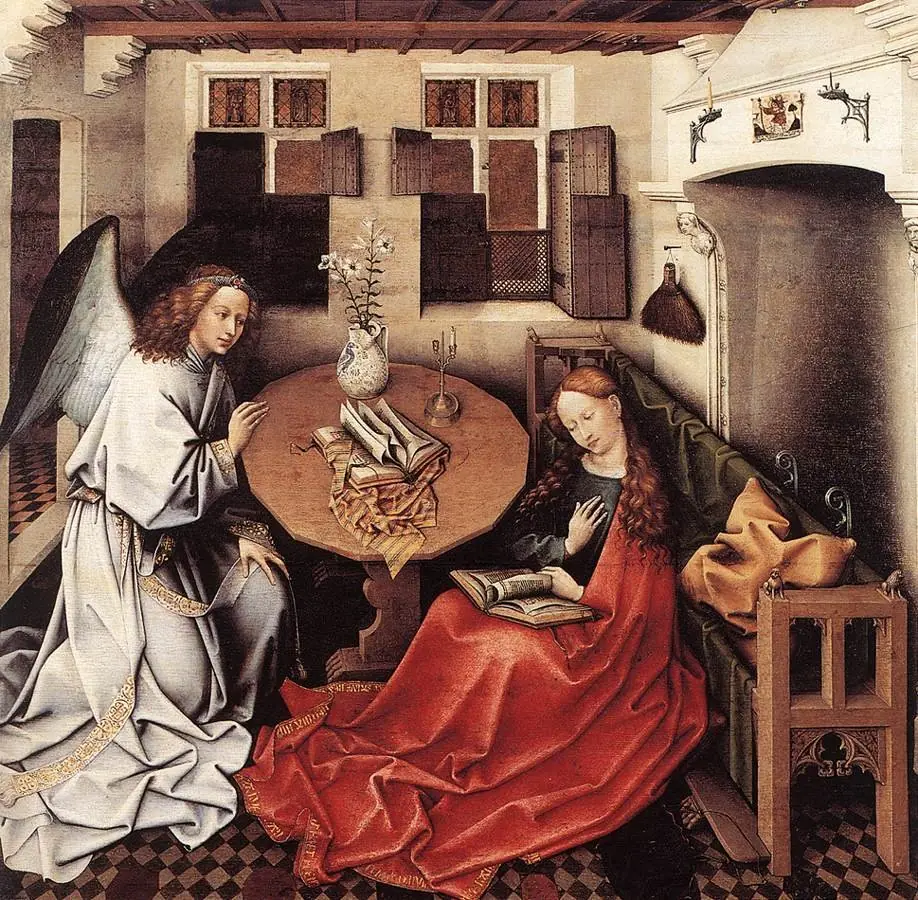
Mérode Altarpiece is an oil painting. It dates from 1500 and is held in the collection of the Metropolitan Museum of Art.
About this work
Subject & Meaning
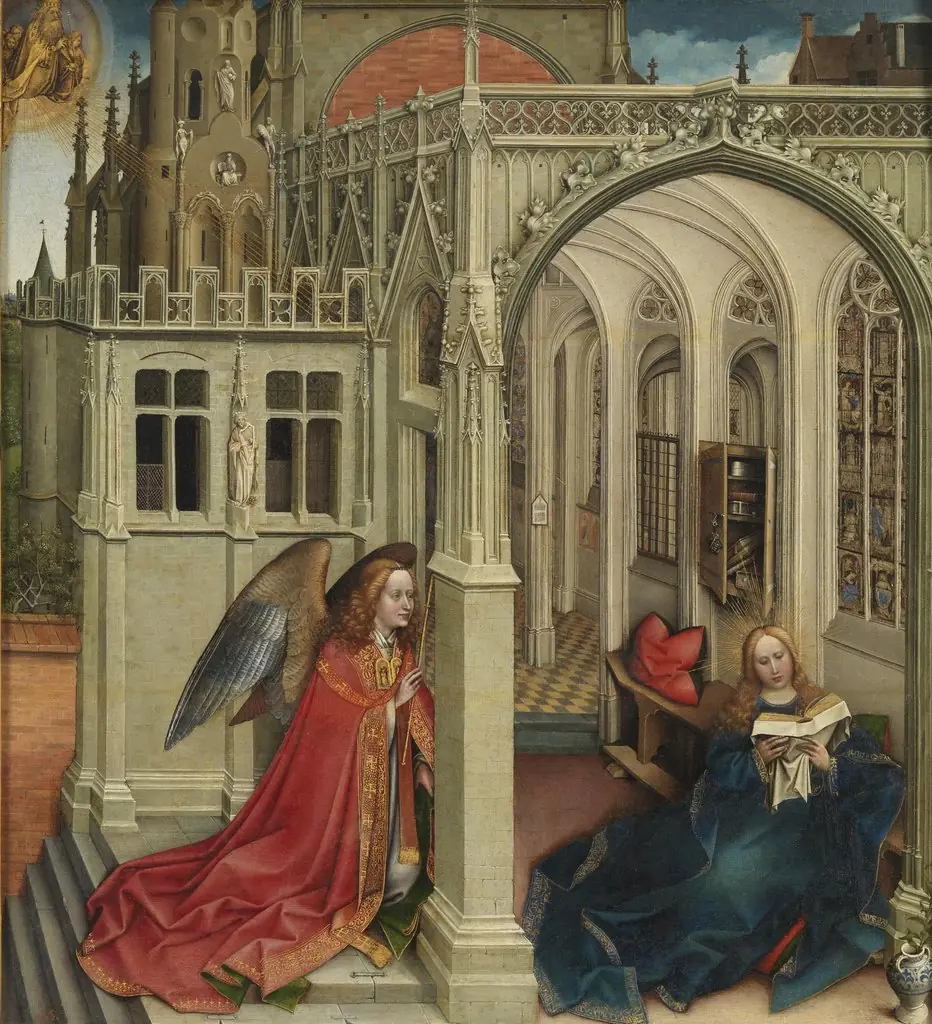
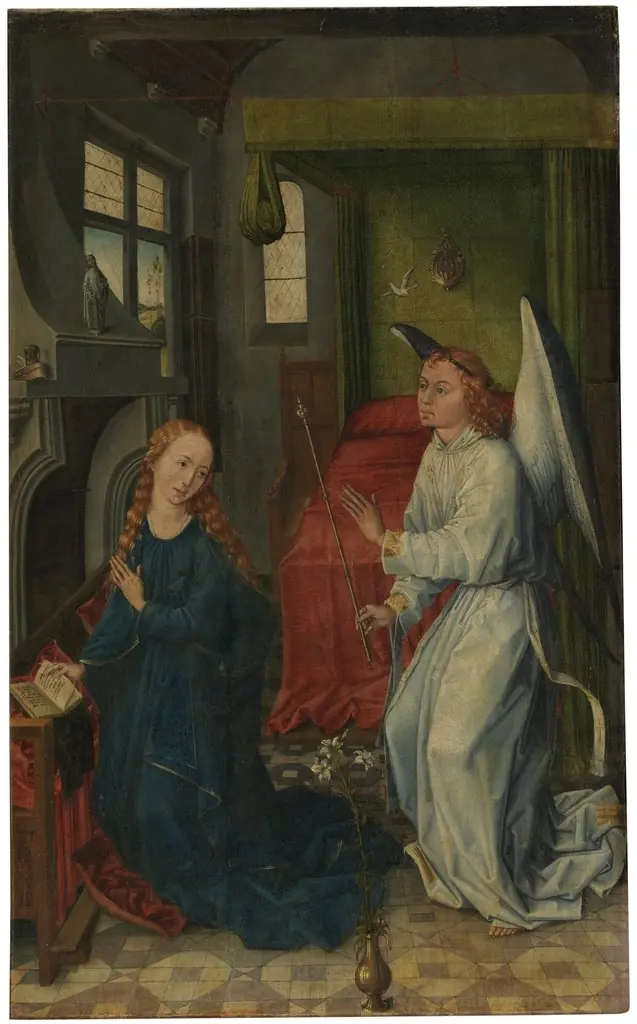
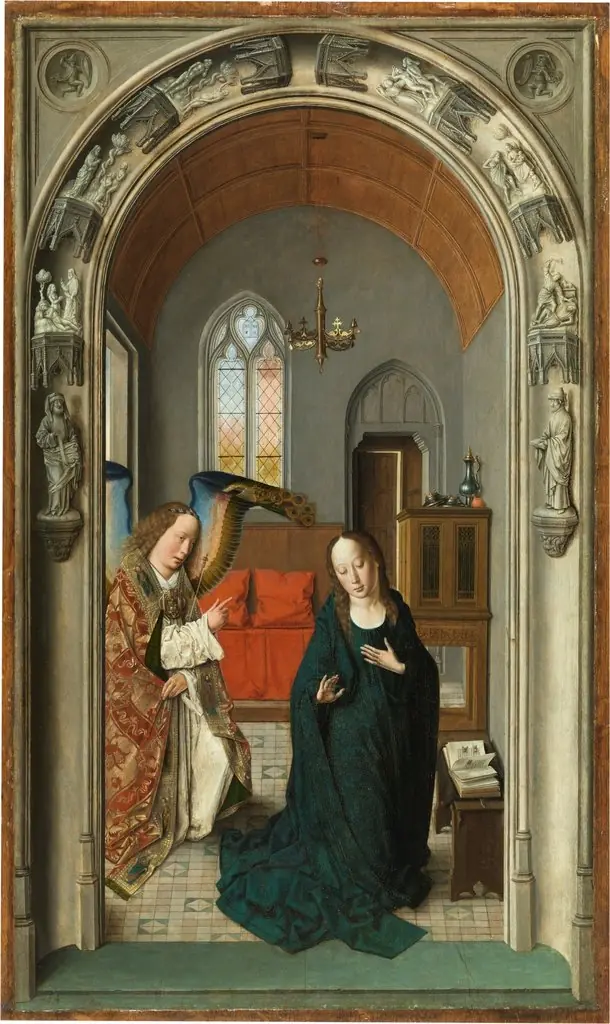
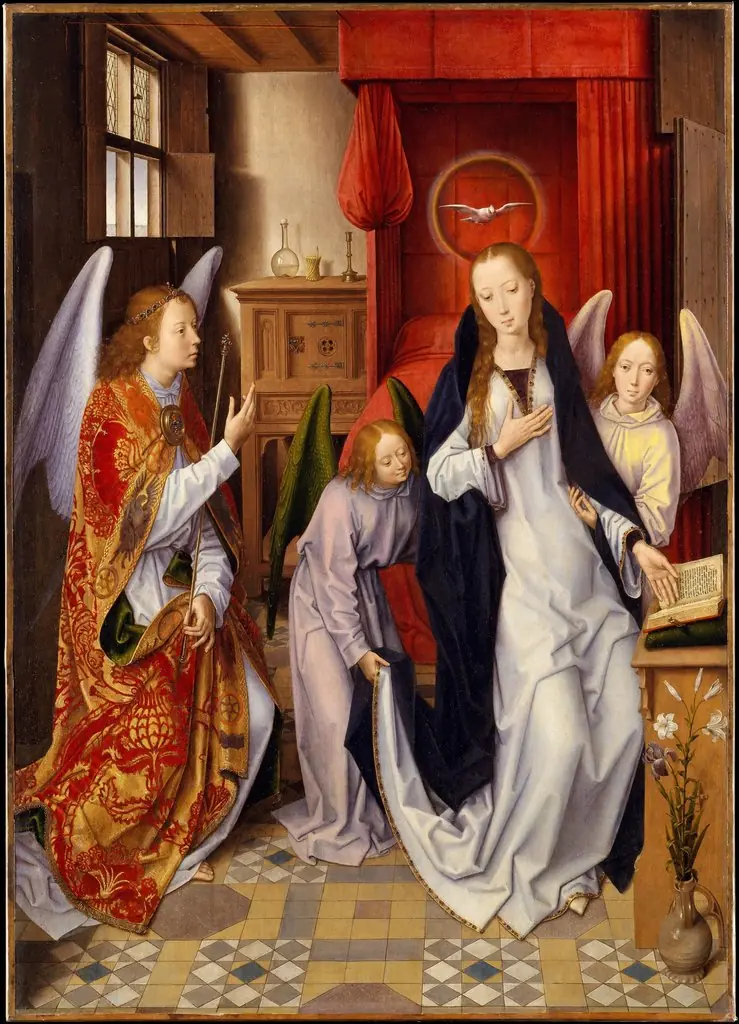
Mary is shown reading, her unbound hair and relaxed posture emphasizing her humanity and humility, seated on the floor to underscore her modesty.
The Mérode Altarpiece centers on the Annunciation, depicting the archangel Gabriel’s announcement to the Virgin Mary within a contemporary Flemish interior, a departure from earlier, more hieratic settings. Mary is shown reading, her unbound hair and relaxed posture emphasizing her humanity and humility, seated on the floor to underscore her modesty. Symbols cluster around her: a vase of lilies evokes her purity, while the extinguished candle and divine light beam through the window signify the Holy Spirit’s invisible presence.
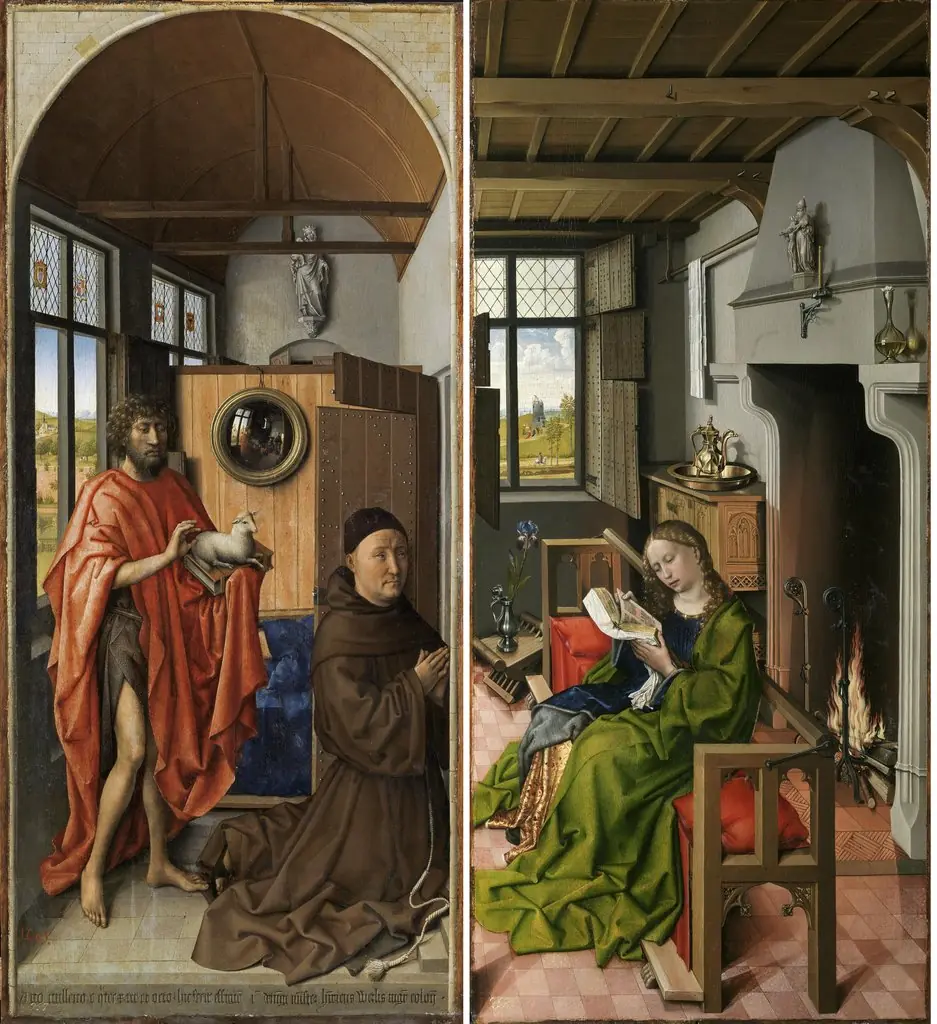
Books and parchment on the table allude to the Old and New Testaments, and the lion-adorned bench references the Throne of Solomon, tying Mary to the lineage of divine wisdom. The right wing portrays Saint Joseph as a carpenter fashioning mousetraps, a motif derived from Saint Augustine’s metaphor of Christ as the bait in a trap to ensnare the devil, though the inclusion of Joseph in this role is unusual. The left wing introduces the donors, Peter Engelbrecht and his wife, kneeling in a garden, their gaze directed toward the sacred scene, with the city of Liège visible through the window, linking the donors to Tournai’s bourgeois milieu. Together, these elements articulate a domestic theology of Incarnation and Redemption, merging private devotion with public symbolism.
Technique & Style
The Mérode Altarpiece is an oil-on-oak panel triptych executed in the Early Netherlandish style, likely between 1425 and 1428. Technical examination reveals the work was produced by multiple hands, with the central panel's wood differing from that of the wings, suggesting the wings were later additions to an existing composition. The painting is characterized by a steep, somewhat uneven perspective where figures appear to hover rather than rest firmly on the ground.
Stylistically, it establishes a domestic realism, depicting the Annunciation within a contemporary interior. The palette relies on pale, opaque whites, reds, and blues, with cool grays and browns defining the architecture. Originally, the window behind the Virgin featured gold leaf, which was later overpainted.
The work is in good condition with minimal paint loss, though areas such as the donor figures were reworked. The composition balances minute, miniature-like details with broad, serene color fields.
History & Provenance
Attributed to Robert Campin (Master of Flémalle) and his workshop in Tournai, the Mérode Altarpiece was likely executed between 1425 and 1432. Technical analysis indicates the central panel predates the wings, suggesting the work began as a single panel before being expanded into a triptych upon commission by donors Peter Engelbrecht and Gretchen Schrinmechers, a bourgeois couple from Mechelen. The side panels, possibly added later to include the donors in the devotional space, depict views of a city, potentially Liège or Mechelen.
Originally housed in the family chapel of the Counts de Merode in Westerlo during the early 20th century, the artwork was stored in a Swiss bank following World War I. In 1944, Countess Jeanne de Merode bequeathed it to her niece, Jeanne-Marie de Grunne. The Grunne family sold the triptych to the Metropolitan Museum of Art in 1958 for one million dollars, despite prior attempts by the Belgian government to acquire it.
Context
The Mérode Altarpiece occupies a pivotal place in the transition from late Gothic to Early Netherlandish painting, bridging medieval tradition and the emerging naturalism of the fifteenth century. Art historians consistently identify the triptych as a foundational work for the new style, with scholars such as Campbell emphasizing its role as a "milestone between two periods." The panel’s domestic Annunciation, set in a contemporary interior rather than a gold-ground shrine, was pioneering, inspiring later artists including Rogier van der Weyden, whose Reading Magdalen echoes Campin’s relaxed, realistically rendered Virgin.
Attribution to Campin’s workshop remains debated; while often grouped under the Master of Flémalle, Campbell questions the stylistic coherence, noting spatial inconsistencies and attributing the wings to lesser hands. The work’s layered symbolism, from the mousetraps symbolizing Christ’s victory over the devil to the Eucharistic references in Joseph’s carpentry, has fueled iconographic studies, with Panofsky and Schapiro expanding analyses of quotidian details. Its private devotional function and technical innovations in oil painting further cement its status as a touchstone for the Northern Renaissance.
Legacy
The Mérode Altarpiece’s later reputation rests on its status as a foundational work of Early Netherlandish painting. Early scholars such as Erwin Panofsky advanced its iconography, especially the mousetrap as a symbol of Christ’s triumph over the devil, into broader art-historical discourse, while later studies have continued to mine its domestic Annunciation scene for insights into private devotion and symbolic detail. Its transition from aristocratic possession to American museum icon after a 1958 sale to The Met for one million dollars crystallized its modern market prestige and provoked Belgian national debate, underscoring its enduring cultural capital.
Within the museum’s collection, it remains a touchstone for the Cloisters’ holdings and a reference point for the transition from late Gothic to early Renaissance modes in Northern Europe.
Overview
The Mérode Altarpiece, also known as the Annunciation Triptych, is an oil painting on oak panels housed in The Cloisters, New York. Though unsigned and undated, this significant work is attributed to the Early Netherlandish painter Robert Campin and his workshop. Composed of three distinct panels, it presents a pivotal religious narrative alongside contemporary figures, reflecting the artistic innovations of its period.
Artist & collection