Artwork
Portrait of Maisonneuve
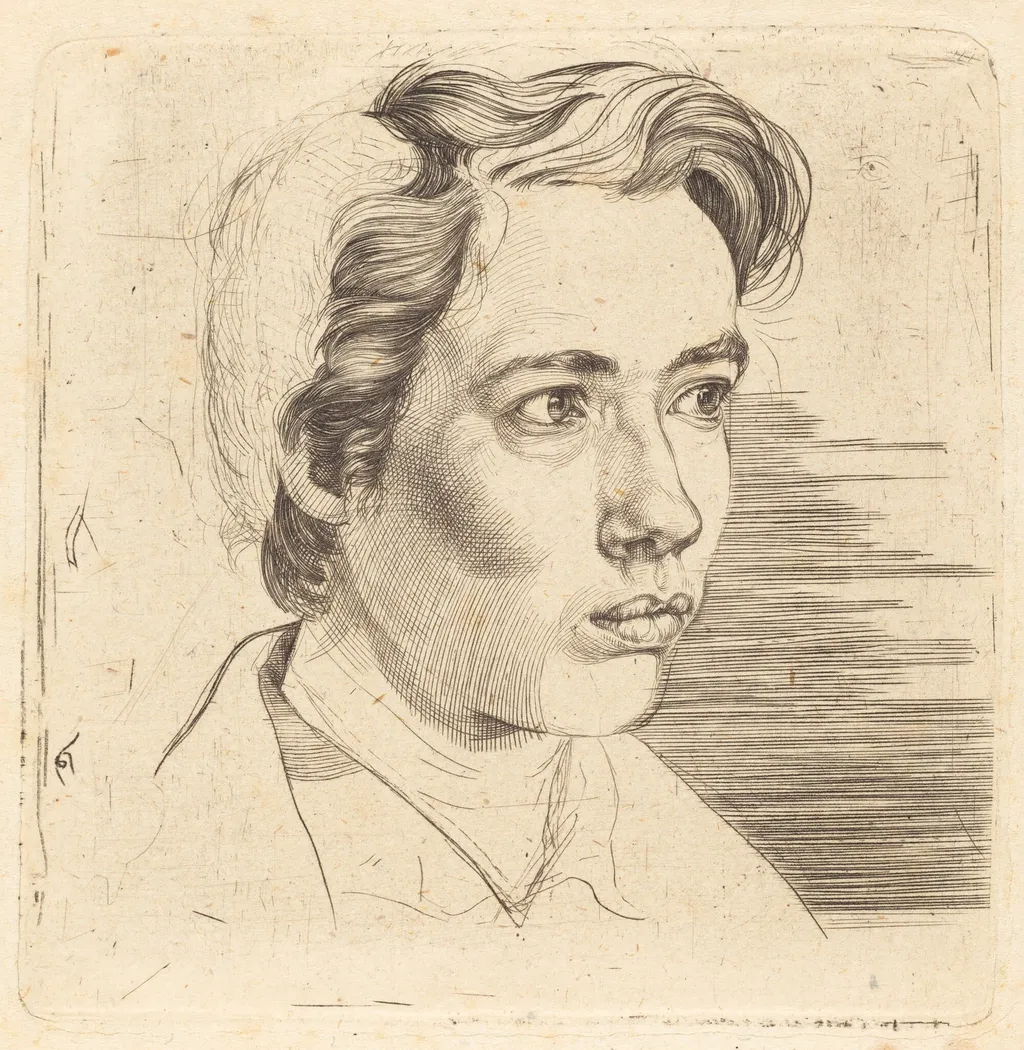
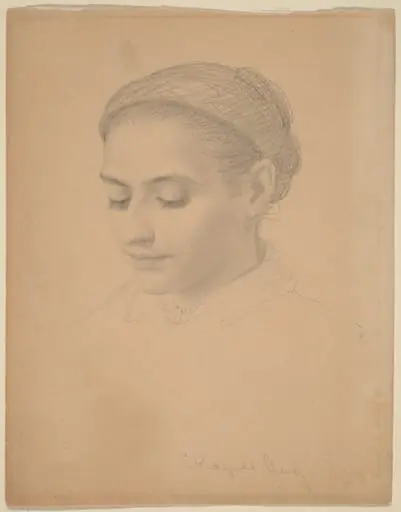
Portrait of Maisonneuve is an ink print by the Romanticist artist Eugen Eduard Schaeffer. It dates from 1824 and is held in the collection of the National Gallery of Art.
- Inscription
- Inscribed:by later hand, lower center verso in graphite: 203
About this work
Overview
Eugen Eduard Schaeffer’s 1824 print presents a monochrome portrait of a woman, rendered in fine lines that capture the delicate curls of her hair and the precise contours of her face and shoulders. The composition is restrained, with the figure set against a largely unadorned background, allowing the viewer’s attention to remain on the subject’s expression and the artist’s meticulous hand.
Subject & Meaning
The sitter is depicted with her hair gathered back, a few loose curls framing her forehead, suggesting a modest yet composed demeanor. While no explicit narrative accompanies the image, the focus on facial detail and the absence of ornamental surroundings imply an intent to convey the individual’s personal presence rather than a broader allegorical theme.
Technique & Style
Created through a combination of engraving and etching on laid paper, the work employs incised lines that vary from sharp, defined edges around the eyes and hair to softer, shaded strokes in the shadows. The etching process, involving acid‑bitten metal plates, enables the subtle gradations of tone that give the portrait its depth, while the engraving provides the crisp outlines characteristic of early‑19th‑century printmaking.
History & Provenance
Issued in 1824, the print reflects Schaeffer’s engagement with portraiture during a period when printed images served both documentary and decorative purposes. Although specific details of the sitter’s identity and the print’s early ownership remain undocumented, the work is recognized as part of Schaeffer’s broader oeuvre of engraved portraits produced for the European art market of the time.
Context
The early nineteenth century saw a resurgence of interest in print media as a means of disseminating likenesses beyond the reach of oil painting. Schaeffer’s portrait aligns with this trend, offering a reproducible image that could be circulated among collectors and patrons, while also demonstrating the technical proficiency expected of professional engravers in the post‑Napoleonic era.
Own this work as a print
Artist & collection

- Self-Portrait
 Elena
Elena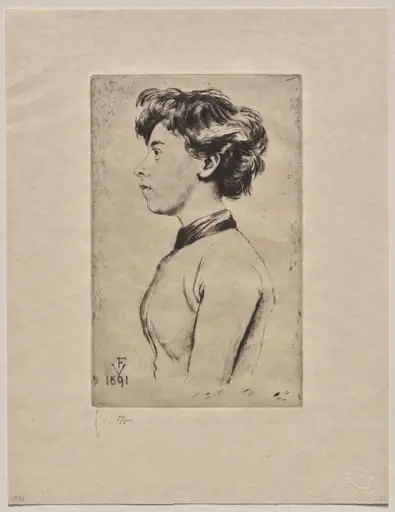 Young Girl in Profile
 verso: O colegă de clasă
 Queen Elisabeth of Belgium (La Reine Élisabeth de Belgique)
 Head of a Woman in Profile
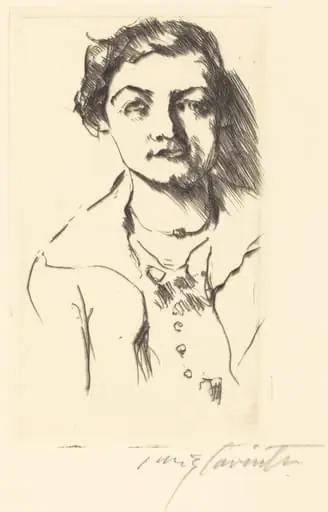 Bildnis einer Jungen Dame—Anneliese Halbe (Portrait of a Young Woman—Anneliese Halbe)
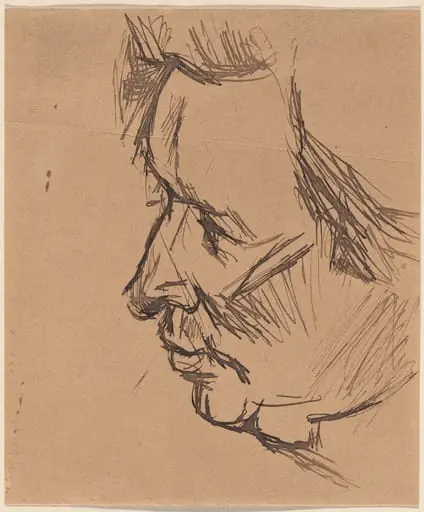 Untitled
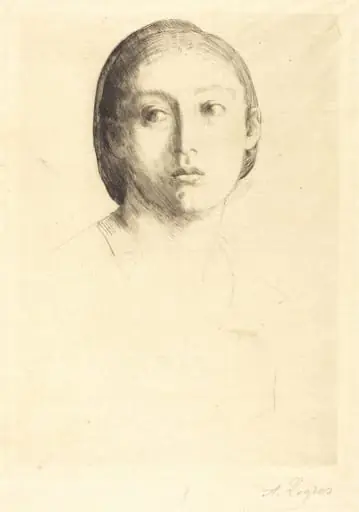 Head of a Young Girl (Tete de jeune fille)
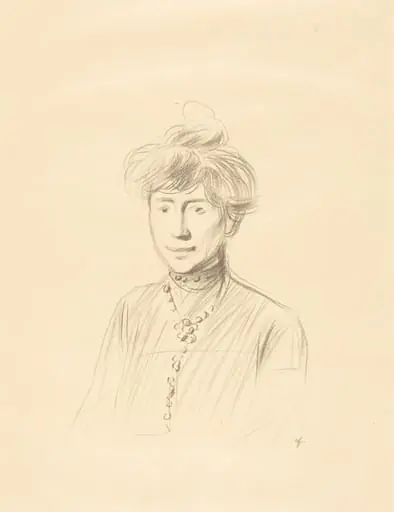 Etude de femme, en buste de face (Study of a Woman, Half-Length Facing Front)
 Head of a Young Woman
 Profile of a Girl