Artwork
In the Palace

In the Palace is an unspecified painting by the Song dynasty painting artist Zhou Wenju. It is held in the collection of the Cleveland Museum of Art.
- Accession no.
- 1976.1
- Credit line
- John L. Severance Fund
About this work
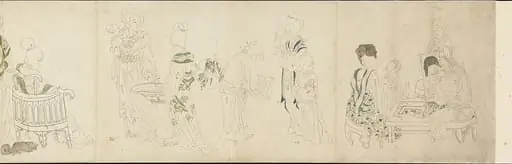
You see a long scroll filled with women in flowing robes, playing music, holding children, and petting dogs.
You see a long scroll filled with women in flowing robes, playing music, holding children, and petting dogs.
This painting is a copy of an older work by Zhou Wenju, who painted for the royal court. The women’s round faces and fancy hairstyles show the style of an earlier dynasty, but the scene feels quiet and real, like a snapshot of daily life in the palace.
To see more of this kind of scene, look up china, southern song dynasty (1127-1279).
Overview
The handscroll presents a domestic scene inside an imperial residence, populated by thirteen court ladies, three attendants, and six children. Figures are rendered in a fluid, unlined brush technique known as baimiao, with selective colour applied to highlight garments and accessories. The composition captures moments of music-making, child‑care, and interaction with pets, offering a glimpse into everyday palace life.
Subject & Meaning
The women are shown engaged in leisurely pursuits, playing instruments, supervising infants, and petting dogs, activities that reflect the cultivated, genteel atmosphere of the court. Their rounded faces and elaborate coiffures, modeled after Tang‑era fashion, underscore a nostalgic ideal of refined femininity and the cultural continuity prized by later dynasties.
Technique & Style
Executed in the plain‑drawing baimiao method, the figures are outlined with fine ink strokes, while colour is applied sparingly to robes and hair ornaments, creating a subtle contrast. The stylised yet naturalistic rendering of bodies and drapery, together with the attention to detail in accessories, aligns with the aesthetic standards of the Southern Song period while echoing earlier Tang visual conventions.
History & Provenance
The scroll is a later replica of an original work by Zhou Wenju, an artist active between 940 and 975 in Zhenjiang, Jiangsu. Zhou served the Southern Tang court in Nanjing under Emperor Li Yu, a noted poet‑ruler. The copy preserves the composition and iconography of Zhou’s court painting, transmitting its visual narrative to subsequent generations.
Context
Courtly genre scenes such as this were popular in the Southern Song, reflecting an interest in documenting aristocratic daily life. By reproducing a Tang‑inspired tableau, the work situates itself within a broader tradition of nostalgic court art, linking the Southern Song elite to the perceived golden age of the Tang dynasty.

Artist & collection
Artist
Zhou Wenju (Chinese: 周文矩) (fl. 942–961), also known as Chou Wen-chu, was a Chinese painter during the Five Dynasties and Ten Kingdoms period (907–960). His exact birth and death dates are not known. Zhou was born in…


- Eight Views of Xiao-Xiang
 Insects and Flowers
 Eight Views of Xiao-Xiang
 Flowers of a Hundred Worlds (Momoyogusa): Section of Flower-draped Carts (Hanasashiguruma)
 The Lantern Night Excursion of Zhong Kui
 Beggars and Street Characters
 Poems and Pictures of the Eight Views of Xiao-Xiang
 Compoziție cu ruine și păsări
 Leisure Enough to Spare
 Copy of Painting inside the Caves of Ajanta (cave 6)
 Conglomerat chimic
 Peisaj